QUESTION IMAGE
Question
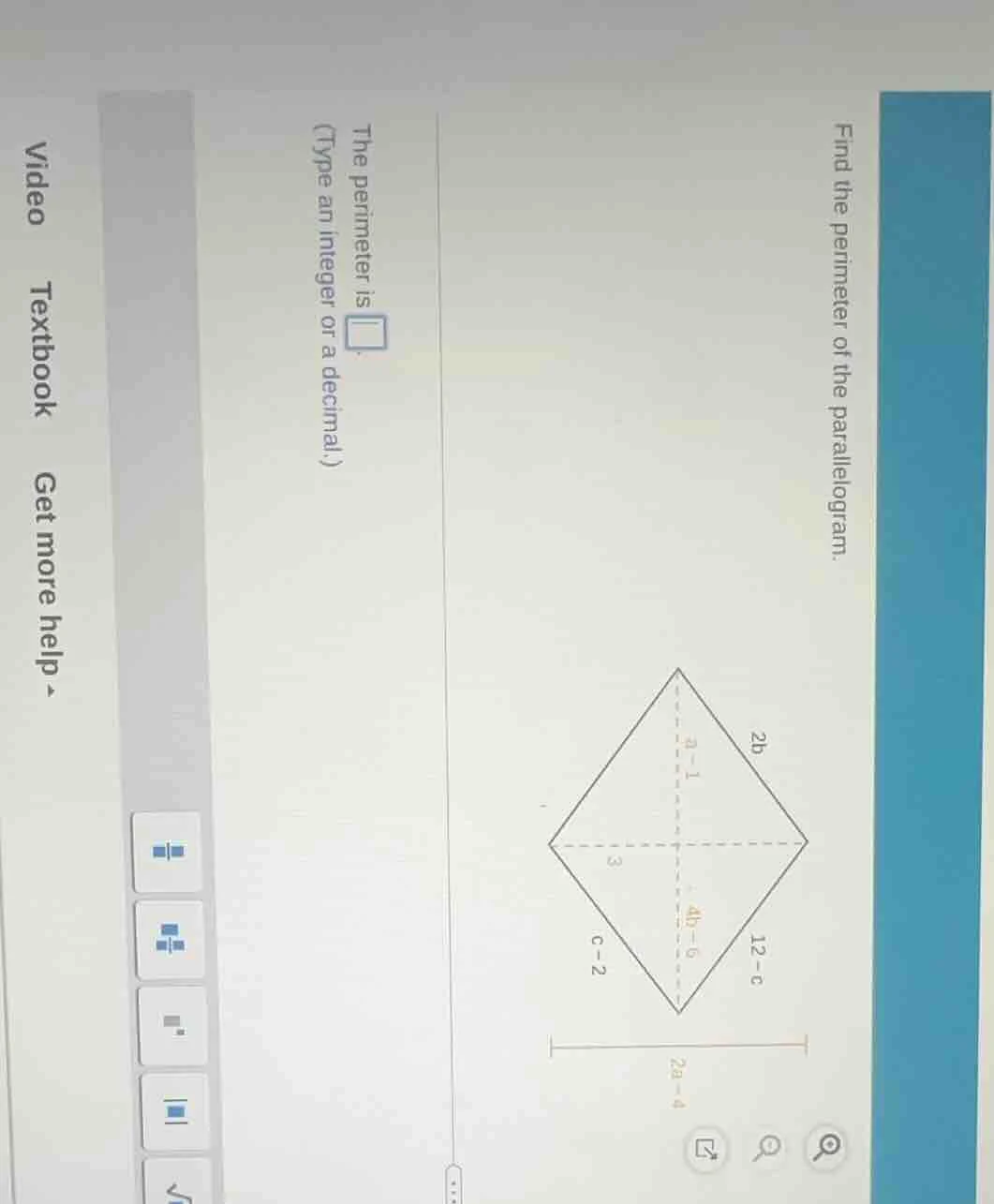
find the perimeter of the parallelogram.
the perimeter is
(type an integer or a decimal.)
Step1: Use parallelogram side property
Opposite sides of a parallelogram are equal, so we set up two equations:
- $2b = c - 2$
- $12 - c = 2b$
Also, the diagonals bisect each other, so:
- $a - 1 = 4b - 6$
- $2a - 4 = 3 + 3$ (the total length of the longer diagonal is twice 3)
Step2: Solve for $a$
Simplify the diagonal equation for $a$:
$2a - 4 = 6$
$2a = 6 + 4$
$2a = 10$
$a = \frac{10}{2} = 5$
Step3: Solve for $b$
Substitute $a=5$ into $a - 1 = 4b - 6$:
$5 - 1 = 4b - 6$
$4 = 4b - 6$
$4b = 4 + 6$
$4b = 10$
$b = \frac{10}{4} = 2.5$
Step4: Solve for $c$
Substitute $b=2.5$ into $2b = c - 2$:
$2(2.5) = c - 2$
$5 = c - 2$
$c = 5 + 2 = 7$
Step5: Calculate side lengths
Find the length of one pair of sides: $2b = 2(2.5) = 5$
Find the length of the other pair: $12 - c = 12 - 7 = 5$
Step6: Compute perimeter
Perimeter of a parallelogram is $2\times(\text{side 1} + \text{side 2})$:
$2\times(5 + 5) = 2\times10 = 20$

Snap & solve any problem in the app
Get step-by-step solutions on Sovi AI
Photo-based solutions with guided steps
Explore more problems and detailed explanations
20