QUESTION IMAGE
Question
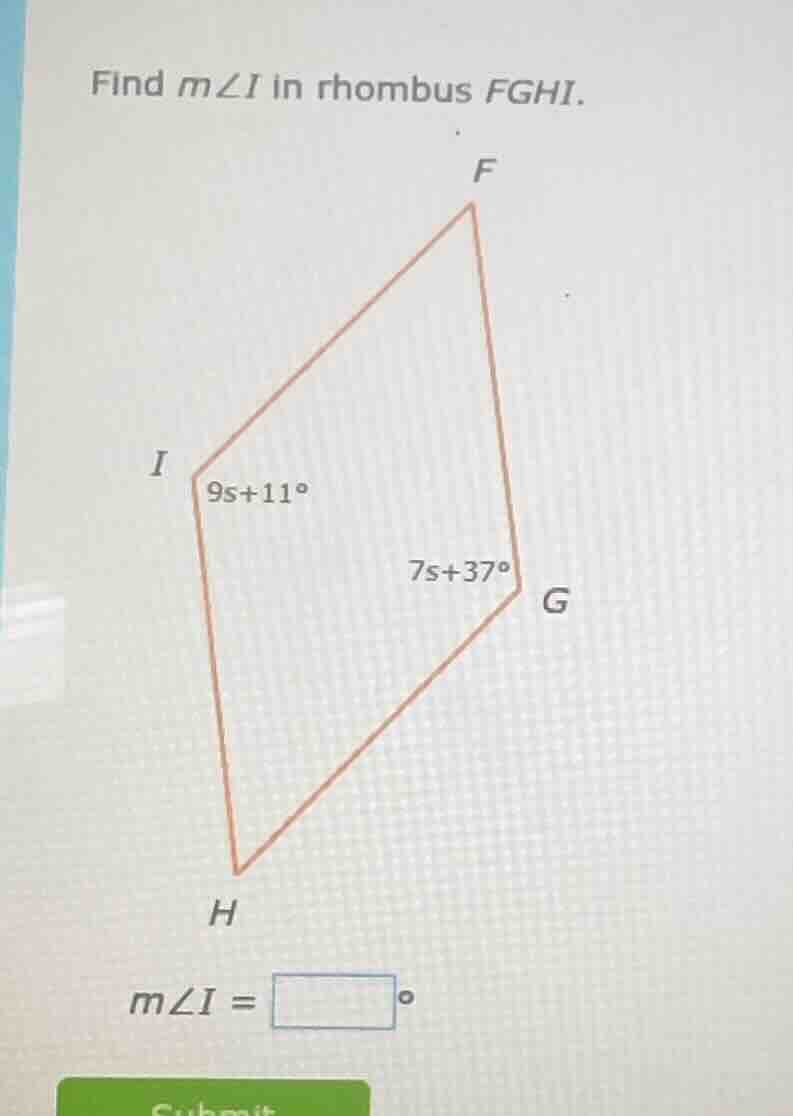
find m∠i in rhombus fghi.
i: 9s+11°
g: 7s+37°
m∠i = °
Step1: Recall rhombus angle property
In a rhombus, adjacent angles are supplementary (sum to \(180^\circ\)). So, \(\angle I\) and \(\angle G\) are adjacent, thus \( (9s + 11) + (7s + 37) = 180 \).
Step2: Solve for \(s\)
Combine like terms: \(9s + 7s + 11 + 37 = 180\)
\(16s + 48 = 180\)
Subtract 48: \(16s = 180 - 48 = 132\)
Divide by 16: \(s = \frac{132}{16} = \frac{33}{4} = 8.25\)? Wait, no, wait: \(180 - 48 = 132\)? Wait, 180 - 48 is 132? Wait, 48 + 132 is 180, yes. Then \(s = 132 / 16 = 8.25\)? Wait, no, wait, 16s = 132? Wait, 9s +7s is 16s, 11 +37 is 48. So 16s = 180 - 48 = 132. Then s = 132 / 16 = 8.25? Wait, but let's check again. Wait, maybe I made a mistake. Wait, 180 - 48 is 132? 48 + 132 = 180, yes. Then 16s = 132, so s = 132 / 16 = 8.25. Wait, but let's plug back. Wait, no, wait, maybe I messed up the equation. Wait, in a rhombus, adjacent angles are supplementary. So angle I and angle G are adjacent? Wait, the rhombus is F, G, H, I. So the order is F, G, H, I, so the angles at I and G: angle I is at vertex I, between sides I-F and I-H? Wait, no, the rhombus is F, G, H, I, so the sides are FG, GH, HI, IF. So angle at G is between FG and GH, angle at I is between HI and IF. So angle I and angle G: are they adjacent? Wait, in a rhombus, consecutive angles are supplementary. So angle F and angle G are consecutive, angle G and angle H, angle H and angle I, angle I and angle F. Wait, maybe the angles given are angle I (9s +11) and angle G (7s +37). So if angle I and angle G are consecutive, then they should be supplementary. So (9s +11) + (7s +37) = 180. So 16s + 48 = 180. 16s = 180 - 48 = 132. s = 132 / 16 = 8.25. Then angle I is 9s +11 = 9*(8.25) +11 = 74.25 +11 = 85.25? Wait, that can't be right. Wait, maybe I mixed up the angles. Wait, maybe angle I and angle H are equal, and angle G and angle F are equal, and consecutive angles are supplementary. Wait, no, in a rhombus, opposite angles are equal, and consecutive angles are supplementary. So angle I and angle G: are they opposite or consecutive? Wait, the rhombus is F, G, H, I. So the vertices are in order, so angle F is opposite angle H, angle G is opposite angle I? Wait, no, in a quadrilateral, opposite angles are those not adjacent. So in rhombus FGH I, the vertices are F, G, H, I, so the sides are FG, GH, HI, IF. So the angles: angle at F (between IF and FG), angle at G (between FG and GH), angle at H (between GH and HI), angle at I (between HI and IF). So opposite angles: angle F and angle H, angle G and angle I. Wait, that's the mistake! In a rhombus, opposite angles are equal. So angle G and angle I: are they opposite? Wait, no, angle F is opposite angle H, angle G is opposite angle I? Wait, no, let's label the rhombus: F connected to G and I, G connected to F and H, H connected to G and I, I connected to H and F. So the angles: angle at F: between F-G and F-I; angle at G: between G-F and G-H; angle at H: between H-G and H-I; angle at I: between I-H and I-F. So opposite angles: angle F and angle H, angle G and angle I. Wait, no, that's not right. Wait, in a rhombus, opposite angles are equal. So angle F = angle H, angle G = angle I? Wait, no, that's not correct. Wait, no, in a parallelogram (which a rhombus is), opposite angles are equal, and consecutive angles are supplementary. So angle F (at vertex F) and angle H (at vertex H) are opposite, so equal. Angle G (at vertex G) and angle I (at vertex I) are opposite, so equal. Wait, that's the mistake! So if angle G and angle I are opposite, then they should be equal. So 9s +11 = 7s +37. Then 9s -7s = 37 -11. 2s =…

Snap & solve any problem in the app
Get step-by-step solutions on Sovi AI
Photo-based solutions with guided steps
Explore more problems and detailed explanations
\(128\)