QUESTION IMAGE
Question
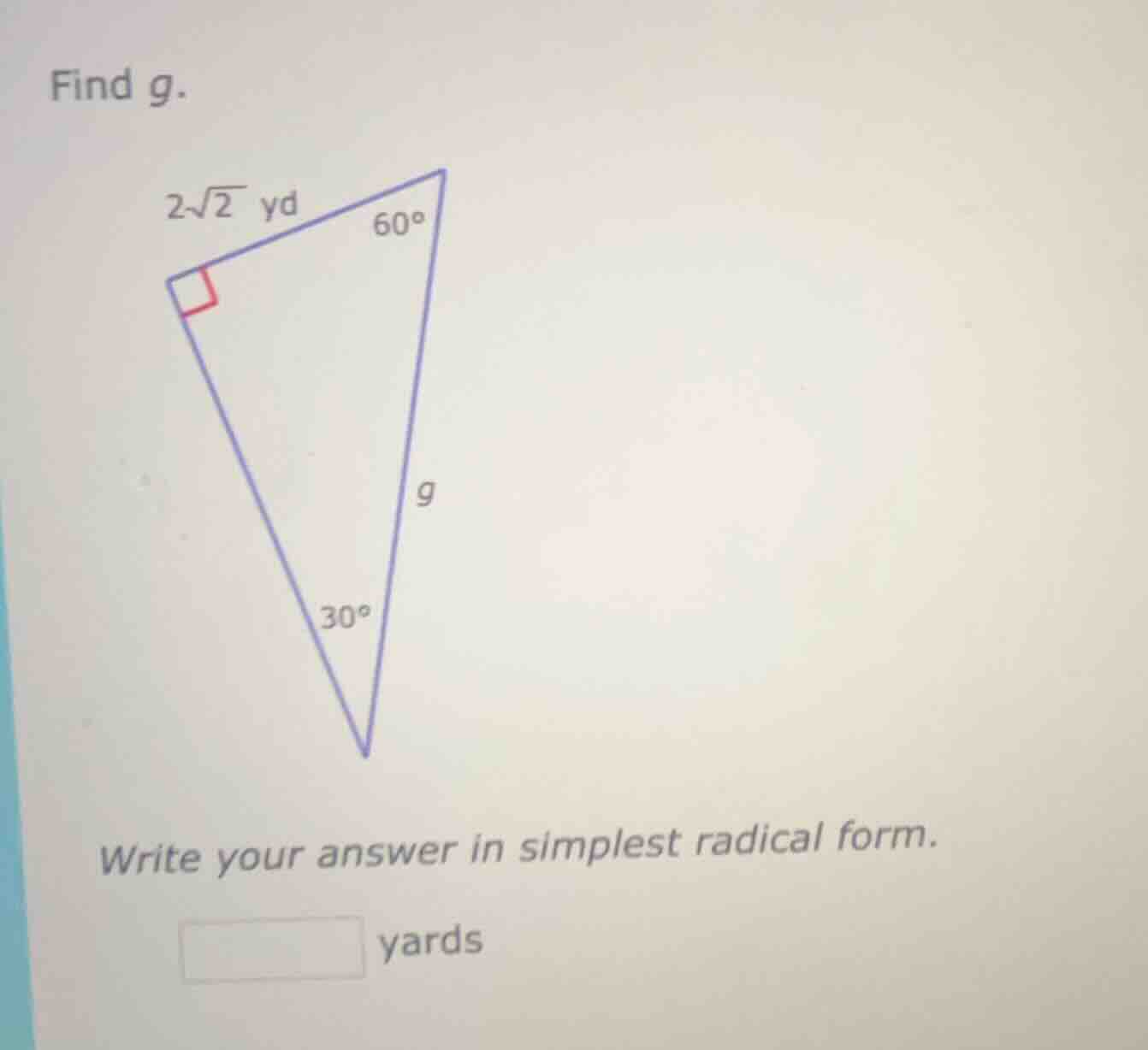
find g.
right triangle with right angle, one leg labeled (2sqrt{2}) yd, angles 60° and 30°, side (g) opposite the 60° angle? wait, no, looking at the triangle: right angle, one leg (2sqrt{2}) yd, angle 60° at the top, 30° at the bottom, side (g) is the hypotenuse? wait, no, the right angle is at the left, so the legs are (2sqrt{2}) and the other leg, and (g) is a side. wait, the triangle has angles 30°, 60°, 90°, so its a 30-60-90 triangle. the side opposite 30° is the shorter leg, opposite 60° is longer leg, hypotenuse is twice the shorter leg. wait, the given side is (2sqrt{2}) yd, lets see: in a 30-60-90 triangle, the ratios are 1 : (sqrt{3}) : 2 (shorter leg : longer leg : hypotenuse). so if the side adjacent to 30° (the leg) is (2sqrt{2}), or is it the shorter leg? wait, the angle at the bottom is 30°, so the side opposite 30° is the shorter leg. wait, the right angle is at the left, so the sides: the horizontal leg (top) is (2sqrt{2}) yd, the vertical leg (left) is adjacent to 30°, and (g) is the hypotenuse? wait, no, the angle at the bottom is 30°, so the side opposite 30° is the top leg ((2sqrt{2}) yd), so the hypotenuse (g) would be twice that? wait, no, in 30-60-90, hypotenuse is twice the shorter leg (opposite 30°). so if the shorter leg (opposite 30°) is (2sqrt{2}), then hypotenuse is (4sqrt{2})? wait, no, maybe i got the angles wrong. wait, the triangle has angles 30°, 60°, 90°, so the sides: lets label the triangle. let’s call the right angle vertex a, the 60° vertex b, and 30° vertex c. so angle at a: right angle, angle at b: 60°, angle at c: 30°. then side ab is (2sqrt{2}) yd (leg), side ac is the other leg, side bc is (g) (hypotenuse? no, wait, in triangle abc, right-angled at a, so sides: ab (leg), ac (leg), bc (hypotenuse). angle at b: 60°, so angle at b: 60°, so side ac (opposite 60°) is (ab \times \tan(60°)), and hypotenuse bc is (ab / cos(60°)). wait, ab is (2sqrt{2}) yd, angle at b is 60°, so (cos(60°) = ab / bc), so (bc = ab / cos(60°) = 2sqrt{2} / 0.5 = 4sqrt{2})? wait, but maybe the given side is the shorter leg. wait, angle at c is 30°, so side ab (opposite 30°) is the shorter leg, so ab = (2sqrt{2}), then hypotenuse bc (g) is twice that, so (4sqrt{2}). alternatively, using trigonometry: (sin(30°) = \text{opposite} / \text{hypotenuse} = 2sqrt{2} / g), so (g = 2sqrt{2} / sin(30°) = 2sqrt{2} / 0.5 = 4sqrt{2}). or (cos(60°) = \text{adjacent} / \text{hypotenuse} = 2sqrt{2} / g), since (cos(60°) = 0.5), so (g = 2sqrt{2} / 0.5 = 4sqrt{2}). so the problem is to find (g) in a 30-60-90 triangle, using trigonometric ratios or the 30-60-90 triangle side ratios.
write your answer in simplest radical form.
blank yards
Step1: Identify trigonometric ratio
We use cosine: $\cos(\theta)=\frac{\text{adjacent}}{\text{hypotenuse}}$. For the $60^\circ$ angle, adjacent side is $2\sqrt{2}$, hypotenuse is $g$.
Step2: Substitute values into formula
$\cos(60^\circ)=\frac{2\sqrt{2}}{g}$
We know $\cos(60^\circ)=\frac{1}{2}$, so:
$\frac{1}{2}=\frac{2\sqrt{2}}{g}$
Step3: Solve for $g$
Cross-multiply to isolate $g$:
$g=2\times2\sqrt{2}$
$g=4\sqrt{2}$

Snap & solve any problem in the app
Get step-by-step solutions on Sovi AI
Photo-based solutions with guided steps
Explore more problems and detailed explanations
$4\sqrt{2}$ yards