QUESTION IMAGE
Question
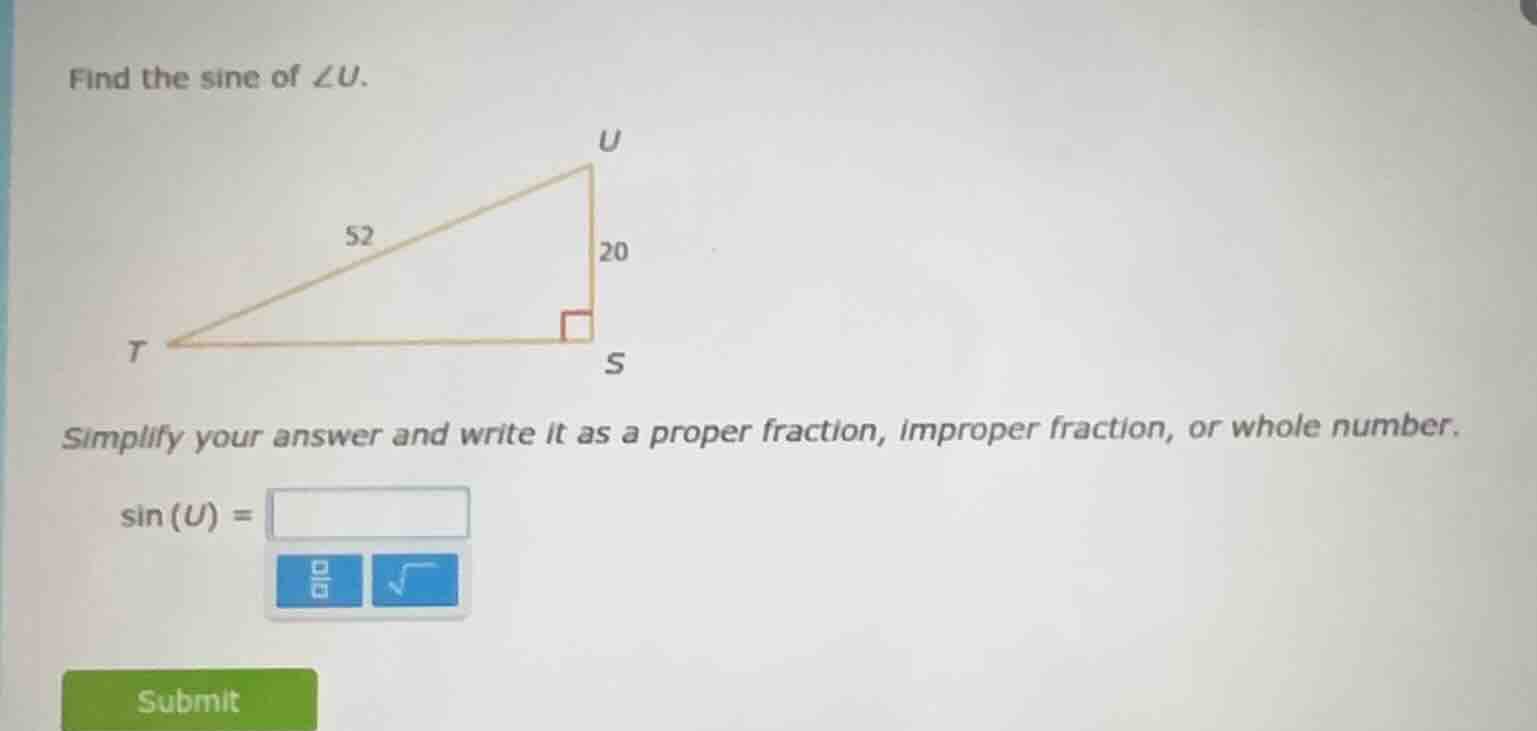
find the sine of ∠u.
u
52
20
t
s
simplify your answer and write it as a proper fraction, improper fraction, or whole number.
sin (u) =
submit
Step1: Recall sine definition
In a right triangle, $\sin(\theta) = \frac{\text{opposite}}{\text{hypotenuse}}$. For $\angle U$, first find the opposite side.
First, find the length of $TS$ (adjacent to $\angle U$? No, wait: in $\triangle TSU$, right-angled at $S$. So for $\angle U$, the opposite side is $TS$, hypotenuse is $TU = 52$, and $SU = 20$. Wait, no: let's label the triangle. Right angle at $S$, so sides: $SU = 20$ (one leg), $TS$ (another leg), $TU = 52$ (hypotenuse). To find $\sin(U)$, we need opposite over hypotenuse. The angle at $U$: the side opposite to $\angle U$ is $TS$, and hypotenuse is $TU = 52$. But we don't know $TS$ yet. Wait, maybe we can find $TS$ using Pythagoras. Wait, no: wait, maybe I made a mistake. Wait, in right triangle, $\sin(\theta) = \frac{\text{opposite}}{\text{hypotenuse}}$. Let's re-express: angle at $U$, so the sides: adjacent to $U$ is $SU = 20$, opposite is $TS$, hypotenuse $TU = 52$. So first, find $TS$ using Pythagoras: $TS^2 + SU^2 = TU^2$. So $TS^2 + 20^2 = 52^2$. So $TS^2 = 52^2 - 20^2$. Calculate that: $52^2 = 2704$, $20^2 = 400$, so $TS^2 = 2704 - 400 = 2304$. Then $TS = \sqrt{2304} = 48$. Ah, so $TS = 48$. Now, $\sin(U)$: opposite side to $U$ is $TS = 48$, hypotenuse is $TU = 52$. So $\sin(U) = \frac{TS}{TU} = \frac{48}{52}$. Simplify that fraction: divide numerator and denominator by 4: $\frac{48 \div 4}{52 \div 4} = \frac{12}{13}$. Wait, wait: wait, no, wait. Wait, angle at $U$: let's check again. The triangle is right-angled at $S$, so vertices: $T$, $S$, $U$. So angle at $U$: the sides: $SU$ is one leg (length 20), $TS$ is the other leg (length 48), $TU$ is hypotenuse (52). So angle at $U$: the side opposite to $U$ is $TS$ (since from $U$, the opposite side is $TS$), and hypotenuse is $TU$. So $\sin(U) = \frac{\text{opposite}}{\text{hypotenuse}} = \frac{TS}{TU} = \frac{48}{52} = \frac{12}{13}$. Wait, but let's confirm. Alternatively, maybe I mixed up opposite and adjacent. Wait, no: angle at $U$, so the angle is between $SU$ and $TU$. So the side opposite to $U$ is $TS$, and adjacent is $SU$. So yes, $\sin(U) = \frac{TS}{TU} = \frac{48}{52} = \frac{12}{13}$. Wait, but let's check the Pythagoras again. $48^2 + 20^2 = 2304 + 400 = 2704$, and $52^2 = 2704$, so that's correct. So $TS = 48$. Then $\sin(U) = \frac{48}{52} = \frac{12}{13}$. Wait, but let me check again. Wait, maybe I had the opposite side wrong. Wait, angle at $U$: if we consider angle $U$, then the sides: the side opposite is $TS$, adjacent is $SU$, hypotenuse $TU$. So yes, $\sin(U) = \frac{opposite}{hypotenuse} = \frac{TS}{TU} = \frac{48}{52} = \frac{12}{13}$. Alternatively, maybe I made a mistake in identifying the opposite side. Wait, no: let's draw the triangle mentally. Right angle at $S$, so $S$ is between $T$ and $U$? No, wait, the triangle is labeled with $T$, $S$, $U$, right-angled at $S$. So $T$---$S$---$U$? No, that would be a straight line. Wait, no, it's a triangle, so $T$, $S$, $U$ form a right triangle with right angle at $S$, so $TS$ and $SU$ are the legs, $TU$ is the hypotenuse. So the angle at $U$ is between $SU$ and $TU$. So the side opposite to angle $U$ is $TS$, which is the leg from $T$ to $S$. So yes, that's correct. So $\sin(U) = \frac{TS}{TU} = \frac{48}{52} = \frac{12}{13}$.
Step1: Find length of TS (opposite to ∠U)
Using Pythagorean theorem:
$$TS^2 + SU^2 = TU^2$$
Substitute \( SU = 20 \), \( TU = 52 \):
$$TS^2 + 20^2 = 52^2$$
$$TS^2 = 52^2 - 20^2$$
$$TS^2 = 2704 - 400 = 2304$$
$$TS = \sqrt{2304} = 48$$
Step2: Calculate \(\sin(U)\)
In a right triangle, \(\sin(\theta) = \frac{\text{opp…

Snap & solve any problem in the app
Get step-by-step solutions on Sovi AI
Photo-based solutions with guided steps
Explore more problems and detailed explanations
\(\frac{12}{13}\)