QUESTION IMAGE
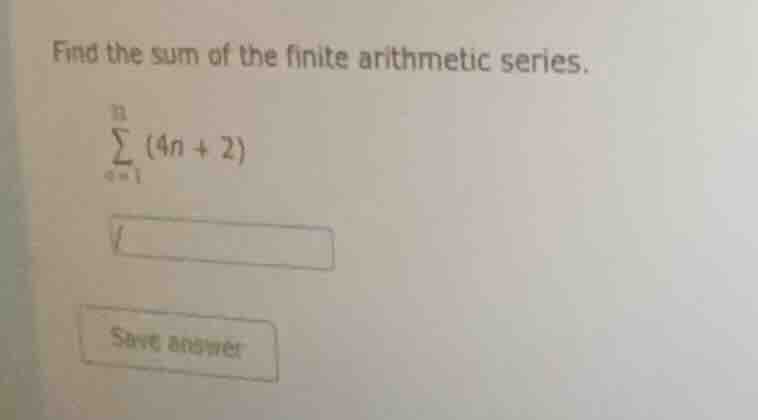
Question
find the sum of the finite arithmetic series.
\\(\sum_{n=1}^{11} (4n + 2)\\)
Step1: Recall the formula for the sum of an arithmetic series
The sum of the first \( n \) terms of an arithmetic series is given by \( S_n=\frac{n}{2}(a_1 + a_n) \), where \( a_1 \) is the first term and \( a_n \) is the \( n \)-th term. Also, for a general term \( a_k=4k + 2 \), we can find \( a_1 \) and \( a_n \).
Step2: Find the first term \( a_1 \)
When \( k = 1 \), \( a_1=4(1)+2=4 + 2=6 \).
Step3: Find the \( n \)-th term \( a_n \)
When \( k=n \), \( a_n = 4n+2 \).
Step4: Use the sum formula
\( S_n=\frac{n}{2}(a_1 + a_n)=\frac{n}{2}(6+(4n + 2)) \)
Simplify the expression inside the parentheses: \( 6+(4n + 2)=4n+8 \)
Then \( S_n=\frac{n}{2}(4n + 8) \)
Factor out 4 from the numerator: \( S_n=\frac{n\times4(n + 2)}{2} \)
Simplify \( \frac{4}{2}=2 \), so \( S_n=2n(n + 2)=2n^2+4n \)

Snap & solve any problem in the app
Get step-by-step solutions on Sovi AI
Photo-based solutions with guided steps
Explore more problems and detailed explanations
\( 2n^2 + 4n \)