QUESTION IMAGE
Question
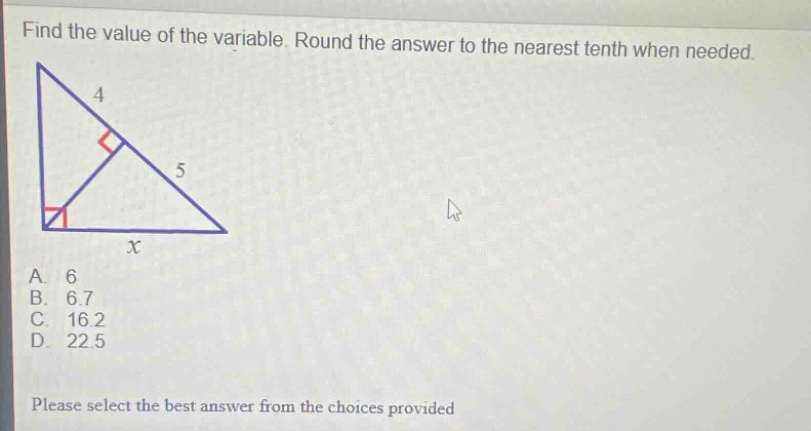
find the value of the variable. round the answer to the nearest tenth when needed.
a. 6
b. 6.7
c. 16.2
d. 22.5
please select the best answer from the choices provided
Step1: Recall geometric mean theorem
In a right triangle, the altitude to the hypotenuse relates the segments of the hypotenuse. Also, the leg of a right triangle is the geometric mean of the hypotenuse and the adjacent segment. Let the hypotenuse be \( c \), one segment be \( a = 4 \), another be \( b = 5 \), and the leg be \( x \). Wait, actually, the formula for the leg \( x \) (where the two segments of the hypotenuse are \( m = 4 \) and \( n = 5 \))? Wait, no, the correct theorem is that in a right triangle, if we have a right triangle with an altitude drawn to the hypotenuse, then each leg is the geometric mean of the hypotenuse and the segment adjacent to that leg. Wait, maybe I mixed up. Wait, the triangle here: the big triangle is right-angled, and there's an altitude to the hypotenuse, creating two smaller right triangles. So the leg \( x \) (the base of the big triangle) is such that \( x^2=4\times(4 + 5) \)? No, wait, no. Wait, the two segments of the hypotenuse are 4 and 5? Wait, no, the length of the hypotenuse of the big triangle is \( 4 + 5=9 \)? No, that can't be. Wait, the two segments of the hypotenuse (the parts divided by the altitude) are 4 and 5? Wait, no, the altitude is perpendicular to the hypotenuse, so the two smaller triangles are similar to the big triangle and to each other. So the leg \( x \) (let's say the horizontal leg) is adjacent to the segment of length 5, and the other leg (vertical) is adjacent to the segment of length 4. Then by the geometric mean theorem, \( x^2=5\times(4 + 5) \)? No, wait, the hypotenuse of the big triangle is \( 4 + 5 = 9 \)? No, that's not right. Wait, the correct formula is: if in a right triangle, a leg is \( x \), and the hypotenuse is \( c \), and the segment of the hypotenuse adjacent to \( x \) is \( n \), then \( x^2 = c\times n \). Wait, maybe the hypotenuse of the big triangle is \( 4 + 5=9 \)? No, that would make the leg \( x \) satisfy \( x^2=5\times9 = 45 \), \( x=\sqrt{45}\approx6.7 \). Ah, that makes sense. Let's re-express:
In a right triangle, when an altitude is drawn to the hypotenuse, the length of each leg is the geometric mean of the length of the hypotenuse and the length of the segment of the hypotenuse adjacent to that leg. So here, the leg \( x \) is adjacent to the segment of length 5, and the hypotenuse of the big triangle is \( 4 + 5 = 9 \). So \( x^2=5\times(4 + 5)=5\times9 = 45 \). Then \( x=\sqrt{45}\approx6.7 \).
Step2: Calculate \( x \)
We have \( x^2 = 4\times(4 + 5) \)? No, wait, no. Wait, the two segments of the hypotenuse are 4 and 5, so the hypotenuse length is \( 4 + 5 = 9 \). The leg \( x \) is such that \( x^2=5\times(4 + 5) \)? Wait, no, the correct formula is that the leg (let's say the one opposite to the segment of length 4) is \( \sqrt{4\times(4 + 5)} \)? No, I think I made a mistake. Let's use the geometric mean theorem correctly. The theorem states that in a right triangle, the square of a leg is equal to the product of the hypotenuse and the segment of the hypotenuse adjacent to that leg. So if the hypotenuse is \( c = m + n \), where \( m = 4 \) and \( n = 5 \), then \( c=9 \). The leg \( x \) is adjacent to the segment \( n = 5 \), so \( x^2 = c\times n=9\times5 = 45 \). Then \( x=\sqrt{45}\approx6.7 \) (since \( \sqrt{45}\approx6.708 \), rounded to the nearest tenth is 6.7).

Snap & solve any problem in the app
Get step-by-step solutions on Sovi AI
Photo-based solutions with guided steps
Explore more problems and detailed explanations
B. 6.7