QUESTION IMAGE
Question
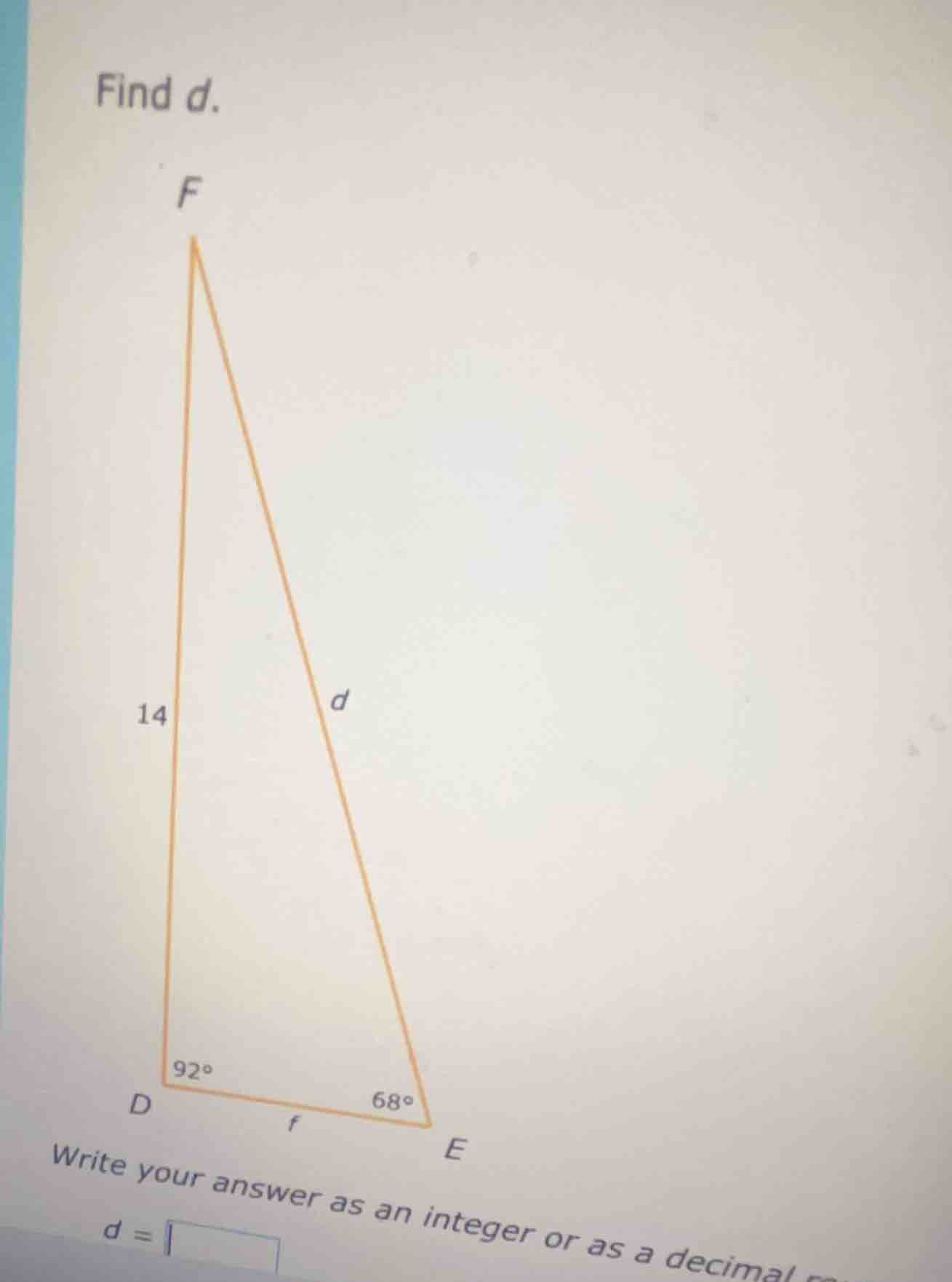
find d.
write your answer as an integer or as a decimal
d =
Step1: Find angle at F
In triangle \( DEF \), the sum of interior angles is \( 180^\circ \). So \( \angle F = 180^\circ - 92^\circ - 68^\circ = 20^\circ \).
Step2: Apply Law of Sines
Law of Sines: \( \frac{d}{\sin D}=\frac{DF}{\sin E} \). Here, \( DF = 14 \), \( \angle D = 92^\circ \), \( \angle E = 68^\circ \), so \( \frac{d}{\sin 92^\circ}=\frac{14}{\sin 68^\circ} \).
Step3: Solve for d
\( d=\frac{14\times\sin 92^\circ}{\sin 68^\circ} \). Calculate \( \sin 92^\circ\approx0.9994 \), \( \sin 68^\circ\approx0.9272 \). Then \( d=\frac{14\times0.9994}{0.9272}\approx\frac{13.9916}{0.9272}\approx15.1 \). Rounding to a reasonable decimal or integer, \( d\approx15 \) (if integer) or more accurately \( \approx15.1 \). But let's compute precisely:
\( \sin 92^\circ = \sin(90^\circ + 2^\circ)=\cos 2^\circ\approx0.9994 \), \( \sin 68^\circ\approx0.9271838546 \)
\( d = \frac{14\times0.9994}{0.9271838546}=\frac{13.9916}{0.9271838546}\approx15.1 \)

Snap & solve any problem in the app
Get step-by-step solutions on Sovi AI
Photo-based solutions with guided steps
Explore more problems and detailed explanations
\( d\approx15.1 \) (or 15 if integer is preferred, but more accurately ~15.1)