QUESTION IMAGE
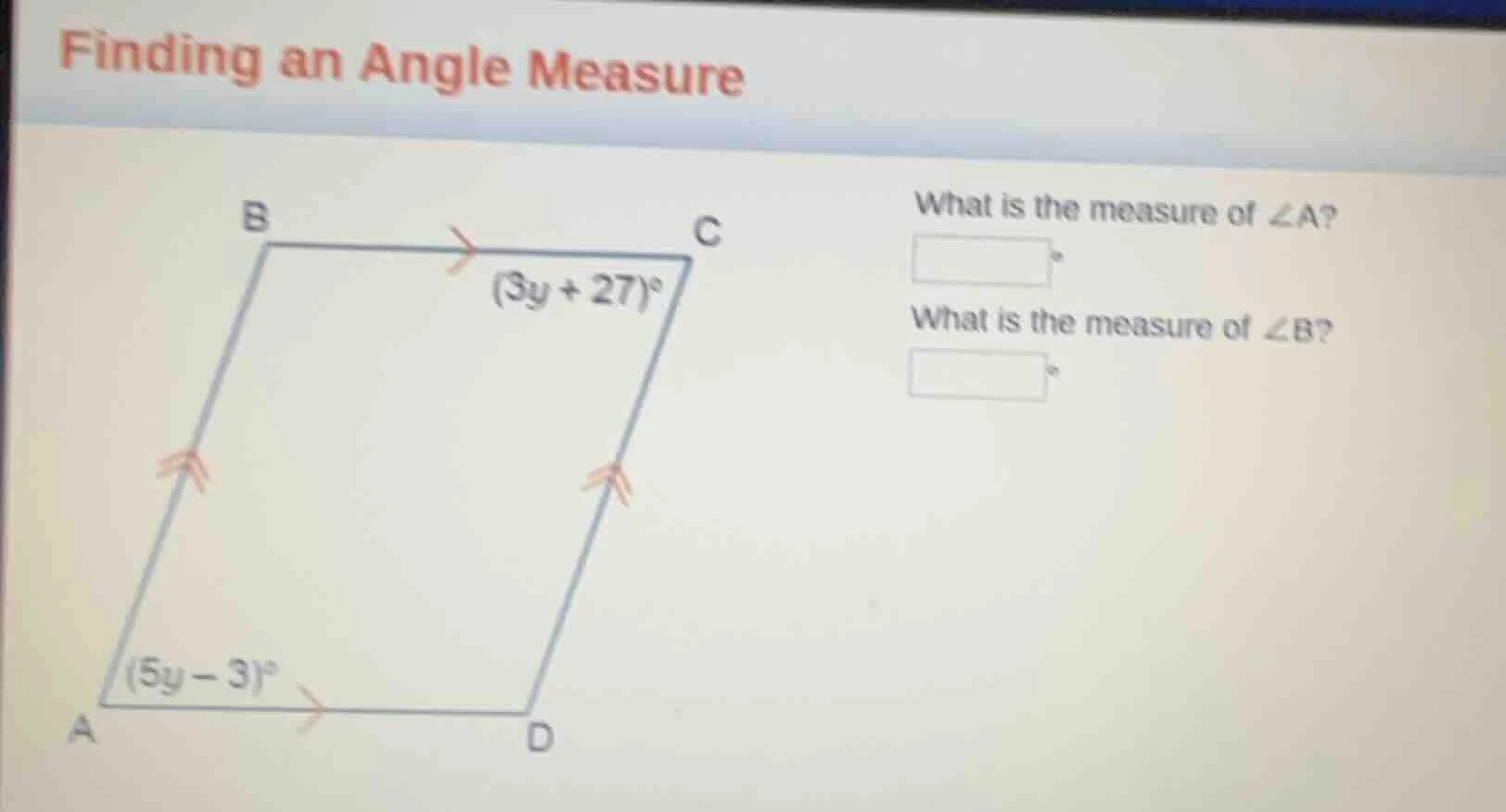
Question
finding an angle measure
what is the measure of ∠a?
□°
what is the measure of ∠b?
□°
Step1: Identify the figure type
The figure is a parallelogram (since opposite sides are parallel, indicated by the arrows). In a parallelogram, consecutive angles are supplementary (sum to \(180^\circ\)) and opposite angles are equal. Also, \(\angle A\) and \(\angle C\) are opposite angles? Wait, no, looking at the sides: \(AB\) and \(CD\) are parallel (arrows on \(AB\) and \(CD\)? Wait, the arrows: \(BC\) has an arrow, \(AD\) has an arrow, and \(AB\) and \(CD\) have double arrows. So \(AB \parallel CD\) and \(BC \parallel AD\), so it's a parallelogram. In a parallelogram, consecutive angles are supplementary. Wait, but \(\angle A\) is \((5y - 3)^\circ\) and \(\angle C\) is \((3y + 27)^\circ\). Wait, in a parallelogram, opposite angles are equal. So \(\angle A = \angle C\)? Wait, no, maybe I misread. Wait, \(AB\) and \(CD\) are parallel (double arrows), \(BC\) and \(AD\) are parallel (single arrows). So \(\angle A\) and \(\angle B\) are consecutive angles (supplementary), \(\angle B\) and \(\angle C\) are consecutive (supplementary), etc. Wait, but also, \(\angle A\) and \(\angle C\) are opposite angles, so they should be equal. So set \(\angle A = \angle C\):
\(5y - 3 = 3y + 27\)
Step2: Solve for \(y\)
Subtract \(3y\) from both sides:
\(5y - 3y - 3 = 27\)
\(2y - 3 = 27\)
Add 3 to both sides:
\(2y = 27 + 3\)
\(2y = 30\)
Divide by 2:
\(y = 15\)
Step3: Find \(\angle A\)
Substitute \(y = 15\) into \(\angle A\)'s expression:
\(\angle A = 5y - 3 = 5(15) - 3 = 75 - 3 = 72^\circ\)? Wait, no, wait: \(5*15=75\), \(75 - 3 = 72\). Wait, but then \(\angle C = 3y + 27 = 3*15 + 27 = 45 + 27 = 72^\circ\). So \(\angle A = \angle C = 72^\circ\). Then, since consecutive angles are supplementary, \(\angle A + \angle B = 180^\circ\), so \(\angle B = 180 - 72 = 108^\circ\). Wait, let's check:
Wait, in a parallelogram, opposite angles are equal, consecutive angles are supplementary. So \(\angle A\) and \(\angle C\) are opposite, so equal. \(\angle B\) and \(\angle D\) are opposite, equal. \(\angle A\) and \(\angle B\) are consecutive, so supplementary.
So solving \(5y - 3 = 3y + 27\) gives \(y = 15\). Then \(\angle A = 5*15 - 3 = 72^\circ\), \(\angle B = 180 - 72 = 108^\circ\).
Wait, let's verify: \(\angle C = 3*15 + 27 = 72^\circ\), which equals \(\angle A\), good. Then \(\angle B\) and \(\angle A\) are consecutive, so \(72 + 108 = 180\), which is supplementary, correct.
Step4: Measure of \(\angle A\)
\(\angle A = 72^\circ\)
Step5: Measure of \(\angle B\)
\(\angle B = 180 - 72 = 108^\circ\)

Snap & solve any problem in the app
Get step-by-step solutions on Sovi AI
Photo-based solutions with guided steps
Explore more problems and detailed explanations
Measure of \(\angle A\): \(\boxed{72}\)
Measure of \(\angle B\): \(\boxed{108}\)