QUESTION IMAGE
Question
finding holes in graphs of rational functions
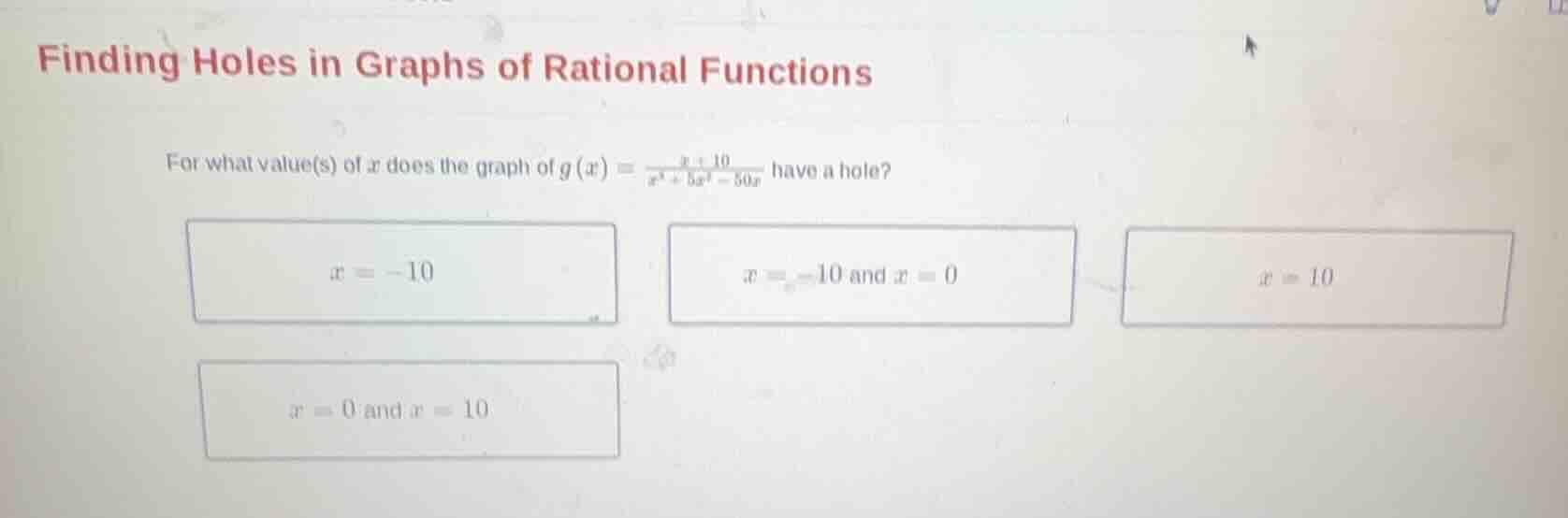
for what value(s) of ( x ) does the graph of ( g(x) = \frac{x + 10}{x^3 + 5x^2 - 50x} ) have a hole?
options: ( x = -10 ); ( x = -10 ) and ( x = 0 ); ( x = 10 ); ( x = 0 ) and ( x = 10 )
Step1: Factor the denominator
First, we factor the denominator \(x^3 + 5x^2 - 50x\). We can factor out an \(x\) first: \(x(x^2 + 5x - 50)\). Then, we factor the quadratic \(x^2 + 5x - 50\). We need two numbers that multiply to \(-50\) and add to \(5\). Those numbers are \(10\) and \(-5\). So, \(x^2 + 5x - 50=(x + 10)(x - 5)\). Therefore, the denominator factors to \(x(x + 10)(x - 5)\).
The function is \(g(x)=\frac{x + 10}{x(x + 10)(x - 5)}\).
Step2: Identify the hole
A hole in the graph of a rational function occurs when there is a common factor in the numerator and the denominator. Here, the common factor is \((x + 10)\). We set the common factor equal to zero to find the \(x\)-value of the hole: \(x + 10 = 0\), which gives \(x=-10\). We need to check that this value does not make the remaining denominator zero (after canceling the common factor). After canceling \((x + 10)\), the function becomes \(\frac{1}{x(x - 5)}\) (for \(x
eq - 10\)). When \(x=-10\), the original denominator was zero (because of the \(x+10\) factor), but after canceling, the remaining denominator at \(x = - 10\) is \((-10)(-10 - 5)=(-10)(-15)=150
eq0\)? Wait, no, actually, when we cancel the common factor, we have to note that \(x
eq - 10\) (since it made the original denominator zero), but the hole is at the \(x\)-value where the common factor is zero, regardless of the remaining denominator (as long as the remaining denominator isn't zero at that \(x\)-value? Wait, no, the hole is where the common factor is zero, because that's where the function is undefined in the original function but would be defined (or have a removable discontinuity) after canceling the common factor. Let's check the original denominator at \(x=-10\): \((-10)^3+5(-10)^2 - 50(-10)=-1000 + 500+500 = 0\), and the numerator at \(x=-10\) is \(-10 + 10 = 0\). So, it's a removable discontinuity (hole) at \(x=-10\). The other values that make the denominator zero are \(x = 0\) and \(x = 5\), but these are vertical asymptotes because they don't cancel with the numerator.

Snap & solve any problem in the app
Get step-by-step solutions on Sovi AI
Photo-based solutions with guided steps
Explore more problems and detailed explanations
\(x=-10\) (corresponding to the option: \(x = - 10\))