QUESTION IMAGE
Question
finding probabilities
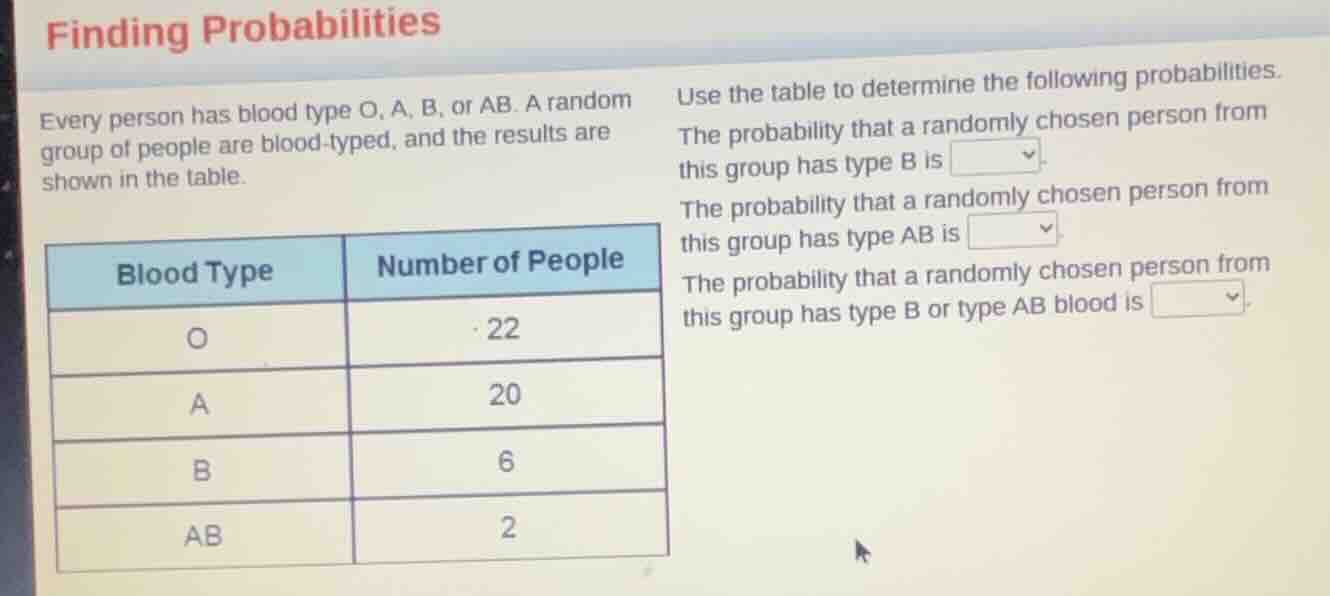
every person has blood type o, a, b, or ab. a random group of people are blood - typed, and the results are shown in the table.
use the table to determine the following probabilities.
the probability that a randomly chosen person from this group has type b is
the probability that a randomly chosen person from this group has type ab is
the probability that a randomly chosen person from this group has type b or type ab blood is
| blood type | number of people |
|---|---|
| a | 20 |
| b | 6 |
| ab | 2 |
To solve these probability problems, we first need to find the total number of people in the group. Then we can use the formula for probability: \( P(\text{event}) = \frac{\text{Number of favorable outcomes}}{\text{Total number of outcomes}} \).
Step 1: Calculate the total number of people
We sum up the number of people for each blood type:
\[
22 + 20 + 6 + 2 = 50
\]
Probability of type B
Step 1: Identify favorable and total outcomes
- Number of people with type B: \( 6 \)
- Total number of people: \( 50 \)
Step 2: Calculate the probability
\[
P(\text{Type B}) = \frac{6}{50} = \frac{3}{25} = 0.12
\]
Probability of type AB
Step 1: Identify favorable and total outcomes
- Number of people with type AB: \( 2 \)
- Total number of people: \( 50 \)
Step 2: Calculate the probability
\[
P(\text{Type AB}) = \frac{2}{50} = \frac{1}{25} = 0.04
\]
Probability of type B or type AB
Step 1: Identify favorable and total outcomes
- Number of people with type B or AB: \( 6 + 2 = 8 \)
- Total number of people: \( 50 \)
Step 2: Calculate the probability
\[
P(\text{Type B or AB}) = \frac{8}{50} = \frac{4}{25} = 0.16
\]
Final Answers
- The probability that a randomly chosen person from this group has type B is \(\boldsymbol{\frac{3}{25}}\) (or \(0.12\)).
- The probability that a randomly chosen person from this group has type AB is \(\boldsymbol{\frac{1}{25}}\) (or \(0.04\)).
- The probability that a randomly chosen person from this group has type B or type AB blood is \(\boldsymbol{\frac{4}{25}}\) (or \(0.16\)).

Snap & solve any problem in the app
Get step-by-step solutions on Sovi AI
Photo-based solutions with guided steps
Explore more problems and detailed explanations
To solve these probability problems, we first need to find the total number of people in the group. Then we can use the formula for probability: \( P(\text{event}) = \frac{\text{Number of favorable outcomes}}{\text{Total number of outcomes}} \).
Step 1: Calculate the total number of people
We sum up the number of people for each blood type:
\[
22 + 20 + 6 + 2 = 50
\]
Probability of type B
Step 1: Identify favorable and total outcomes
- Number of people with type B: \( 6 \)
- Total number of people: \( 50 \)
Step 2: Calculate the probability
\[
P(\text{Type B}) = \frac{6}{50} = \frac{3}{25} = 0.12
\]
Probability of type AB
Step 1: Identify favorable and total outcomes
- Number of people with type AB: \( 2 \)
- Total number of people: \( 50 \)
Step 2: Calculate the probability
\[
P(\text{Type AB}) = \frac{2}{50} = \frac{1}{25} = 0.04
\]
Probability of type B or type AB
Step 1: Identify favorable and total outcomes
- Number of people with type B or AB: \( 6 + 2 = 8 \)
- Total number of people: \( 50 \)
Step 2: Calculate the probability
\[
P(\text{Type B or AB}) = \frac{8}{50} = \frac{4}{25} = 0.16
\]
Final Answers
- The probability that a randomly chosen person from this group has type B is \(\boldsymbol{\frac{3}{25}}\) (or \(0.12\)).
- The probability that a randomly chosen person from this group has type AB is \(\boldsymbol{\frac{1}{25}}\) (or \(0.04\)).
- The probability that a randomly chosen person from this group has type B or type AB blood is \(\boldsymbol{\frac{4}{25}}\) (or \(0.16\)).