QUESTION IMAGE
Question
finding slope guided notes & practice
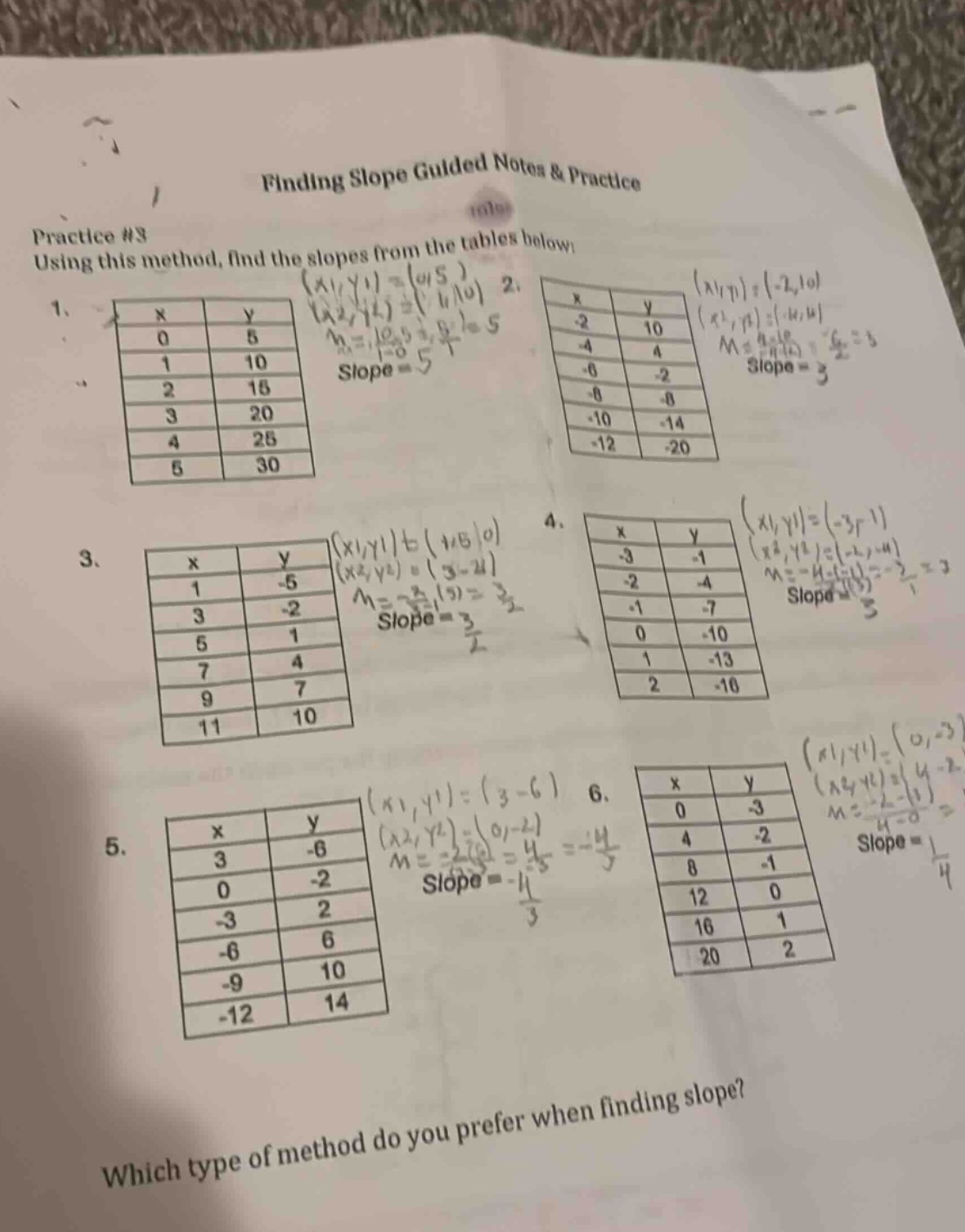
practice #3
using this method, find the slopes from the tables below:
1.
| x | y |
|---|---|
| 1 | 10 |
| 2 | 15 |
| 3 | 20 |
| 4 | 25 |
| 5 | 30 |
$(x_1,y_1)=(0,5)$
$(x_2,y_2)=(1,10)$
$m=\frac{10-5}{1-0}=5$
slope$=5$
2.
| x | y |
|---|---|
| -4 | 4 |
| -6 | -2 |
| -8 | -8 |
| -10 | -14 |
| -12 | -20 |
$(x_1,y_1)=(-2,10)$
$(x_2,y_2)=(-4,4)$
$m=\frac{4-10}{-4-(-2)}=3$
slope$=3$
3.
| x | y |
|---|---|
| 3 | -2 |
| 5 | 1 |
| 7 | 4 |
| 9 | 7 |
| 11 | 10 |
$(x_1,y_1)=(1,-5)$
$(x_2,y_2)=(3,-2)$
$m=\frac{-2-(-5)}{3-1}=\frac{3}{2}$
slope$=\frac{3}{2}$
4.
| x | y |
|---|---|
| -2 | -4 |
| -1 | -7 |
| 0 | -10 |
| 1 | -13 |
| 2 | -16 |
$(x_1,y_1)=(-3,-1)$
$(x_2,y_2)=(-2,-4)$
$m=\frac{-4-(-1)}{-2-(-3)}=3$
slope$=3$
5.
| x | y |
|---|---|
| 0 | -2 |
| -3 | 2 |
| -6 | 6 |
| -9 | 10 |
| -12 | 14 |
$(x_1,y_1)=(3,-6)$
$(x_2,y_2)=(0,-2)$
$m=\frac{-2-(-6)}{0-3}=-\frac{4}{3}$
slope$=-\frac{4}{3}$
6.
| x | y |
|---|---|
| 4 | -2 |
| 8 | -1 |
| 12 | 0 |
| 16 | 1 |
| 20 | 2 |
$(x_1,y_1)=(0,-3)$
$(x_2,y_2)=(4,-2)$
$m=\frac{-2-(-3)}{4-0}=\frac{1}{4}$
slope$=\frac{1}{4}$
which type of method do you prefer when finding slope?
Step1: Recall slope formula
Slope $m = \frac{y_2 - y_1}{x_2 - x_1}$ for points $(x_1,y_1),(x_2,y_2)$
Step2: Calculate slope for Table1
Pick $(0,5)$ and $(1,10)$:
$m = \frac{10 - 5}{1 - 0} = 5$
Step3: Calculate slope for Table2
Pick $(-2,10)$ and $(-4,4)$:
$m = \frac{4 - 10}{-4 - (-2)} = \frac{-6}{-2} = 3$
Step4: Calculate slope for Table3
Pick $(1,-5)$ and $(3,-2)$:
$m = \frac{-2 - (-5)}{3 - 1} = \frac{3}{2}$
Step5: Calculate slope for Table4
Pick $(-3,-1)$ and $(-2,-4)$:
$m = \frac{-4 - (-1)}{-2 - (-3)} = \frac{-3}{1} = -3$
Step6: Calculate slope for Table5
Pick $(3,-6)$ and $(0,-2)$:
$m = \frac{-2 - (-6)}{0 - 3} = \frac{4}{-3} = -\frac{4}{3}$
Step7: Calculate slope for Table6
Pick $(0,-3)$ and $(4,-2)$:
$m = \frac{-2 - (-3)}{4 - 0} = \frac{1}{4}$

Snap & solve any problem in the app
Get step-by-step solutions on Sovi AI
Photo-based solutions with guided steps
Explore more problems and detailed explanations
- Slope = 5
- Slope = 3
- Slope = $\frac{3}{2}$
- Slope = -3
- Slope = $-\frac{4}{3}$
- Slope = $\frac{1}{4}$
For the preference question: A common preferred method is using the slope formula with two clear points from the table, as it is direct and consistent for linear relationships.