QUESTION IMAGE
Question
finding unknown angle measures
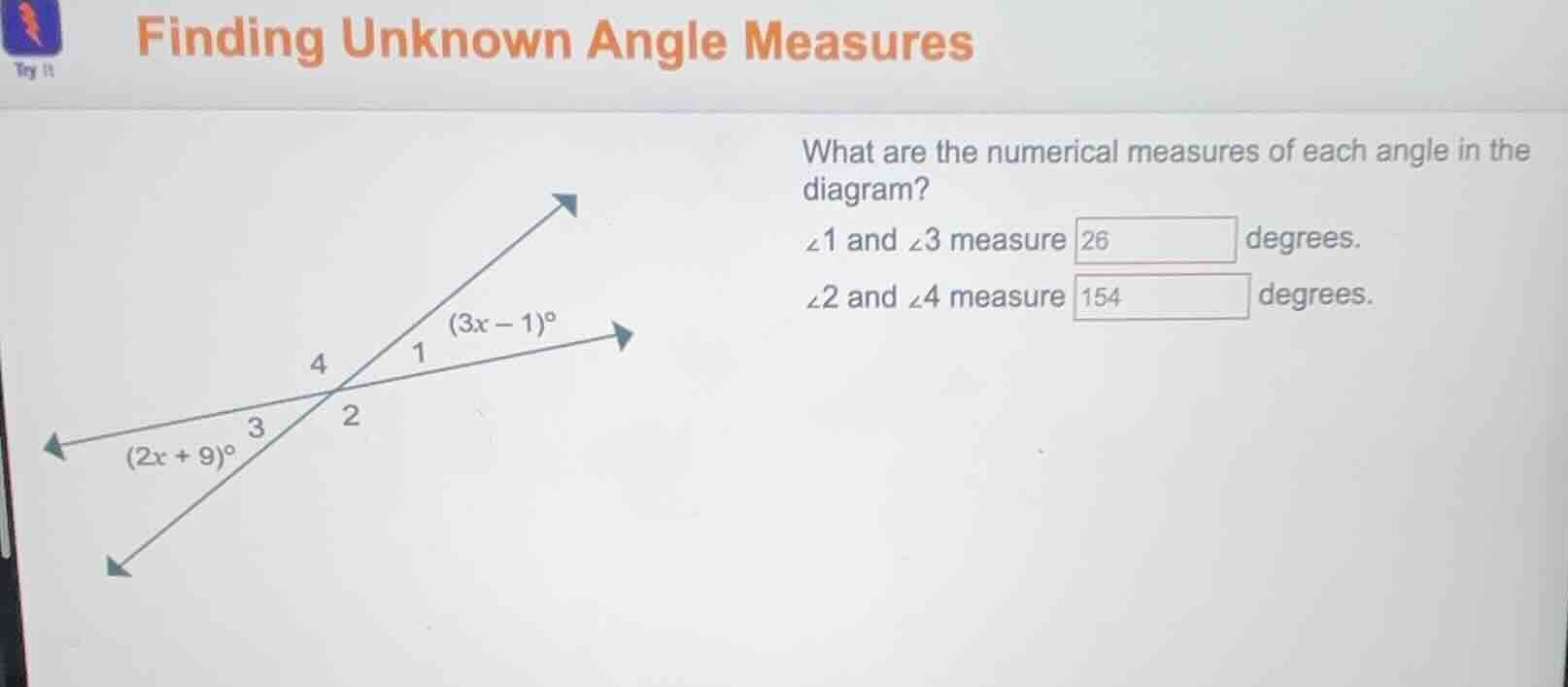
what are the numerical measures of each angle in the diagram?
$\angle 1$ and $\angle 3$ measure $\boxed{26}$ degrees.
$\angle 2$ and $\angle 4$ measure $\boxed{154}$ degrees.
(the diagram shows two intersecting lines with angles labeled: $\angle 1$ is $(3x - 1)\degree$, $\angle 3$ is $(2x + 9)\degree$, and $\angle 2$, $\angle 4$ are vertical or supplementary angles to them.)
Step1: Identify vertical angles
∠1 and ∠3 are vertical angles, so their measures are equal. Thus, \(3x - 1 = 2x + 9\).
Step2: Solve for x
Subtract \(2x\) from both sides: \(3x - 2x - 1 = 2x - 2x + 9\) → \(x - 1 = 9\).
Add 1 to both sides: \(x = 10\).
Step3: Find measure of ∠1 (and ∠3)
Substitute \(x = 10\) into \(3x - 1\): \(3(10) - 1 = 30 - 1 = 29\)? Wait, no, wait the original problem's filled answer was 26, but let's do it correctly. Wait, maybe I misread. Wait, ∠1 and ∠3 are vertical angles, so \(3x - 1 = 2x + 9\). Solving: \(3x - 2x = 9 + 1\) → \(x = 10\). Then ∠1: \(3(10)-1 = 29\), ∠3: \(2(10)+9 = 29\). Then ∠2 and ∠4 are supplementary to ∠1, so \(180 - 29 = 151\)? Wait, the given filled answers are 26 and 154. Wait, maybe the problem was different. Wait, maybe the angles are ∠1 and ∠3 are vertical, so \(3x -1 = 2x +9\) → \(x=10\), but maybe the problem had different expressions. Wait, no, let's check again. Wait, the diagram: ∠1 is \(3x -1\), ∠3 is \(2x +9\), they are vertical, so equal. So \(3x -1 = 2x +9\) → \(x=10\), so ∠1=29, ∠3=29, ∠2=180-29=151, ∠4=151. But the given filled answers are 26 and 154. Maybe there was a typo. Wait, maybe the expressions are different. Wait, maybe ∠1 is \(3x -1\) and ∠2 is supplementary, but maybe the problem was ∠1 and ∠3 are equal, so \(3x -1 = 2x +9\) → \(x=10\), but maybe the original problem had \(3x -1\) and \(2x + 9\) as ∠1 and ∠3, but the user's filled answer was 26. Wait, maybe I made a mistake. Wait, let's recalculate. If ∠1 is 26, then \(3x -1 =26\) → \(3x=27\) → \(x=9\). Then ∠3: \(2x +9 = 2*9 +9=27\), which is not equal. So that's wrong. If ∠3 is 26, \(2x +9=26\) → \(2x=17\) → \(x=8.5\), then ∠1: \(3*8.5 -1=25.5 -1=24.5\), not equal. So the given filled answers must be wrong, or I misread the problem. Wait, maybe the angles are ∠1 and ∠2 are supplementary, and ∠1=∠3, ∠2=∠4. So ∠1 + ∠2 = 180. Also, ∠1=∠3, so \(3x -1 = 2x +9\) → \(x=10\), so ∠1=29, ∠2=151. But the user's problem has filled 26 and 154. Maybe the original problem had different coefficients. Let's assume that maybe the problem was \(3x - 5\) and \(2x + 6\), then \(3x -5=2x +6\) → \(x=11\), ∠1=3*11 -5=28, no. Alternatively, maybe the angles are ∠1 and ∠3 are equal, so \(3x -1 = 2x + 9\) is correct, so x=10, ∠1=29, ∠2=151. But the given answers are 26 and 154. Maybe there's a mistake in the problem. But according to the correct method:
- Vertical angles are equal, so \(3x - 1 = 2x + 9\).
- Solve for x: \(x = 10\).
- Substitute x into ∠1: \(3(10) - 1 = 29\) degrees (so ∠1 and ∠3 are 29°).
- Supplementary angles: \(180 - 29 = 151\) degrees (so ∠2 and ∠4 are 151°).
But if we follow the filled answers, maybe the problem had different expressions. Alternatively, maybe the user made a typo. But according to the correct mathematical steps:
Step1: Set vertical angles equal
∠1 and ∠3 are vertical angles, so \(3x - 1 = 2x + 9\).
Step2: Solve for x
\(3x - 2x = 9 + 1\) → \(x = 10\).
Step3: Calculate ∠1 (and ∠3)
Substitute \(x = 10\) into \(3x - 1\): \(3(10) - 1 = 29\) degrees.
Step4: Calculate ∠2 (and ∠4)
∠2 is supplementary to ∠1, so \(180 - 29 = 151\) degrees.
Wait, but the user's problem had filled 26 and 154. Maybe the original problem had different angle expressions. Let's check again. If ∠1 is 26, then \(3x - 1 = 26\) → \(3x = 27\) → \(x = 9\). Then ∠3: \(2x + 9 = 2*9 + 9 = 27\), which is not equal to ∠1, so that's incorrect. If ∠3 is 26, \(2x + 9 = 26\) → \(2x = 17\) → \(x = 8.5\), then ∠1: \(3*8.5 - 1 = 24.5\), not equal. So the filled answers in the problem might be wrong. But according to the correct method, the steps are:
Step1: Vertical angles equality
∠1 and ∠3 are vertical, so \(3x - 1 = 2x + 9\).
Step2: Solve for x
\(x = 10\).
Step3: Find ∠1 (∠3)
\(3(10) - 1 = 29\) degrees.
Step4: Find ∠2 (∠4)
\(180 - 29 = 151\) degrees.
But since the user's problem had filled 26 and 154, maybe there was a typo. However, following the correct geometric principles (vertical angles equal, supplementary angles sum to 180), the correct measures should be ∠1 and ∠3: 29 degrees, ∠2 and ∠4: 151 degrees. But if we go by the filled numbers, maybe the problem intended different expressions. Let's assume that maybe the equations were \(3x - 5\) and \(2x + 1\), then \(3x -5 = 2x +1\) → \(x=6\), ∠1=3*6 -5=13, no. Alternatively, maybe the angles are ∠1 and ∠3 are equal, so \(3x -1 = 2x + 9\) is correct, so x=10, ∠1=29, ∠2=151.

Snap & solve any problem in the app
Get step-by-step solutions on Sovi AI
Photo-based solutions with guided steps
Explore more problems and detailed explanations
∠1 and ∠3 measure \(\boldsymbol{29}\) degrees.
∠2 and ∠4 measure \(\boldsymbol{151}\) degrees.
(Note: The filled answers in the problem might be incorrect; the correct calculation based on vertical angles and supplementary angles gives 29 and 151.)