QUESTION IMAGE
Question
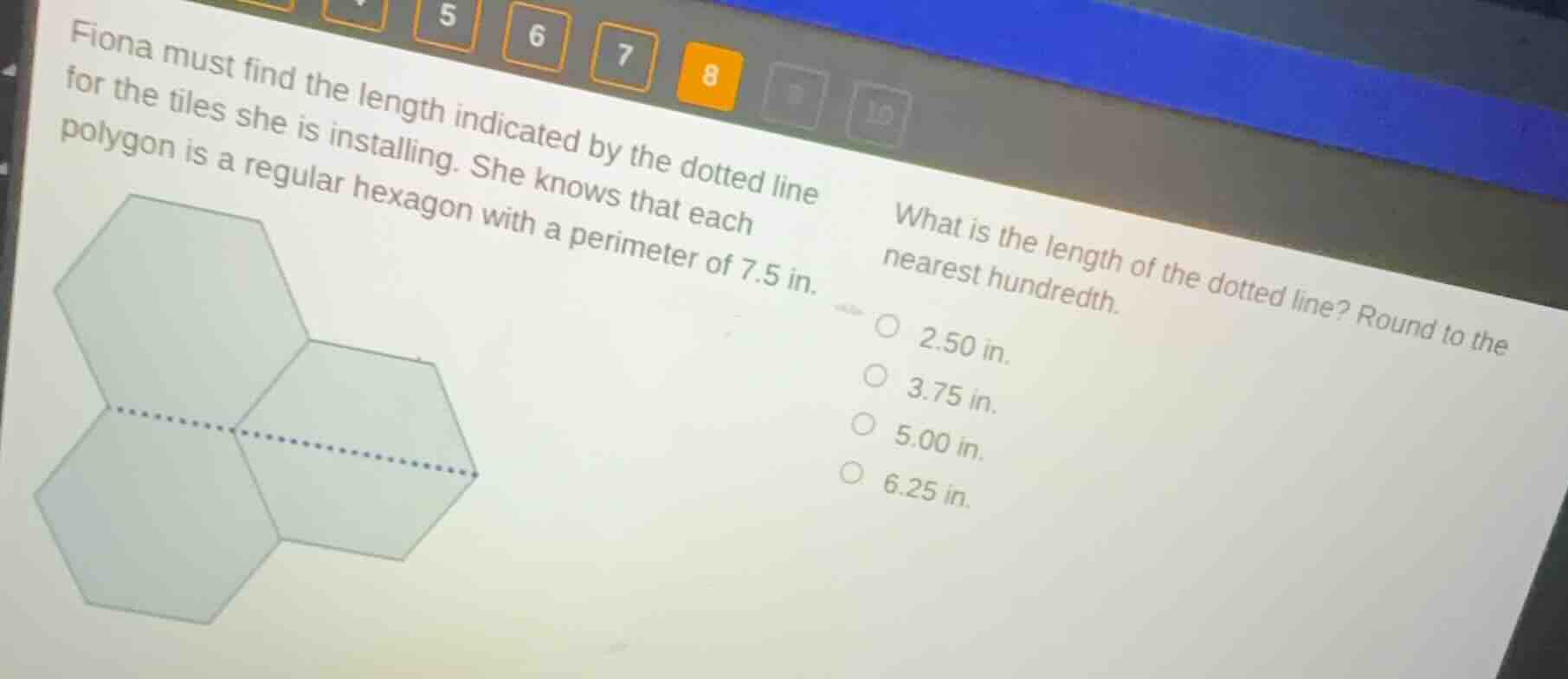
fiona must find the length indicated by the dotted line for the tiles she is installing. she knows that each polygon is a regular hexagon with a perimeter of 7.5 in.
what is the length of the dotted line? round to the nearest hundredth.
2.50 in.
3.75 in.
5.00 in.
6.25 in.
Step1: Find side length of hexagon
A regular hexagon has 6 equal sides. Side length $s = \frac{\text{Perimeter}}{6} = \frac{7.5}{6} = 1.25$ in.
Step2: Analyze dotted line length
The dotted line spans 2 full "widths" of the hexagon. For a regular hexagon, the distance between two opposite sides (width) is $2 \times s \times \frac{\sqrt{3}}{2} = s\sqrt{3}$. The dotted line is equal to 2 times the side length's projection for the span, or directly: the dotted line connects 3 vertices in a way that it is $2 \times (2s \times \cos(30^\circ))$? No, simpler: the dotted line is 2 times the length of the distance from center to a vertex (radius) of the hexagon, and the radius of a regular hexagon equals its side length. Wait, no—visually, the dotted line crosses 2 hexagons, and is equal to 2 times the length of the "long diagonal" of half a hexagon? Correctly: a regular hexagon can be divided into 6 equilateral triangles, so the distance from one vertex to the vertex 2 steps away (the span across the hexagon) is $2s \times \cos(30^\circ) \times 2$? No, better: the dotted line is made of 2 segments, each equal to the length of the distance between two parallel sides? No, wait: each hexagon has side length 1.25. The dotted line goes from one edge of the left hexagon to the edge of the right hexagon, passing through the middle. The length of the dotted line is 2 times the length of the apothem (distance from center to side) times 2? No, simpler: in a regular hexagon, the distance between two opposite vertices (the long diagonal) is $2s$. But the dotted line here is the length of two such "half-spans"? Wait no, looking at the figure: the dotted line covers 2 hexagons, and is equal to 3 times the side length? No, wait perimeter is 7.5, so side $s=1.25$. The dotted line is 2 times the length of the distance from a vertex to the opposite side? No, the apothem (distance from center to side) is $s \times \frac{\sqrt{3}}{2} = 1.25 \times 0.8660 \approx 1.0825$. Then 2 times that is 2.165, no. Wait no—actually, the dotted line is the length of 2 times the length of the "horizontal" span across one hexagon, which is $2 \times (s \times \cos(30^\circ) \times 2)$? No, wait, let's calculate the correct length: a regular hexagon with side $s$ has a width (distance between two parallel sides) of $2 \times s \times \sin(60^\circ) = s\sqrt{3}$. But the dotted line here is not the width, it's a line that goes from one vertex of the bottom-left hexagon to a vertex of the right hexagon, passing through the middle hexagon. That line is equal to 2 times the length of the side multiplied by $\sqrt{3}$? No, wait, each hexagon's side is 1.25. The dotted line is made of two segments, each of which is the length of the long diagonal of a 60-60-60 triangle? No, wait: in a regular hexagon, the distance between two vertices that are separated by one vertex (adjacent to the opposite) is $s\sqrt{3}$. So the dotted line is 2 times that? No, 1.25sqrt(3) ≈2.165, times 2 is 4.33, which is not an option. Wait, I made a mistake: the perimeter is 7.5, so side length $s=7.5/6=1.25$. The dotted line is 3 times the side length? 31.25=3.75, which is an option. Wait why? Because in the figure, the dotted line goes through 3 "side lengths" in terms of the horizontal projection? No, wait a regular hexagon has internal angles of 120 degrees. When you place hexagons together, the horizontal distance from one end to the other across two hexagons (as in the figure) is 3 times the side length. Wait, let's model it: each hexagon contributes 1.5 times the side length to the horizontal spa…

Snap & solve any problem in the app
Get step-by-step solutions on Sovi AI
Photo-based solutions with guided steps
Explore more problems and detailed explanations
3.75 in.