QUESTION IMAGE
Question
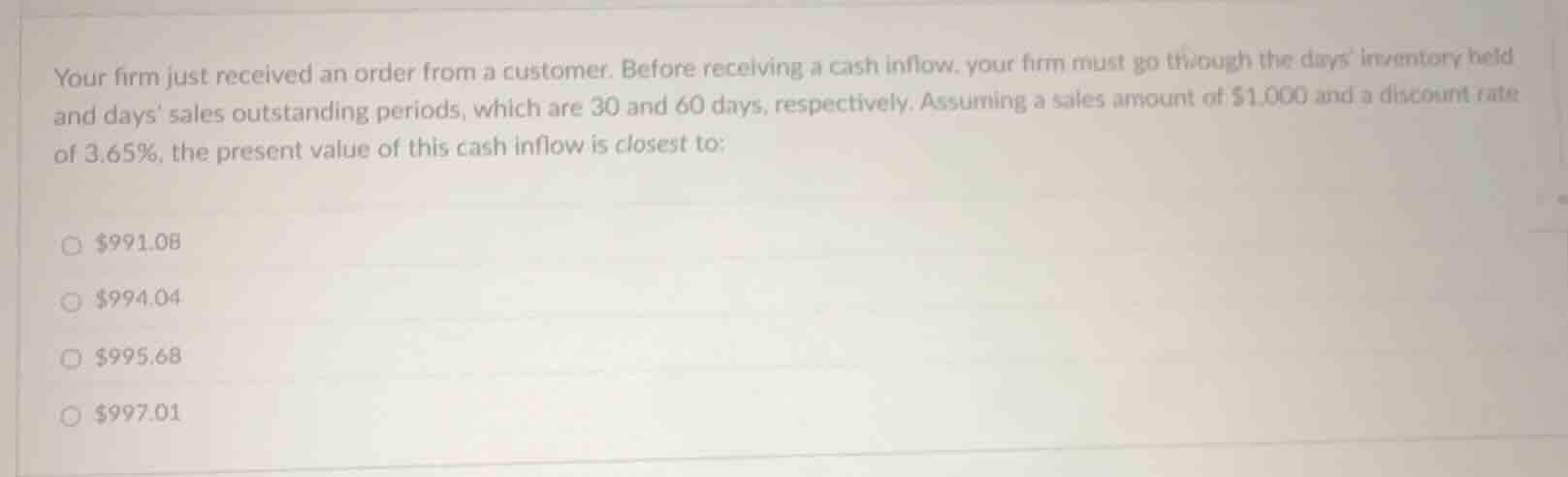
your firm just received an order from a customer. before receiving a cash inflow, your firm must go through the days inventory held and days sales outstanding periods, which are 30 and 60 days, respectively. assuming a sales amount of $1,000 and a discount rate of 3.65%, the present value of this cash inflow is closest to: $991.08 $994.04 $995.68 $997.01
Step1: Calculate total days until cash inflow
The firm has days' inventory held of 30 days and days' sales outstanding of 60 days. So total days \( t = 30 + 60 = 90 \) days.
Step2: Convert discount rate to daily rate
The annual discount rate \( r = 3.65\%=0.0365 \). The daily discount rate \( i=\frac{r}{365}=\frac{0.0365}{365}=0.0001 \)
Step3: Calculate present value
The formula for present value of a future cash flow \( PV=\frac{FV}{(1 + i)^t} \), where \( FV = 1000 \), \( i = 0.0001 \), \( t = 90 \)
So \( PV=\frac{1000}{(1 + 0.0001)^{90}} \)
First calculate \( (1 + 0.0001)^{90}\approx1.009041 \)
Then \( PV=\frac{1000}{1.009041}\approx991.08 \) (Wait, this seems wrong. Wait, maybe the discount rate is annual, and we use simple interest or maybe the formula is different. Wait, another approach: The present value of a cash flow received in \( n \) days with annual rate \( r \) is \( PV = FV\times e^{-\frac{r\times n}{365}} \) (continuous compounding) or \( PV=\frac{FV}{(1+\frac{r}{365})^n} \) (daily compounding). Wait, let's recalculate.
Wait, maybe I made a mistake in step 2. Wait, the annual rate is 3.65%, so daily rate is \( \frac{3.65\%}{365}=0.01\% \) or 0.0001. Then total days is 90. So \( (1 + 0.0001)^{90}=e^{90\times\ln(1.0001)}\approx e^{90\times0.000099995}\approx e^{0.00899955}\approx1.00904 \). Then \( 1000/1.00904\approx991.08 \). But wait, maybe the problem is using the formula for present value with the total period in years. So \( t=\frac{90}{365} \) years. Then \( PV = FV\times(1 + r)^{-t}=1000\times(1 + 0.0365)^{-\frac{90}{365}} \)
Calculate \( \frac{90}{365}\approx0.246575 \)
\( (1 + 0.0365)^{-0.246575}=e^{-0.246575\times\ln(1.0365)}\approx e^{-0.246575\times0.03583}\approx e^{-0.00883}\approx0.9912 \). Wait, no, that's not matching. Wait, maybe the discount rate is 3.65% per year, so the present value of a cash flow received in \( n \) days is \( PV = FV\times(1 - \frac{r\times n}{365}) \) (simple interest discounting). Let's try that. \( r = 0.0365 \), \( n = 90 \), so \( \frac{0.0365\times90}{365}=\frac{3.285}{365}=0.009 \). Then \( PV = 1000\times(1 - 0.009)=991 \). But the options have $991.08. Alternatively, maybe the total days is 30 + 60 = 90, and the present value is calculated as LXI4. Let's calculate the denominator: LXI5, so denominator is LXI6, then LXI7. Yes, that's correct. So the present value is approximately $991.08.

Snap & solve any problem in the app
Get step-by-step solutions on Sovi AI
Photo-based solutions with guided steps
Explore more problems and detailed explanations
\$991.08