QUESTION IMAGE
Question
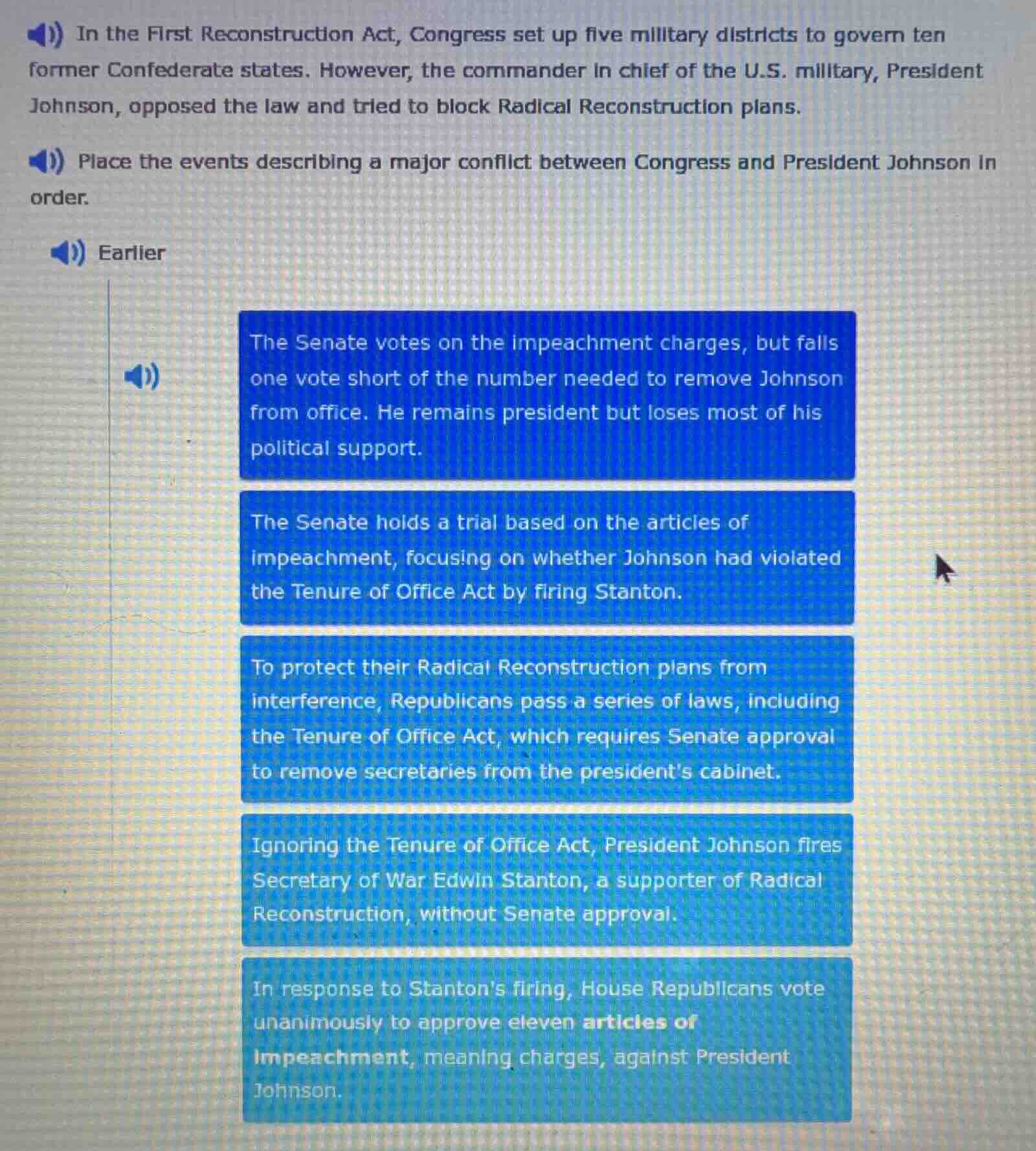
in the first reconstruction act, congress set up five military districts to govern ten former confederate states. however, the commander in chief of the u.s. military, president johnson, opposed the law and tried to block radical reconstruction plans. place the events describing a major conflict between congress and president johnson in order. earlier the senate votes on the impeachment charges, but falls one vote short of the number needed to remove johnson from office. he remains president but loses most of his political support. the senate holds a trial based on the articles of impeachment, focusing on whether johnson had violated the tenure of office act by firing stanton. to protect their radical reconstruction plans from interference, republicans pass a series of laws, including the tenure of office act, which requires senate approval to remove secretaries from the presidents cabinet. ignoring the tenure of office act, president johnson fires secretary of war edwin stanton, a supporter of radical reconstruction, without senate approval. in response to stantons firing, house republicans vote unanimously to approve eleven articles of impeachment, meaning charges, against president johnson.
To solve this, we analyze the chronological order of events in the conflict between Congress and President Johnson:
- Congress passes laws (including Tenure of Office Act): Republicans pass laws (like Tenure of Office Act) to protect Reconstruction plans.
- Johnson fires Stanton: Johnson ignores the act and fires Stanton without Senate approval.
- House approves impeachment articles: House Republicans vote to impeach Johnson in response to Stanton’s firing.
- Senate holds impeachment trial: The Senate holds a trial to determine if Johnson violated the Tenure of Office Act.
- Senate votes on impeachment: The Senate votes on impeachment charges (falls short of removing Johnson).
Ordered Events (from Earlier to Later):
- To protect their Radical Reconstruction plans from interference, Republicans pass a series of laws, including the Tenure of Office Act, which requires Senate approval to remove secretaries from the president’s cabinet.
- Ignoring the Tenure of Office Act, President Johnson fires Secretary of War Edwin Stanton, a supporter of Radical Reconstruction, without Senate approval.
- In response to Stanton’s firing, House Republicans vote unanimously to approve eleven articles of Impeachment, meaning charges, against President Johnson.
- The Senate holds a trial based on the articles of impeachment, focusing on whether Johnson had violated the Tenure of Office Act by firing Stanton.
- The Senate votes on the impeachment charges, but falls one vote short of the number needed to remove Johnson from office. He remains president but loses most of his political support.
(If the task is to list the order, the above sequence is the correct chronological flow of events.)

Snap & solve any problem in the app
Get step-by-step solutions on Sovi AI
Photo-based solutions with guided steps
Explore more problems and detailed explanations
To solve this, we analyze the chronological order of events in the conflict between Congress and President Johnson:
- Congress passes laws (including Tenure of Office Act): Republicans pass laws (like Tenure of Office Act) to protect Reconstruction plans.
- Johnson fires Stanton: Johnson ignores the act and fires Stanton without Senate approval.
- House approves impeachment articles: House Republicans vote to impeach Johnson in response to Stanton’s firing.
- Senate holds impeachment trial: The Senate holds a trial to determine if Johnson violated the Tenure of Office Act.
- Senate votes on impeachment: The Senate votes on impeachment charges (falls short of removing Johnson).
Ordered Events (from Earlier to Later):
- To protect their Radical Reconstruction plans from interference, Republicans pass a series of laws, including the Tenure of Office Act, which requires Senate approval to remove secretaries from the president’s cabinet.
- Ignoring the Tenure of Office Act, President Johnson fires Secretary of War Edwin Stanton, a supporter of Radical Reconstruction, without Senate approval.
- In response to Stanton’s firing, House Republicans vote unanimously to approve eleven articles of Impeachment, meaning charges, against President Johnson.
- The Senate holds a trial based on the articles of impeachment, focusing on whether Johnson had violated the Tenure of Office Act by firing Stanton.
- The Senate votes on the impeachment charges, but falls one vote short of the number needed to remove Johnson from office. He remains president but loses most of his political support.
(If the task is to list the order, the above sequence is the correct chronological flow of events.)