QUESTION IMAGE
Question
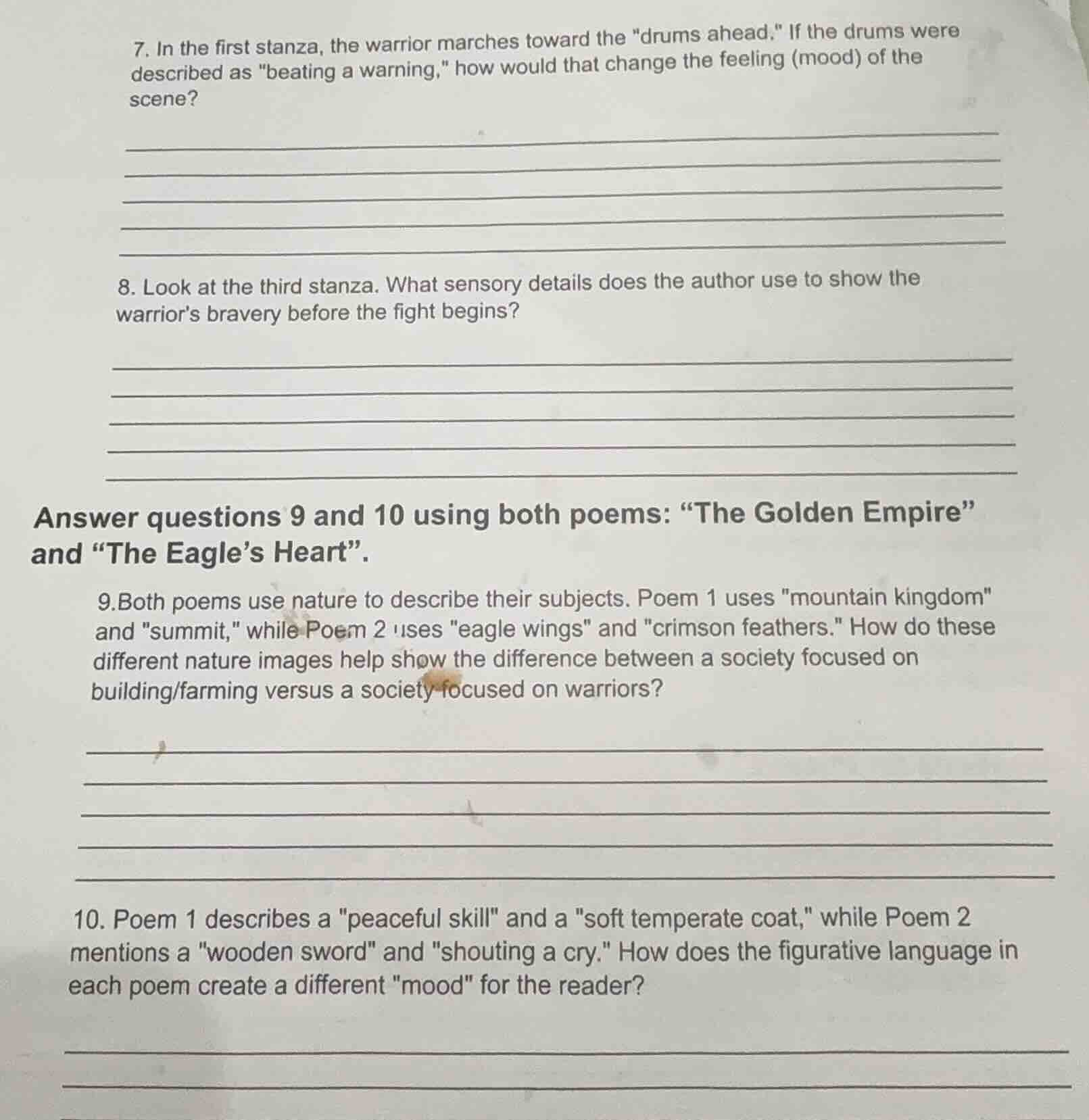
- in the first stanza, the warrior marches toward the \drums ahead.\ if the drums were described as \beating a warning,\ how would that change the feeling (mood) of the scene?
- look at the third stanza. what sensory details does the author use to show the warriors bravery before the fight begins?
answer questions 9 and 10 using both poems: \the golden empire\ and \the eagle’s heart\.
9.both poems use nature to describe their subjects. poem 1 uses \mountain kingdom\ and \summit,\ while poem 2 uses \eagle wings\ and \crimson feathers.\ how do these different nature images help show the difference between a society focused on building/farming versus a society focused on warriors?
- poem 1 describes a \peaceful skill\ and a \soft temperate coat,\ while poem 2 mentions a \wooden sword\ and \shouting a cry.\ how does the figurative language in each poem create a different \mood\ for the reader?
Since the poems "The Golden Empire" and "The Eagle’s Heart" are not provided, I'll give general guidance on how to answer these questions, and you can apply it once you have the poems:
Question 7
- First, identify the original mood of the scene with the drums (e.g., maybe heroic, determined, or adventurous).
- Then, analyze how "beating a warning" changes the tone: warnings imply danger, threat, or caution. So the mood would shift from, say, bold determination to tense anticipation or fear of impending danger. It would make the scene feel more ominous, as if the warrior is marching into a risky, forewarned situation rather than a bold, unknowing advance.
- Sensory details include sight, sound, touch, taste, smell. Look at the third stanza for descriptions: maybe visual (e.g., warrior’s posture, gear), auditory (e.g., battle cries, silent resolve), or tactile (e.g., gripping a weapon).
- For example, if the stanza has "his eyes blaze, sword glinting" (sight) or "he stands still, heart steady" (internal but can relate to sensory - like the feel of resolve), these show bravery (calm in face of fight, bold appearance).
- For the "building/farming" society (Poem 1 with "mountain kingdom," "summit"): Nature images like mountains/summits suggest stability, growth (farming: land - based, settled), and a society rooted in place, focused on nurturing (farming) or building (kingdom - construction, governance).
- For the "warrior" society (Poem 2 with "eagle wings," "crimson feathers"): Eagles are fierce, free, and associated with battle/strength. These images suggest a society of action, combat, and valor (warriors are like eagles: bold, predatory, ready to fight).
- The contrast: one nature image (mountains) is static, nurturing; the other (eagle) is dynamic, fierce - showing the societies’ core focuses (settled vs. war - like).

Snap & solve any problem in the app
Get step-by-step solutions on Sovi AI
Photo-based solutions with guided steps
Explore more problems and detailed explanations
Originally, the drums might create a bold, determined mood (e.g., of a warrior advancing bravely). Describing them as "beating a warning" would shift the mood to tense and ominous, implying danger/threat ahead, making the scene feel more cautionary or fear - inducing (e.g., the warrior now marches into a forewarned, risky situation).