QUESTION IMAGE
Question
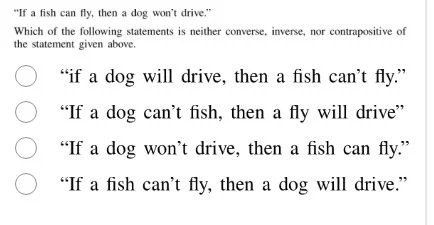
“if a fish can fly, then a dog won’t drive.”
which of the following statements is neither converse, inverse, nor contrapositive of
the statement given above?
\bigcirc “if a dog will drive, then a fish can’t fly.”
\bigcirc “if a dog can’t fish, then a fly will drive”
\bigcirc “if a dog won’t drive, then a fish can fly.”
\bigcirc “if a fish can’t fly, then a dog will drive.”
To solve this, we first recall the definitions of converse, inverse, and contrapositive of a conditional statement \(p \to q\):
- Converse: \(q \to p\)
- Inverse: \(
eg p \to
eg q\)
- Contrapositive: \(
eg q \to
eg p\)
Let the original statement be: "If a fish can fly (\(p\)), then a dog won't drive (\(q\))", so \(p\): "a fish can fly", \(
eg p\): "a fish can't fly"; \(q\): "a dog won't drive", \(
eg q\): "a dog will drive".
Analyze each option:
- Option 1: "If a dog will drive, then a fish can’t fly."
This is \(
eg q \to
eg p\), which is the contrapositive of \(p \to q\).
- Option 2: "If a dog can’t fish, then a fly will drive"
This statement introduces entirely new terms ("can’t fish", "fly will drive") that are not related to \(p\), \(
eg p\), \(q\), or \(
eg q\) from the original statement. It does not follow the structure of converse, inverse, or contrapositive.
- Option 3: "If a dog won’t drive, then a fish can fly."
This is \(q \to p\), which is the converse of \(p \to q\).
- Option 4: "If a fish can’t fly, then a dog will drive."
This is \(
eg p \to
eg q\) (since \(
eg q\) is "a dog will drive"), which is the inverse of \(p \to q\).
We analyze the structure of each option relative to the original conditional statement. The second option introduces unrelated terms and does not match the structure of converse, inverse, or contrapositive.

Snap & solve any problem in the app
Get step-by-step solutions on Sovi AI
Photo-based solutions with guided steps
Explore more problems and detailed explanations
"If a dog can’t fish, then a fly will drive" (the second option)