QUESTION IMAGE
Question
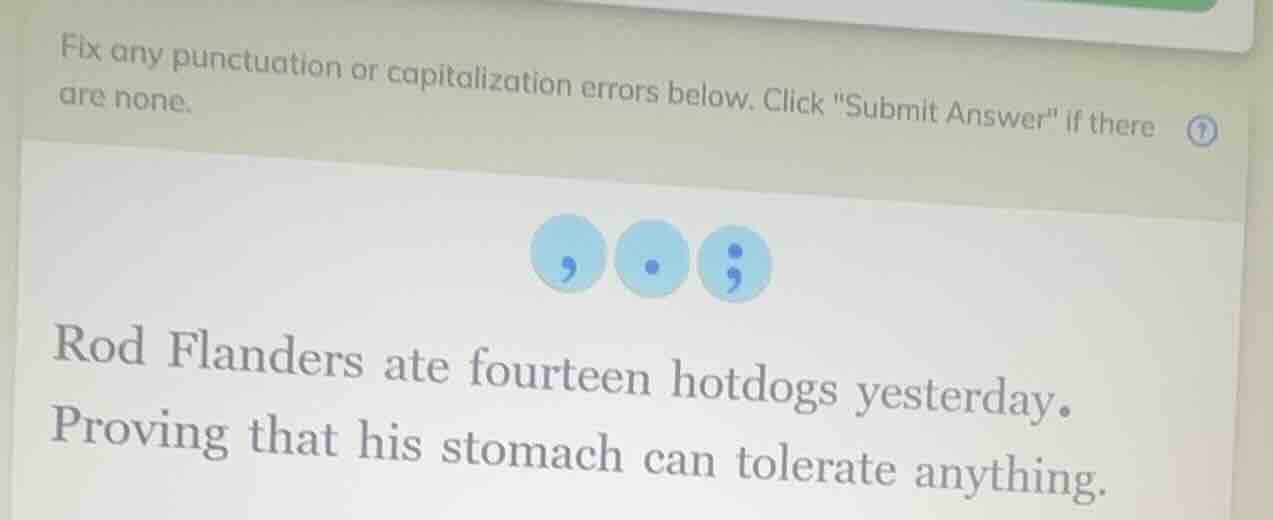
fix any punctuation or capitalization errors below. click \submit answer\ if there are none.
rod flanders ate fourteen hotdogs yesterday. proving that his stomach can tolerate anything.
The second sentence "Proving that his stomach can tolerate anything." is a dependent clause and should be connected to the first sentence with a comma instead of a period. Also, the period at the end of the first sentence should be a comma, and the period at the end of the second sentence should be removed as it's now part of a single sentence. Wait, actually, the second part is a sentence fragment when separated. So we should combine them or correct the punctuation. The correct way is to change the period after "yesterday" to a comma, and the period after "anything" is incorrect as the second part is a dependent clause? Wait, no, "Proving that his stomach can tolerate anything" is a participial phrase, so the correct punctuation is to replace the period after "yesterday" with a comma, and the period at the end of the second sentence is not needed. Wait, let's re - examine:
Original sentences:
"Rod Flanders ate fourteen hotdogs yesterday.
Proving that his stomach can tolerate anything."
The second "sentence" is a fragment. To correct, we can make it: "Rod Flanders ate fourteen hotdogs yesterday, proving that his stomach can tolerate anything." So we change the period after "yesterday" to a comma, and remove the period at the end of the second sentence.

Snap & solve any problem in the app
Get step-by-step solutions on Sovi AI
Photo-based solutions with guided steps
Explore more problems and detailed explanations
Rod Flanders ate fourteen hotdogs yesterday, proving that his stomach can tolerate anything.