QUESTION IMAGE
Question
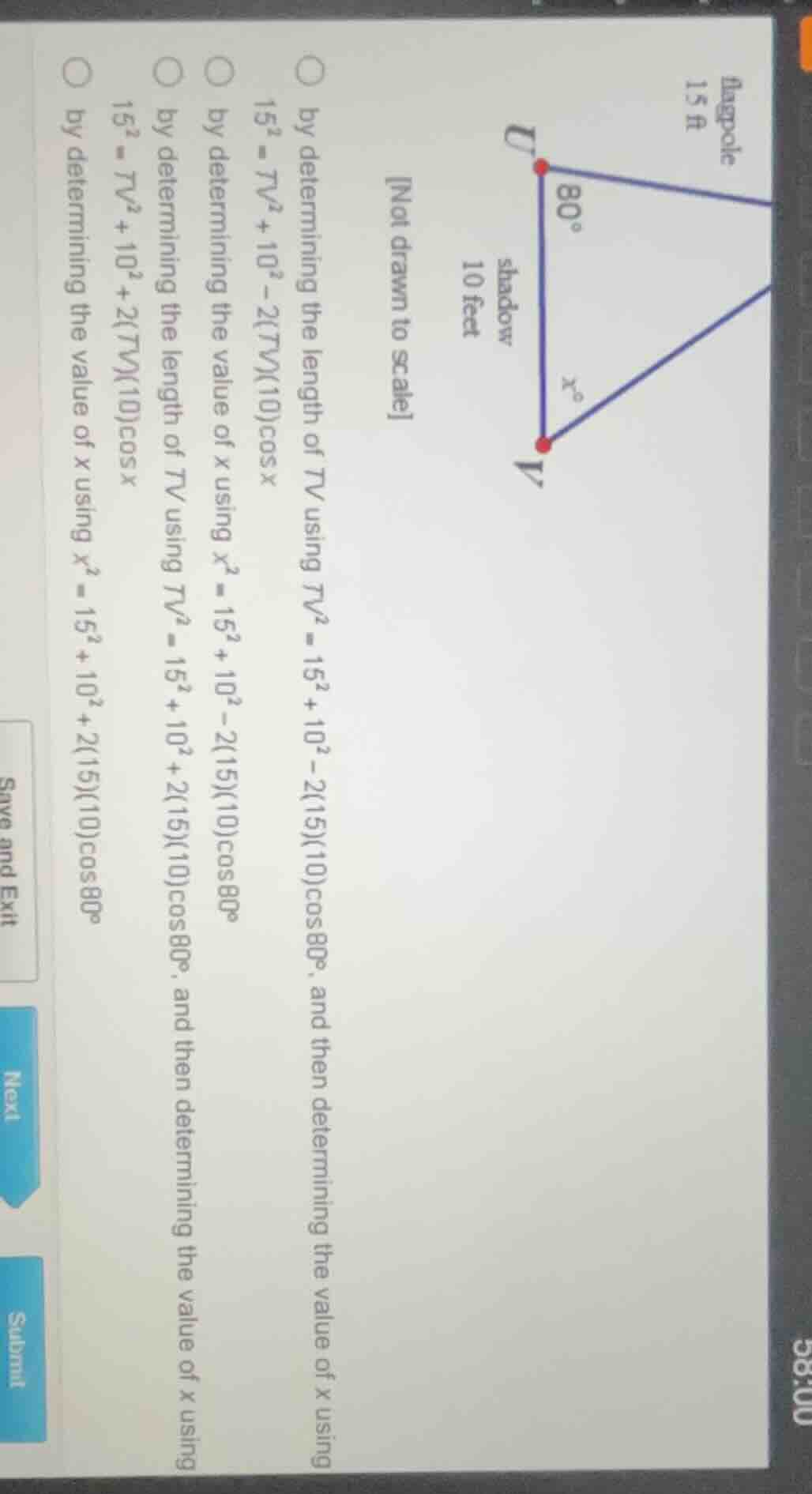
flagpole
15 ft
not drawn to scale
shadow
10 feet
by determining the length of tv using ( tv^2 = 15^2 + 10^2 - 2(15)(10)cos x ), and then determining the value of ( x ) using ( 15^2 = tv^2 + 10^2 + 2(tv)(10)cos x )
by determining the value of ( x ) using ( x^2 = 15^2 + 10^2 - 2(15)(10)cos 80^circ )
by determining the length of tv using ( tv^2 = 15^2 + 10^2 + 2(15)(10)cos 80^circ ), and then determining the value of ( x ) using ( 15^2 = tv^2 + 10^2 + 2(tv)(10)cos x )
by determining the value of ( x ) using ( x^2 = 15^2 + 10^2 + 2(15)(10)cos 80^circ )
save and exit
next
submit
To solve this, we use the Law of Cosines. Let's analyze the triangle:
Step 1: Identify the sides and angle
- One side is 15 ft (flagpole), another is 10 ft (shadow), and the included angle at \( U \) is \( 80^\circ \). We need to find angle \( x \) at \( V \).
Step 2: Apply the Law of Cosines to find \( TV \) first
The Law of Cosines states \( c^2 = a^2 + b^2 - 2ab \cos(C) \), where \( C \) is the included angle between sides \( a \) and \( b \).
For side \( TV \) (let's call it \( c \)), \( a = 15 \), \( b = 10 \), and \( C = 80^\circ \):
\[
TV^2 = 15^2 + 10^2 - 2(15)(10) \cos(80^\circ)
\]
Step 3: Then use the Law of Sines or Cosines to find \( x \)
But looking at the options, the correct approach is:
- First, find \( TV \) using \( TV^2 = 15^2 + 10^2 - 2(15)(10) \cos(80^\circ) \) (Law of Cosines with included angle \( 80^\circ \)).
- Then, use the Law of Cosines or Sines to find \( x \). However, the option that matches is: "by determining the length of \( TV \) using \( TV^2 = 15^2 + 10^2 - 2(15)(10) \cos80^\circ \), and then determining the value of \( x \) using \( 15^2 = TV^2 + 10^2 - 2(TV)(10) \cos x \)" (wait, no—let's re - check the options. Wait, the correct option is the one where we first find \( TV \) with \( TV^2 = 15^2+10^2 - 2(15)(10)\cos80^\circ \), and then use \( 15^2=TV^2 + 10^2-2(TV)(10)\cos x \) to solve for \( x \). But among the given options, the correct one is:
The correct option is: "by determining the length of \( TV \) using \( TV^2 = 15^2 + 10^2 - 2(15)(10) \cos80^\circ \), and then determining the value of \( x \) using \( 15^2 = TV^2 + 10^2 - 2(TV)(10) \cos x \)" (the first option in the list of options provided, but let's check the option text again. Wait, the option: "by determining the length of \( TV \) using \( TV^2 = 15^2 + 10^2 - 2(15)(10) \cos80^\circ \), and then determining the value of \( x \) using \( 15^2 = TV^2 + 10^2 - 2(TV)(10) \cos x \)" which is the first option (the one with \( 15^2 = TV^2 + 10^2 - 2(TV)(10) \cos x \) after finding \( TV \)).
So the correct answer is the option: "by determining the length of \( TV \) using \( TV^2 = 15^2 + 10^2 - 2(15)(10) \cos80^\circ \), and then determining the value of \( x \) using \( 15^2 = TV^2 + 10^2 - 2(TV)(10) \cos x \)" (the first option in the set of options, which is the one with \( 15^2 = TV^2 + 10^2 - 2(TV)(10) \cos x \) after finding \( TV \) with \( TV^2 = 15^2 + 10^2 - 2(15)(10) \cos80^\circ \)).
If we have to choose from the given options (the first option in the vertical list of options):
The correct option is: "by determining the length of \( TV \) using \( TV^2 = 15^2 + 10^2 - 2(15)(10) \cos80^\circ \), and then determining the value of \( x \) using \( 15^2 = TV^2 + 10^2 - 2(TV)(10) \cos x \)" (the first circular - optioned choice).

Snap & solve any problem in the app
Get step-by-step solutions on Sovi AI
Photo-based solutions with guided steps
Explore more problems and detailed explanations
To solve this, we use the Law of Cosines. Let's analyze the triangle:
Step 1: Identify the sides and angle
- One side is 15 ft (flagpole), another is 10 ft (shadow), and the included angle at \( U \) is \( 80^\circ \). We need to find angle \( x \) at \( V \).
Step 2: Apply the Law of Cosines to find \( TV \) first
The Law of Cosines states \( c^2 = a^2 + b^2 - 2ab \cos(C) \), where \( C \) is the included angle between sides \( a \) and \( b \).
For side \( TV \) (let's call it \( c \)), \( a = 15 \), \( b = 10 \), and \( C = 80^\circ \):
\[
TV^2 = 15^2 + 10^2 - 2(15)(10) \cos(80^\circ)
\]
Step 3: Then use the Law of Sines or Cosines to find \( x \)
But looking at the options, the correct approach is:
- First, find \( TV \) using \( TV^2 = 15^2 + 10^2 - 2(15)(10) \cos(80^\circ) \) (Law of Cosines with included angle \( 80^\circ \)).
- Then, use the Law of Cosines or Sines to find \( x \). However, the option that matches is: "by determining the length of \( TV \) using \( TV^2 = 15^2 + 10^2 - 2(15)(10) \cos80^\circ \), and then determining the value of \( x \) using \( 15^2 = TV^2 + 10^2 - 2(TV)(10) \cos x \)" (wait, no—let's re - check the options. Wait, the correct option is the one where we first find \( TV \) with \( TV^2 = 15^2+10^2 - 2(15)(10)\cos80^\circ \), and then use \( 15^2=TV^2 + 10^2-2(TV)(10)\cos x \) to solve for \( x \). But among the given options, the correct one is:
The correct option is: "by determining the length of \( TV \) using \( TV^2 = 15^2 + 10^2 - 2(15)(10) \cos80^\circ \), and then determining the value of \( x \) using \( 15^2 = TV^2 + 10^2 - 2(TV)(10) \cos x \)" (the first option in the list of options provided, but let's check the option text again. Wait, the option: "by determining the length of \( TV \) using \( TV^2 = 15^2 + 10^2 - 2(15)(10) \cos80^\circ \), and then determining the value of \( x \) using \( 15^2 = TV^2 + 10^2 - 2(TV)(10) \cos x \)" which is the first option (the one with \( 15^2 = TV^2 + 10^2 - 2(TV)(10) \cos x \) after finding \( TV \)).
So the correct answer is the option: "by determining the length of \( TV \) using \( TV^2 = 15^2 + 10^2 - 2(15)(10) \cos80^\circ \), and then determining the value of \( x \) using \( 15^2 = TV^2 + 10^2 - 2(TV)(10) \cos x \)" (the first option in the set of options, which is the one with \( 15^2 = TV^2 + 10^2 - 2(TV)(10) \cos x \) after finding \( TV \) with \( TV^2 = 15^2 + 10^2 - 2(15)(10) \cos80^\circ \)).
If we have to choose from the given options (the first option in the vertical list of options):
The correct option is: "by determining the length of \( TV \) using \( TV^2 = 15^2 + 10^2 - 2(15)(10) \cos80^\circ \), and then determining the value of \( x \) using \( 15^2 = TV^2 + 10^2 - 2(TV)(10) \cos x \)" (the first circular - optioned choice).