QUESTION IMAGE
Question
fluency and skills practice
lesson 5
functions continued
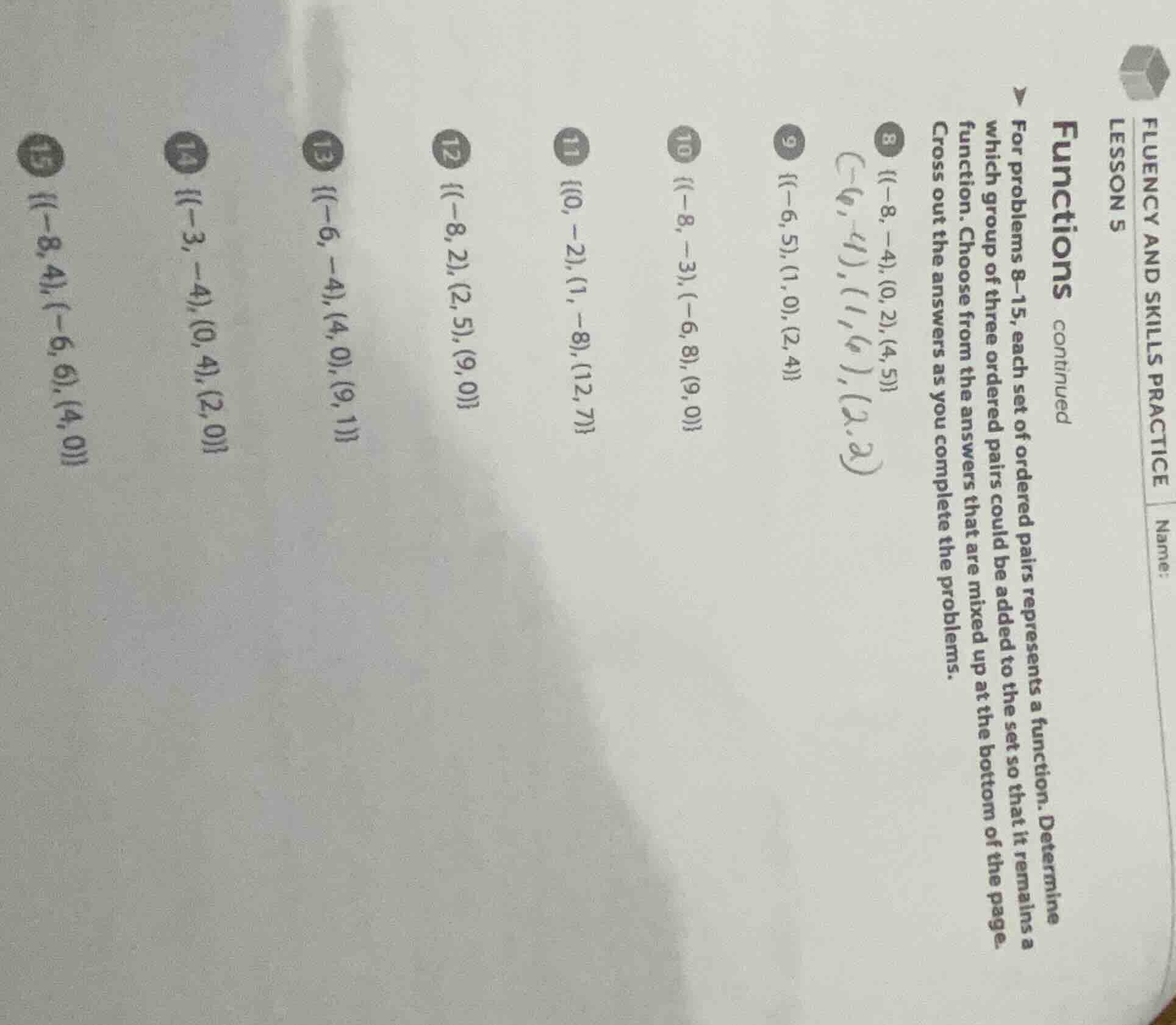
for problems 8–15, each set of ordered pairs represents a function. determine which group of three ordered pairs could be added to the set so that it remains a function. choose from the answers that are mixed up at the bottom of the page. cross out the answers as you complete the problems.
8 {(-8, -4), (0, 2), (4, 5)}
{(-6, 5), (1, 0), (2, 4)}
9 {(-6, 5), (1, 0), (2, 4)}
10 {(-8, -3), (-6, 8), (9, 0)}
11 {(0, -2), (1, -8), (12, 7)}
12 {(-8, 2), (2, 5), (9, 0)}
13 {(-6, -4), (4, 0), (9, 1)}
14 {(-3, -4), (0, 4), (2, 0)}
15 {(-8, 4), (-6, 6), (4, 0)}
To determine which ordered pair can be added to a set and still have it represent a function, we use the definition of a function: a relation where each input (x - value) has exactly one output (y - value). So we check the x - values of the given set and the candidate ordered pairs to see if there is a repeat in x - values.
Problem 8
The given set is \(\{(-8, - 4),(0,2),(4,5)\}\)
We need to check the x - values of the candidate ordered pairs \((-4,-1)\), \((1,4)\), \((2,2)\)
- For \((-4,-1)\): The x - value is \(-4\), which is not in \(\{-8,0,4\}\)
- For \((1,4)\): The x - value is \(1\), which is not in \(\{-8,0,4\}\)
- For \((2,2)\): The x - value is \(2\), which is not in \(\{-8,0,4\}\)
Wait, maybe I misread the problem. Wait, the problem says "which group of three ordered pairs could be added to the set so that it remains a function". Wait, no, looking back: "For problems 8 - 15, each set of ordered pairs represents a function. Determine which group of three ordered pairs could be added to the set so that it remains a function. Choose from the answers that are mixed up at the bottom of the page. Cross out the answers as you complete the problems."
Wait, maybe the candidate sets are the ones below. Let's take problem 8:
Given set: \(\{(-8, - 4),(0,2),(4,5)\}\)
We need to check which of the other sets (like problem 9 - 15) can be added. Wait, no, the problem is: each set (like problem 8's set) and we need to find which group (the other sets) can be added. Wait, maybe the key is that in a function, all x - values (the first elements of the ordered pairs) must be unique across the combined set.
Let's take problem 8's set: \(\text{Set}_8=\{(-8, - 4),(0,2),(4,5)\}\)
Now let's check the x - values of the other sets:
- Problem 9: \(\text{Set}_9=\{(-6,5),(1,0),(2,4)\}\). The x - values are \(-6,1,2\), none of which are in \(\{-8,0,4\}\)
- Problem 10: \(\text{Set}_{10}=\{(-8, - 3),(-6,8),(9,0)\}\). The x - value \(-8\) is already in \(\text{Set}_8\) (since \(\text{Set}_8\) has \((-8,-4)\)), so we can't add this set.
- Problem 11: \(\text{Set}_{11}=\{(0, - 2),(1, - 8),(12,7)\}\). The x - value \(0\) is already in \(\text{Set}_8\) (since \(\text{Set}_8\) has \((0,2)\)), so we can't add this set.
- Problem 12: \(\text{Set}_{12}=\{(-8,2),(2,5),(9,0)\}\). The x - value \(-8\) is already in \(\text{Set}_8\), so we can't add this set.
- Problem 13: \(\text{Set}_{13}=\{(-6, - 4),(4,0),(9,1)\}\). The x - value \(4\) is already in \(\text{Set}_8\) (since \(\text{Set}_8\) has \((4,5)\)), so we can't add this set.
- Problem 14: \(\text{Set}_{14}=\{(-3, - 4),(0,4),(2,0)\}\). The x - value \(0\) is already in \(\text{Set}_8\), so we can't add this set.
- Problem 15: \(\text{Set}_{15}=\{(-8,4),(-6,6),(4,0)\}\). The x - values \(-8\) and \(4\) are already in \(\text{Set}_8\), so we can't add this set.
So the set that can be added to \(\text{Set}_8\) is \(\text{Set}_9=\{(-6,5),(1,0),(2,4)\}\) because none of its x - values (\(-6,1,2\)) are in the x - values of \(\text{Set}_8\) (\(-8,0,4\)).
If we assume that the "group of three ordered pairs" for problem 8 is the set from problem 9, then the answer is the set \(\{(-6,5),(1,0),(2,4)\}\) (which is problem 9's set).
General Approach for Each Problem
- Identify the x - values of the original function's ordered pairs.
- For each candidate set of ordered pairs, identify their x - values.
- Check if any of the candidate set's x - values are already present in the original function's x - values.
- If there is no overlap in x - values, the candidate set can be added to the original set and th…

Snap & solve any problem in the app
Get step-by-step solutions on Sovi AI
Photo-based solutions with guided steps
Explore more problems and detailed explanations
To determine which ordered pair can be added to a set and still have it represent a function, we use the definition of a function: a relation where each input (x - value) has exactly one output (y - value). So we check the x - values of the given set and the candidate ordered pairs to see if there is a repeat in x - values.
Problem 8
The given set is \(\{(-8, - 4),(0,2),(4,5)\}\)
We need to check the x - values of the candidate ordered pairs \((-4,-1)\), \((1,4)\), \((2,2)\)
- For \((-4,-1)\): The x - value is \(-4\), which is not in \(\{-8,0,4\}\)
- For \((1,4)\): The x - value is \(1\), which is not in \(\{-8,0,4\}\)
- For \((2,2)\): The x - value is \(2\), which is not in \(\{-8,0,4\}\)
Wait, maybe I misread the problem. Wait, the problem says "which group of three ordered pairs could be added to the set so that it remains a function". Wait, no, looking back: "For problems 8 - 15, each set of ordered pairs represents a function. Determine which group of three ordered pairs could be added to the set so that it remains a function. Choose from the answers that are mixed up at the bottom of the page. Cross out the answers as you complete the problems."
Wait, maybe the candidate sets are the ones below. Let's take problem 8:
Given set: \(\{(-8, - 4),(0,2),(4,5)\}\)
We need to check which of the other sets (like problem 9 - 15) can be added. Wait, no, the problem is: each set (like problem 8's set) and we need to find which group (the other sets) can be added. Wait, maybe the key is that in a function, all x - values (the first elements of the ordered pairs) must be unique across the combined set.
Let's take problem 8's set: \(\text{Set}_8=\{(-8, - 4),(0,2),(4,5)\}\)
Now let's check the x - values of the other sets:
- Problem 9: \(\text{Set}_9=\{(-6,5),(1,0),(2,4)\}\). The x - values are \(-6,1,2\), none of which are in \(\{-8,0,4\}\)
- Problem 10: \(\text{Set}_{10}=\{(-8, - 3),(-6,8),(9,0)\}\). The x - value \(-8\) is already in \(\text{Set}_8\) (since \(\text{Set}_8\) has \((-8,-4)\)), so we can't add this set.
- Problem 11: \(\text{Set}_{11}=\{(0, - 2),(1, - 8),(12,7)\}\). The x - value \(0\) is already in \(\text{Set}_8\) (since \(\text{Set}_8\) has \((0,2)\)), so we can't add this set.
- Problem 12: \(\text{Set}_{12}=\{(-8,2),(2,5),(9,0)\}\). The x - value \(-8\) is already in \(\text{Set}_8\), so we can't add this set.
- Problem 13: \(\text{Set}_{13}=\{(-6, - 4),(4,0),(9,1)\}\). The x - value \(4\) is already in \(\text{Set}_8\) (since \(\text{Set}_8\) has \((4,5)\)), so we can't add this set.
- Problem 14: \(\text{Set}_{14}=\{(-3, - 4),(0,4),(2,0)\}\). The x - value \(0\) is already in \(\text{Set}_8\), so we can't add this set.
- Problem 15: \(\text{Set}_{15}=\{(-8,4),(-6,6),(4,0)\}\). The x - values \(-8\) and \(4\) are already in \(\text{Set}_8\), so we can't add this set.
So the set that can be added to \(\text{Set}_8\) is \(\text{Set}_9=\{(-6,5),(1,0),(2,4)\}\) because none of its x - values (\(-6,1,2\)) are in the x - values of \(\text{Set}_8\) (\(-8,0,4\)).
If we assume that the "group of three ordered pairs" for problem 8 is the set from problem 9, then the answer is the set \(\{(-6,5),(1,0),(2,4)\}\) (which is problem 9's set).
General Approach for Each Problem
- Identify the x - values of the original function's ordered pairs.
- For each candidate set of ordered pairs, identify their x - values.
- Check if any of the candidate set's x - values are already present in the original function's x - values.
- If there is no overlap in x - values, the candidate set can be added to the original set and the combined set will still be a function.
For example, for problem 8, the original set has x - values \(-8,0,4\). The set from problem 9 has x - values \(-6,1,2\), so there is no overlap. So we can add the set from problem 9 to the set from problem 8 and still have a function.