QUESTION IMAGE
Question
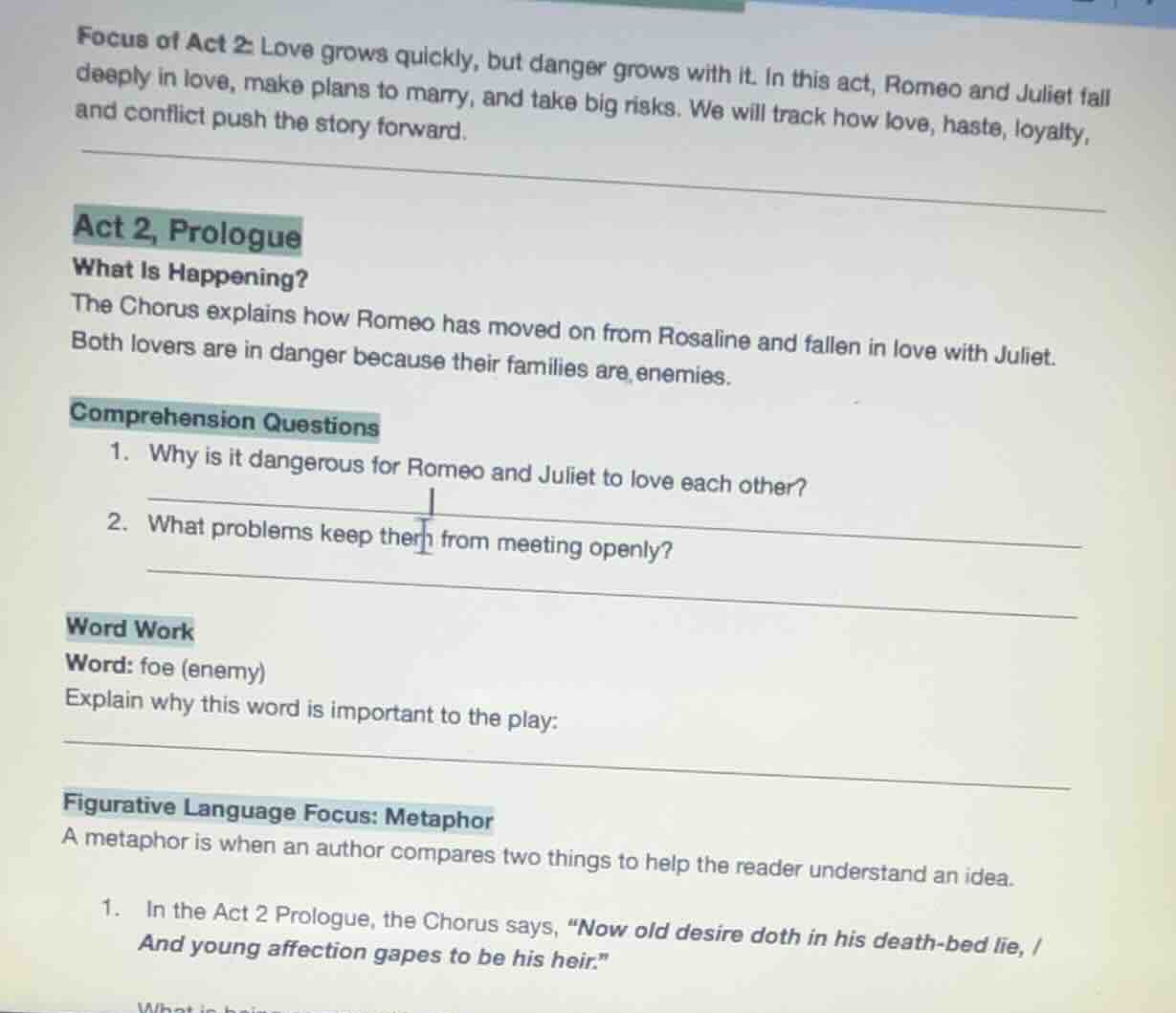
focus of act 2: love grows quickly, but danger grows with it. in this act, romeo and juliet fall deeply in love, make plans to marry, and take big risks. we will track how love, haste, loyalty, and conflict push the story forward.
act 2, prologue
what is happening?
the chorus explains how romeo has moved on from rosaline and fallen in love with juliet.
both lovers are in danger because their families are enemies.
comprehension questions
- why is it dangerous for romeo and juliet to love each other?
- what problems keep them from meeting openly?
word work
word: foe (enemy)
explain why this word is important to the play:
figurative language focus: metaphor
a metaphor is when an author compares two things to help the reader understand an idea.
- in the act 2 prologue, the chorus says, “now old desire doth in his death - bed lie, / and young affection gapes to be his heir.”
- For the first comprehension question: The core conflict of the play is the violent, long-standing feud between Romeo's family (the Montagues) and Juliet's family (the Capulets). Any romantic connection between members of the two households would be seen as a betrayal by both sides, putting them at risk of anger, violence, or punishment from their families and the broader Verona community.
- For the second comprehension question: The same bitter, public feud between their families prevents open meetings. If they were seen together openly, it would ignite further conflict, endanger both of their safety, and likely lead to their families intervening to end their relationship forcefully.
- For the Word Work question: The word "foe" encapsulates the central, foundational conflict of Romeo and Juliet. It defines the hostile relationship between the Montagues and Capulets, which is the root cause of all the danger, secrecy, and tragedy that befalls Romeo and Juliet.
- For the Figurative Language question (partial prompt): The metaphor compares Romeo's former unrequited love for Rosaline ("old desire") to a dying man on his deathbed, and his new, intense love for Juliet ("young affection") to an heir waiting to take the place of the dying man. This explains how Romeo has completely abandoned his feelings for Rosaline and fully embraced his love for Juliet.

Snap & solve any problem in the app
Get step-by-step solutions on Sovi AI
Photo-based solutions with guided steps
Explore more problems and detailed explanations
- It is dangerous because Romeo (a Montague) and Juliet (a Capulet) come from families that are bitter, long-standing enemies, and their love would be seen as a betrayal by both households, putting them at risk of violence or punishment.
- The violent, public feud between their rival families (the Montagues and Capulets) keeps them from meeting openly, as being seen together would spark more conflict and put their safety in jeopardy.
- "Foe" is important because it names the core, foundational conflict of the play: the hostile relationship between the Montagues and Capulets, which is the source of all the danger and tragedy for Romeo and Juliet.
- The metaphor compares Romeo's old, fading love for Rosaline to a dying man on his deathbed, and his new, passionate love for Juliet to an heir ready to replace the dying man. This illustrates that Romeo's feelings for Rosaline are completely gone, replaced by his intense love for Juliet.