QUESTION IMAGE
Question
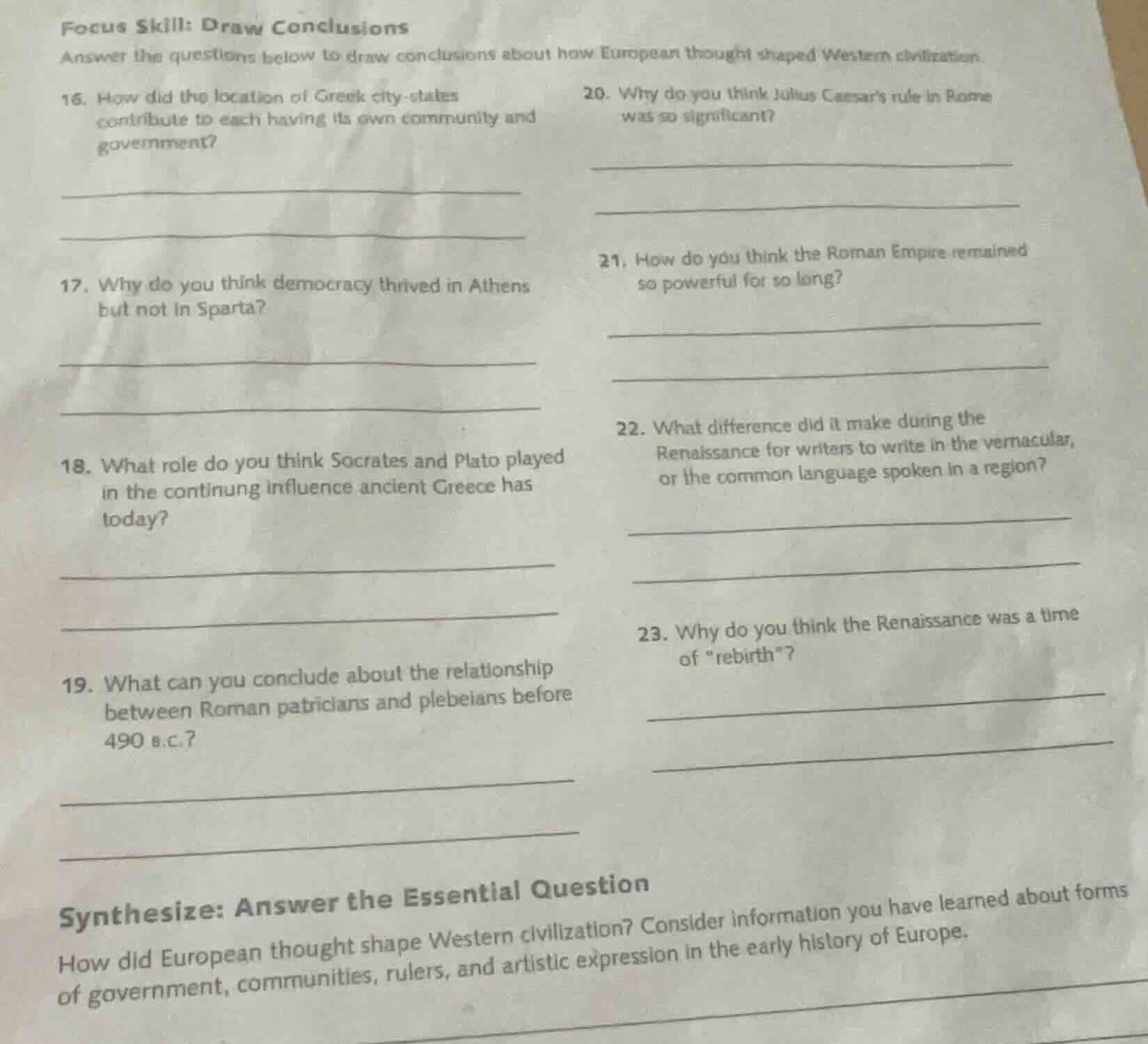
focus skill: draw conclusions
answer the questions below to draw conclusions about how european thought shaped western civilization.
- how did the location of greek city-states contribute to each having its own community and government?
- why do you think democracy thrived in athens but not in sparta?
- what role do you think socrates and plato played in the continuing influence ancient greece has today?
- what can you conclude about the relationship between roman patricians and plebeians before 490 b.c.?
- why do you think julius caesars rule in rome was so significant?
- how do you think the roman empire remained so powerful for so long?
- what difference did it make during the renaissance for writers to write in the vernacular, or the common language spoken in a region?
- why do you think the renaissance was a time of
ebirth\?
synthesize: answer the essential question
how did european thought shape western civilization? consider information you have learned about forms of government, communities, rulers, and artistic expression in the early history of europe.
Brief Explanations
- Greek city-states were separated by mountains, seas, and valleys, creating geographic isolation. This made large centralized control difficult, so each small, isolated community developed its own self-governing system.
- Athens focused on trade, education, and citizen participation, creating a culture that valued debate and individual input in governance. Sparta was a militaristic oligarchy focused on controlling a slave population, so it suppressed broad citizen power.
- Socrates and Plato founded Western philosophical thought: Socrates developed the Socratic method (critical questioning) still used in education, and Plato's works on ethics, politics, and epistemology laid the foundation for Western philosophical and political frameworks that persist today.
- Before 490 B.C., patricians (wealthy landowners) held all political power, while plebeians (common people) had no political rights, leading to a highly unequal, stratified relationship with growing tensions.
- Julius Caesar expanded Rome's territory, reformed the government to stabilize the republic, implemented social and economic reforms (like land redistribution for the poor), and laid the groundwork for the Roman Empire, shifting Rome from a republic to an imperial system.
- The Roman Empire maintained power through a strong, centralized government, efficient military, legal system that unified diverse peoples, infrastructure (roads, aqueducts) that connected regions, and the ability to integrate conquered cultures while spreading Roman laws and culture.
- Writing in the vernacular made literature, ideas, and knowledge accessible to ordinary people (not just educated elites who knew Latin/Greek), spreading Renaissance humanist ideas more widely and fostering national cultural identities.
- The Renaissance was a "rebirth" because it revived interest in the art, philosophy, science, and literature of ancient Greece and Rome, which had been largely overlooked during the medieval period, while also sparking new innovations in art, science, and thought.
- European thought shaped Western civilization by establishing foundational systems: Greek democracy and philosophy laid the groundwork for modern political theory and critical thinking; Roman law and governance created models for modern legal systems and administration; the Renaissance revived classical ideas and sparked humanism, which influenced modern art, science, and individual rights, all of which form the core of Western cultural, political, and intellectual structures.

Snap & solve any problem in the app
Get step-by-step solutions on Sovi AI
Photo-based solutions with guided steps
Explore more problems and detailed explanations
- Greek city-states were geographically isolated by mountains, seas, and valleys, which prevented a single central government from forming. Each small, separated community developed its own independent government and community structure.
- Athens prioritized trade, education, and citizen engagement, fostering a culture that supported democratic participation. Sparta was a militaristic oligarchy focused on controlling a large enslaved population, so it restricted power to a small elite rather than allowing broad democracy.
- Socrates and Plato established the foundation of Western philosophy: Socrates' critical questioning method (Socratic method) remains a core part of modern education and critical thinking, while Plato's writings on politics, ethics, and knowledge shaped Western political and philosophical frameworks that are still influential today.
- Before 490 B.C., the relationship was deeply unequal: patricians (wealthy landowning elite) held all political power, while plebeians (common people, including farmers and artisans) had no political representation, leading to growing class tensions.
- Julius Caesar expanded Roman territory, stabilized the declining Roman Republic through government reforms, implemented social and economic changes to support the poor, and laid the structural groundwork for the transition from the Roman Republic to the Roman Empire, permanently altering Rome's political system.
- The Roman Empire remained powerful due to a centralized, efficient government, a professional and organized military, a unified legal system that applied across diverse regions, extensive infrastructure (roads, aqueducts) that connected and integrated territories, and its ability to absorb and integrate conquered cultures while spreading Roman norms.
- Writing in the vernacular made Renaissance ideas, literature, and knowledge accessible to ordinary people (not just educated elites who knew Latin or Greek), accelerating the spread of humanist thought, fostering regional cultural identities, and expanding literacy among non-elite groups.
- The Renaissance was a "rebirth" because it revived widespread interest in the art, philosophy, science, and literature of ancient Greece and Rome, which had been marginalized during the medieval period, while also spawning new, innovative developments in art, science, and human-centered thought.
- European thought shaped Western civilization through multiple foundational contributions: Greek democracy and philosophy created the basis for modern political theory and critical thinking; Roman legal and governance systems provided models for modern legal structures and administrative practices; the Renaissance revived classical ideas and sparked humanism, which influenced modern art, science, and the emphasis on individual rights, all combining to form the core of Western cultural, political, and intellectual traditions.