QUESTION IMAGE
Question
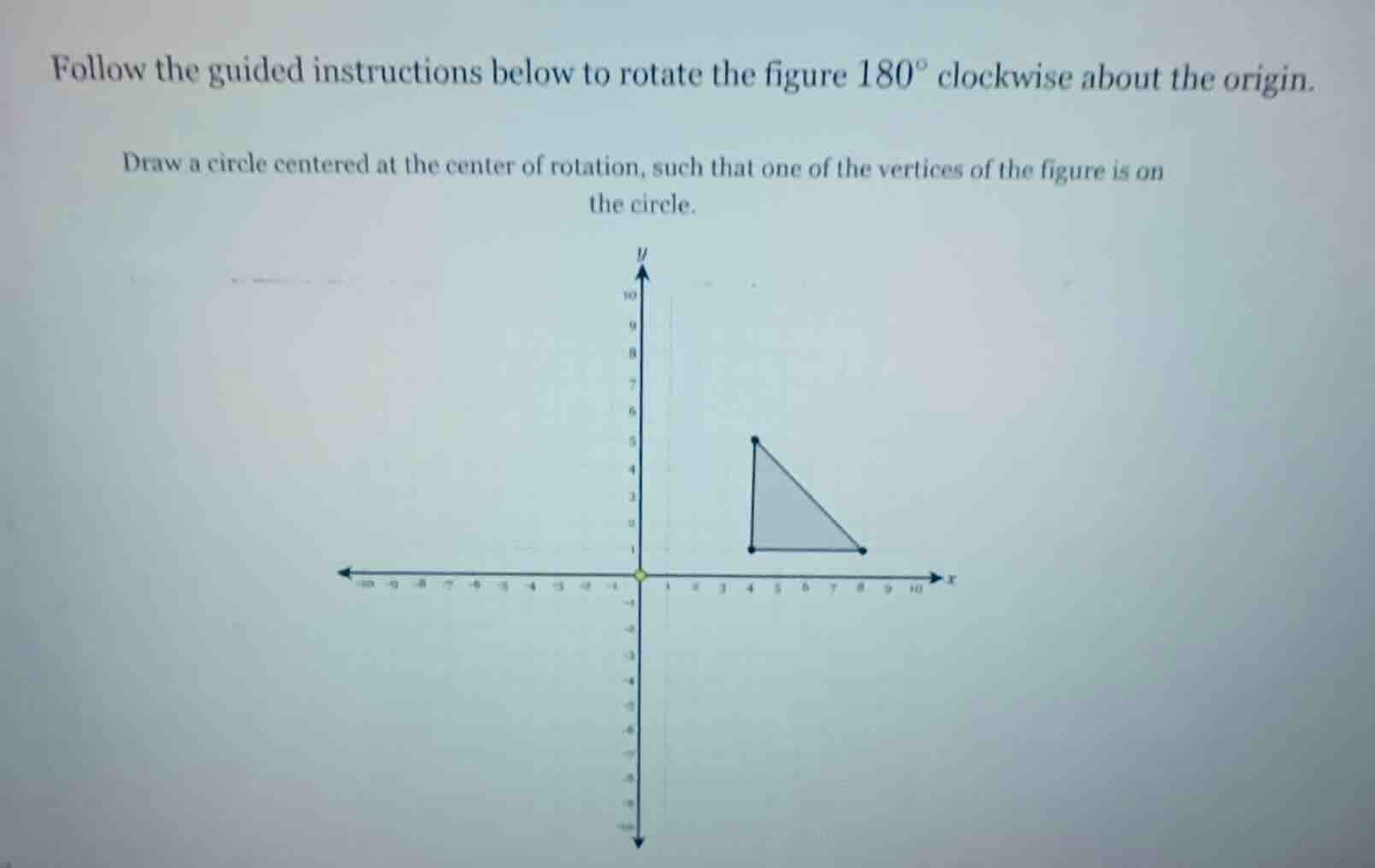
follow the guided instructions below to rotate the figure 180° clockwise about the origin. draw a circle centered at the center of rotation, such that one of the vertices of the figure is on the circle.
Step1: Identify a vertex
Let's take one vertex of the triangle, say the vertex at \((4, 1)\).
Step2: Determine the center of rotation
The center of rotation is the origin \((0, 0)\).
Step3: Calculate the radius of the circle
The distance from the origin \((0, 0)\) to the point \((4, 1)\) is given by the distance formula \(d = \sqrt{(x_2 - x_1)^2+(y_2 - y_1)^2}\). Here, \(x_1 = 0\), \(y_1 = 0\), \(x_2 = 4\), \(y_2 = 1\). So \(d=\sqrt{(4 - 0)^2+(1 - 0)^2}=\sqrt{16 + 1}=\sqrt{17}\).
Step4: Draw the circle
Using a compass (or in a coordinate - geometric sense), draw a circle centered at \((0,0)\) with radius \(\sqrt{17}\). This circle will pass through the point \((4,1)\) (and we could do the same for other vertices as well, but we just need to do it for one vertex as per the instruction).
(Note: If we take another vertex, say the vertex at \((5,5)\), the distance from the origin \((0,0)\) to \((5,5)\) is \(d=\sqrt{(5 - 0)^2+(5 - 0)^2}=\sqrt{25 + 25}=\sqrt{50} = 5\sqrt{2}\), and we can draw a circle centered at the origin with radius \(5\sqrt{2}\) passing through \((5,5)\) too. Either vertex can be used to draw the required circle.)

Snap & solve any problem in the app
Get step-by-step solutions on Sovi AI
Photo-based solutions with guided steps
Explore more problems and detailed explanations
To draw the circle:
- Select a vertex of the triangle (e.g., \((4,1)\) or \((5,5)\) or the third vertex).
- Find the distance from the origin (center of rotation) to this vertex using the distance formula \(d=\sqrt{(x - 0)^2+(y - 0)^2}=\sqrt{x^{2}+y^{2}}\) (where \((x,y)\) is the coordinates of the vertex).
- Draw a circle centered at the origin with this distance as the radius. For example, if we choose the vertex \((4,1)\), the circle has center \((0,0)\) and radius \(\sqrt{17}\), and it passes through \((4,1)\).