QUESTION IMAGE
Question
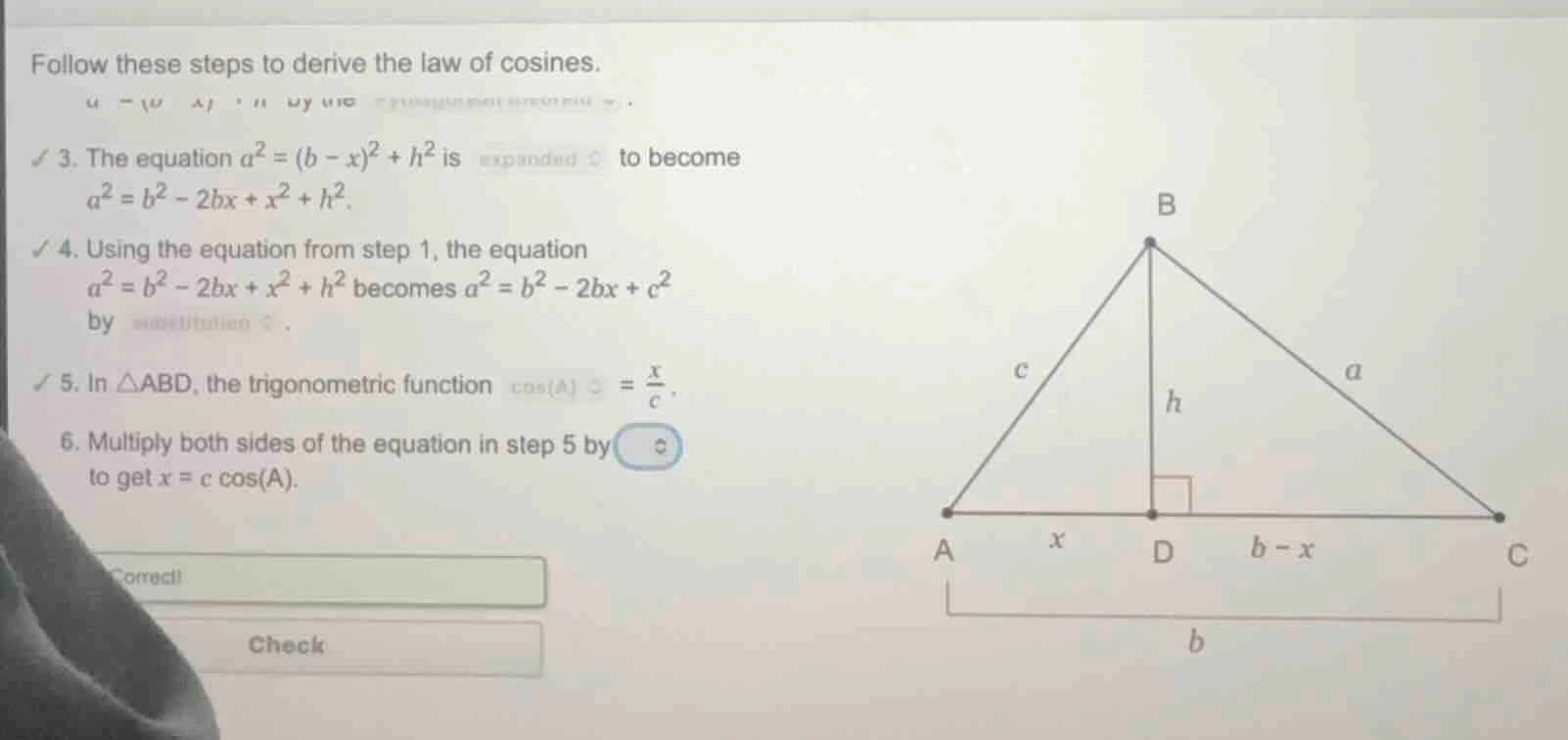
follow these steps to derive the law of cosines.
✓ 3. the equation $a^{2}=(b-x)^{2}+h^{2}$ is expanded to become $a^{2}=b^{2}-2bx+x^{2}+h^{2}$.
✓ 4. using the equation from step 1, the equation $a^{2}=b^{2}-2bx+x^{2}+h^{2}$ becomes $a^{2}=b^{2}-2bx+c^{2}$ by substitution.
✓ 5. in $\triangle abd$, the trigonometric function $\cos(a)=\frac{x}{c}$.
- multiply both sides of the equation in step 5 by to get $x = c \cos(a)$.
Step1: Identify step 5 equation
$\cos(A) = \frac{x}{c}$
Step2: Isolate $x$ via multiplication
Multiply both sides by $c$:
$c \times \cos(A) = c \times \frac{x}{c}$
Simplify to get $x = c\cos(A)$

Snap & solve any problem in the app
Get step-by-step solutions on Sovi AI
Photo-based solutions with guided steps
Explore more problems and detailed explanations
The missing value to multiply both sides by is $\boldsymbol{c}$ (which is already correctly identified in the image, and this completes the derivation step for the Law of Cosines).