QUESTION IMAGE
Question
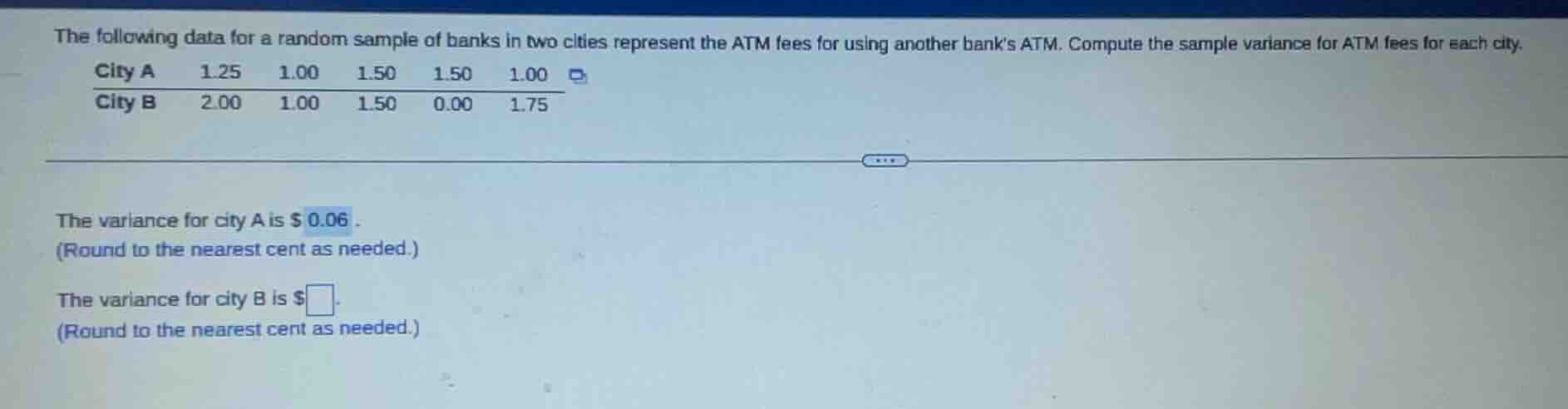
the following data for a random sample of banks in two cities represent the atm fees for using another banks atm. compute the sample variance for atm fees for each city.
city a 1.25 1.00 1.50 1.50 1.00
city b 2.00 1.00 1.50 0.00 1.75
the variance for city a is $0.06 .
(round to the nearest cent as needed.)
the variance for city b is $□.
(round to the nearest cent as needed.)
Step1: Calculate City B's mean
First, find the average of City B's fees.
$$\bar{x}_B = \frac{2.00 + 1.00 + 1.50 + 0.00 + 1.75}{5} = \frac{6.25}{5} = 1.25$$
Step2: Compute squared deviations
Subtract mean from each value, square the result.
$$(2.00-1.25)^2 = 0.5625, \quad (1.00-1.25)^2 = 0.0625$$
$$(1.50-1.25)^2 = 0.0625, \quad (0.00-1.25)^2 = 1.5625$$
$$(1.75-1.25)^2 = 0.25$$
Step3: Sum squared deviations
Add all squared deviation values.
$$0.5625 + 0.0625 + 0.0625 + 1.5625 + 0.25 = 2.5$$
Step4: Calculate sample variance
Divide sum by $n-1$ (sample size minus 1).
$$s_B^2 = \frac{2.5}{5-1} = \frac{2.5}{4} = 0.625$$
Step5: Round to nearest cent
Round the variance to two decimal places.
$$0.625 \approx 0.63$$

Snap & solve any problem in the app
Get step-by-step solutions on Sovi AI
Photo-based solutions with guided steps
Explore more problems and detailed explanations
The variance for city A is $\$0.06$
The variance for city B is $\$0.63$