QUESTION IMAGE
Question
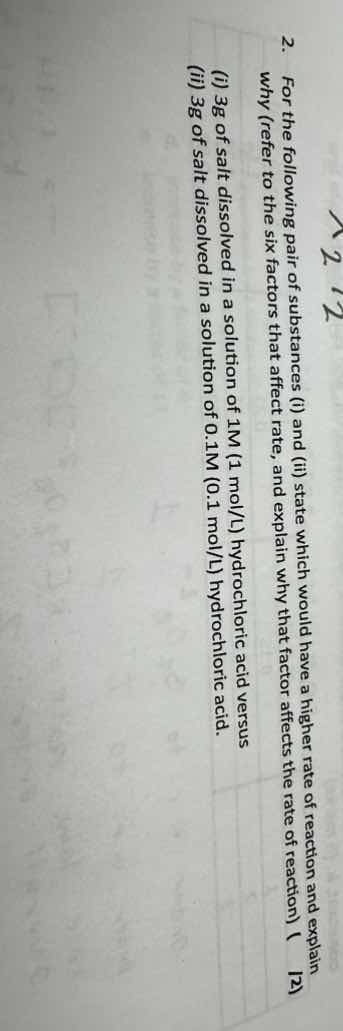
- for the following pair of substances (i) and (ii) state which would have a higher rate of reaction and explain why (refer to the six factors that affect rate, and explain why that factor affects the rate of reaction) 2
(i) 3g of salt dissolved in a solution of 1m (1 mol/l) hydrochloric acid versus
(ii) 3g of salt dissolved in a solution of 0.1m (0.1 mol/l) hydrochloric acid.
To solve this, we analyze the reaction rate factors (like concentration, surface area, etc.) for the two cases:
Part (i): 3g of salt in 1M HCl
Part (ii): 3g of salt in 0.1M HCl
Step 1: Identify the Relevant Factor
The key factor here is concentration of the acid (since the mass of salt is the same, surface area/amount of reactant is constant). Reaction rate is proportional to reactant concentration (from collision theory: higher concentration → more frequent collisions).
Step 2: Compare Concentrations
- 1M HCl has a higher concentration of \( \text{H}^+ \) (or \( \text{HCl} \)) than 0.1M HCl.
Step 3: Relate Concentration to Reaction Rate
A higher concentration of HCl means more frequent collisions between \( \text{H}^+ \) (from HCl) and the salt (reactant). Thus, the reaction (dissolution of salt in acid) will be faster in 1M HCl.

Snap & solve any problem in the app
Get step-by-step solutions on Sovi AI
Photo-based solutions with guided steps
Explore more problems and detailed explanations
The pair (i) (3g of salt in 1M HCl) has a higher reaction rate. This is because the concentration of the hydrochloric acid (1M) is higher than in (ii) (0.1M), and reaction rate increases with reactant concentration (more frequent collisions between acid ions and salt particles).