QUESTION IMAGE
Question
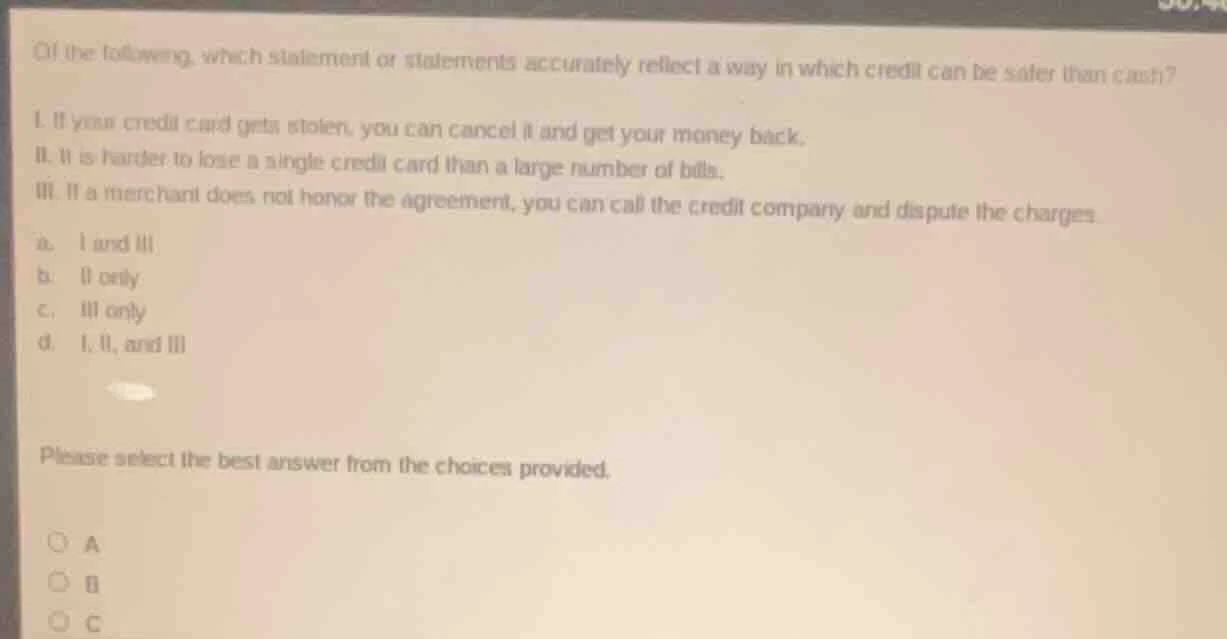
of the following, which statement or statements accurately reflect a way in which credit can be safer than cash?
i. if your credit card gets stolen, you can cancel it and get your money back.
ii. it is harder to lose a single credit card than a large number of bills.
iii. if a merchant does not honor the agreement, you can call the credit company and dispute the charges.
a. i and iii
b. ii only
c. iii only
d. i, ii, and iii
please select the best answer from the choices provided.
○ a
○ b
○ c
- For Statement I: If a credit card is stolen, canceling it and getting money back (via fraud protection) is a safety feature, so I is valid.
- For Statement II: Losing one credit card is easier than losing many bills? No, a single card is easier to misplace than multiple bills? Wait, no—wait, the statement says "harder to lose a single credit card than a large number of bills". Actually, a single card is easier to lose than many bills? Wait, no, maybe the logic is that carrying one card is better than carrying many bills (so less to lose). Wait, maybe the statement is that it's harder to lose one card (vs many bills) in terms of quantity—losing one card is a single item, losing many bills is multiple. So II is saying that losing the card is harder (i.e., less likely) than losing many bills. So if you carry a card instead of many bills, you have less to lose, so II is valid.
- For Statement III: Disputing charges with the credit company when a merchant fails to honor the agreement is a safety feature, so III is valid.
Thus, I, II, and III are all valid, so the correct option is d. But wait, let's re - check:
Wait, Statement II: "It is harder to lose a single credit card than a large number of bills." If you have a single credit card, compared to a large number of bills, the credit card is one item, bills are many. So losing one item (card) is less likely (harder) than losing many items (bills)? Wait, no—losing a single card is easier than losing many bills? Wait, maybe the intended meaning is that carrying a credit card (one item) is better than carrying many bills (multiple items) because you have fewer things to lose. So the statement is saying that losing the card (one thing) is harder (i.e., less probable) than losing many bills (many things). So in terms of safety, using a card instead of many bills means you have less to lose, so II is a valid safety aspect.
Statement I: If the card is stolen, you can cancel it and get your money back (through fraud protection), so that's a safety feature.
Statement III: Disputing charges is a way to get your money back if the merchant doesn't fulfill the agreement, so that's a safety feature.
So all three statements are valid, so the answer is d. But in the options, option d is "I, II, and III".
Wait, but in the given options, the choices are:
a. I and III
b. II only
c. III only
d. I, II, and III
So the correct answer is d. But in the radio buttons, the options are A, B, C (maybe a typo, but the options in the question are a, b, c, d, and the radio buttons are A, B, C—maybe the radio buttons are mislabeled, but the correct option is d (I, II, and III).

Snap & solve any problem in the app
Get step-by-step solutions on Sovi AI
Photo-based solutions with guided steps
Explore more problems and detailed explanations
d. I, II, and III