QUESTION IMAGE
Question
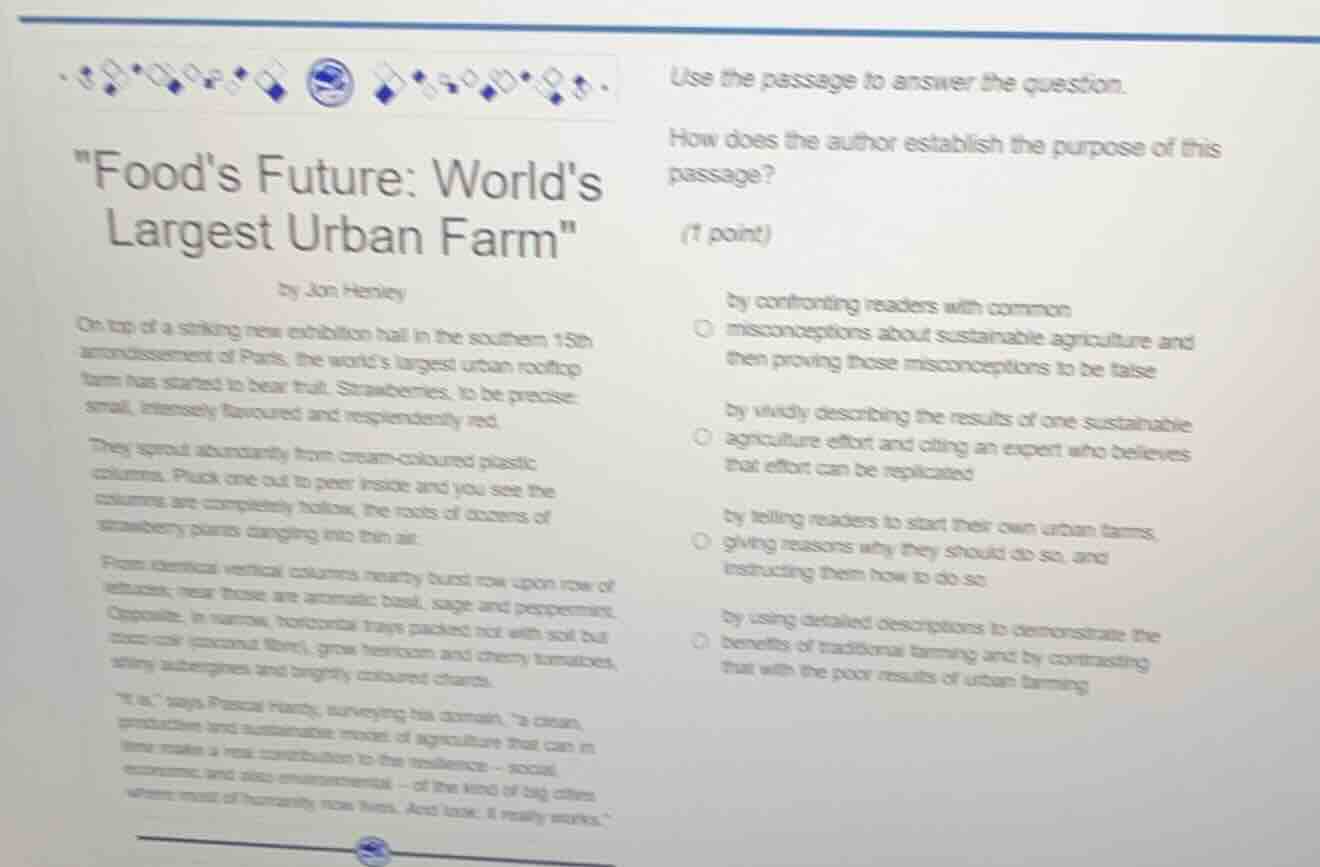
foods future: worlds largest urban farm by jon henley on top of a striking new exhibition hall in the southern 15th arrondissement of paris, the world’s largest urban rooftop farm has started to bear fruit. strawberries, to be precise: small, intensely flavoured and resplendently red. they sprout abundantly from cream - coloured plastic columns. pluck one out to peer inside and you see the columns are completely hollow, the roots of dozens of strawberry plants dangling into thin air. from identical vertical columns nearby burst row upon row of lettuce; near those, are aromatic basil, sage and peppermint. opposite, in narrow, horizontal trays packed not with soil but rock wool (coconut fibre), grow heirloom and cherry tomatoes, shiny aubergines and brightly coloured chards. “it is,” says pascal hardy, surveying his domain, “a clean, productive and sustainable model of agriculture that can in time make a real contribution to the resilience - social, economic, and also environmental - of the kind of big cities where most of humanity now lives. and look, it really works.” use the passage to answer the question. how does the author establish the purpose of this passage? (1 point) by confronting readers with common misconceptions about sustainable agriculture and then proving those misconceptions to be false by vividly describing the results of one sustainable agriculture effort and citing an expert who believes that effort can be replicated by telling readers to start their own urban farms, giving reasons why they should do so, and instructing them how to do so by using detailed descriptions to demonstrate the benefits of traditional farming and by contrasting that with the poor results of urban farming
- Analyze Option 1: The passage doesn't start by confronting misconceptions. It describes the farm first, so this is incorrect.
- Analyze Option 2: The passage vividly describes the urban farm (strawberries, vertical columns with lettuce, herbs, tomatoes, etc.) and includes a quote from Pascal Hardy who says the model is replicable. This matches the option's description.
- Analyze Option 3: The passage doesn't tell readers to start their own urban farms or instruct them on how to do so. It focuses on describing the existing farm. So this is incorrect.
- Analyze Option 4: The passage is about an urban farm, not traditional farming, and it shows the success of the urban farm, not poor results. So this is incorrect.

Snap & solve any problem in the app
Get step-by-step solutions on Sovi AI
Photo-based solutions with guided steps
Explore more problems and detailed explanations
B. by vividly describing the results of one sustainable agriculture effort and citing an expert who believes that effort can be replicated