QUESTION IMAGE
Question
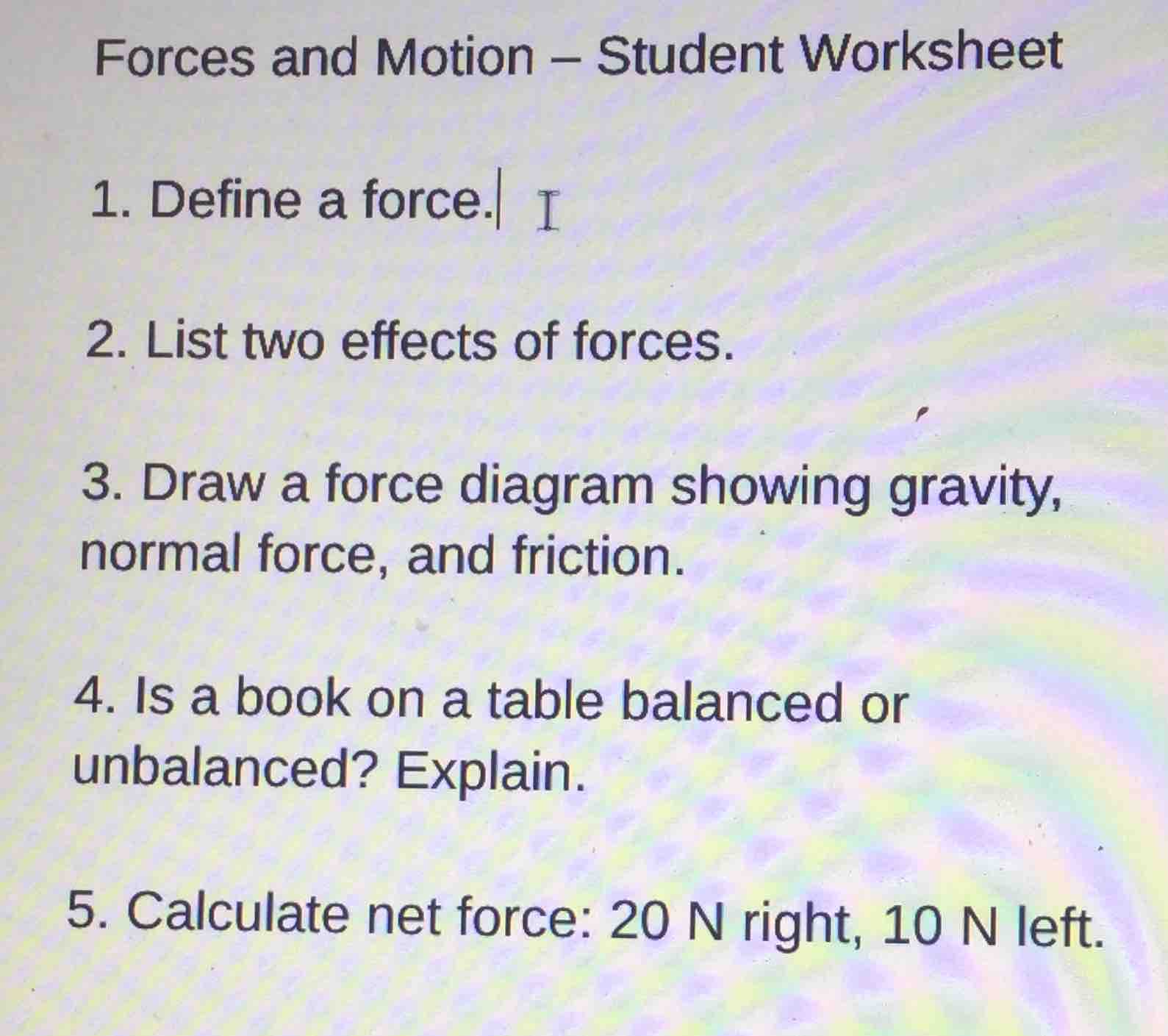
forces and motion – student worksheet
- define a force.
- list two effects of forces.
- draw a force diagram showing gravity, normal force, and friction.
- is a book on a table balanced or unbalanced? explain.
- calculate net force: 20 n right, 10 n left.
Question 1: Define a force.
A force is a push or pull on an object resulting from its interaction with another object. Forces can cause changes in an object's motion (like starting, stopping, or changing direction) or in its shape. In physics, force is a vector quantity, meaning it has both magnitude (size) and direction, and is measured in newtons (N).
Forces can alter an object's state of motion. For example, a force can make a stationary object start moving (like pushing a stationary cart) or make a moving object stop (like applying brakes to a car). Additionally, forces can change the shape of an object, such as compressing a spring or stretching a rubber band.
To draw a force diagram (free - body diagram) for an object (e.g., a book sliding on a table or a box on an incline), follow these steps:
- Identify the object: Let's take a book sliding on a horizontal table as an example.
- Gravity (Weight): Draw a downward - pointing arrow from the center of the object, labeled \( F_g \) (or \( W \)) to represent the force of gravity pulling the object towards the Earth.
- Normal Force: Draw an upward - pointing arrow from the bottom of the object (where it contacts the table), labeled \( F_N \) (or \( N \)). This force is perpendicular to the surface (for a horizontal table, it is vertical) and is exerted by the table to support the object, balancing the force of gravity in the vertical direction (if the object is on a horizontal surface and not accelerating vertically).
- Friction: If the object is moving (or has a tendency to move) relative to the surface, draw a frictional force arrow. For a book sliding to the right on the table, the kinetic friction force \( F_f \) (or \( f \)) acts to the left (opposing the motion), parallel to the surface.
For an object on an inclined plane:
- Gravity still acts downward from the center.
- The normal force acts perpendicular to the incline (not vertical).
- Friction (if present) acts parallel to the incline, opposing the motion (or tendency to move) of the object.
The diagram should have the object represented as a simple shape (like a rectangle), with arrows for each force labeled clearly.

Snap & solve any problem in the app
Get step-by-step solutions on Sovi AI
Photo-based solutions with guided steps
Explore more problems and detailed explanations
A force is a push or pull acting on an object, arising from its interaction with another object, capable of causing changes in the object’s motion (e.g., accelerating, decelerating, changing direction) or shape; it is a vector quantity (with magnitude and direction) measured in newtons (N).