QUESTION IMAGE
Question
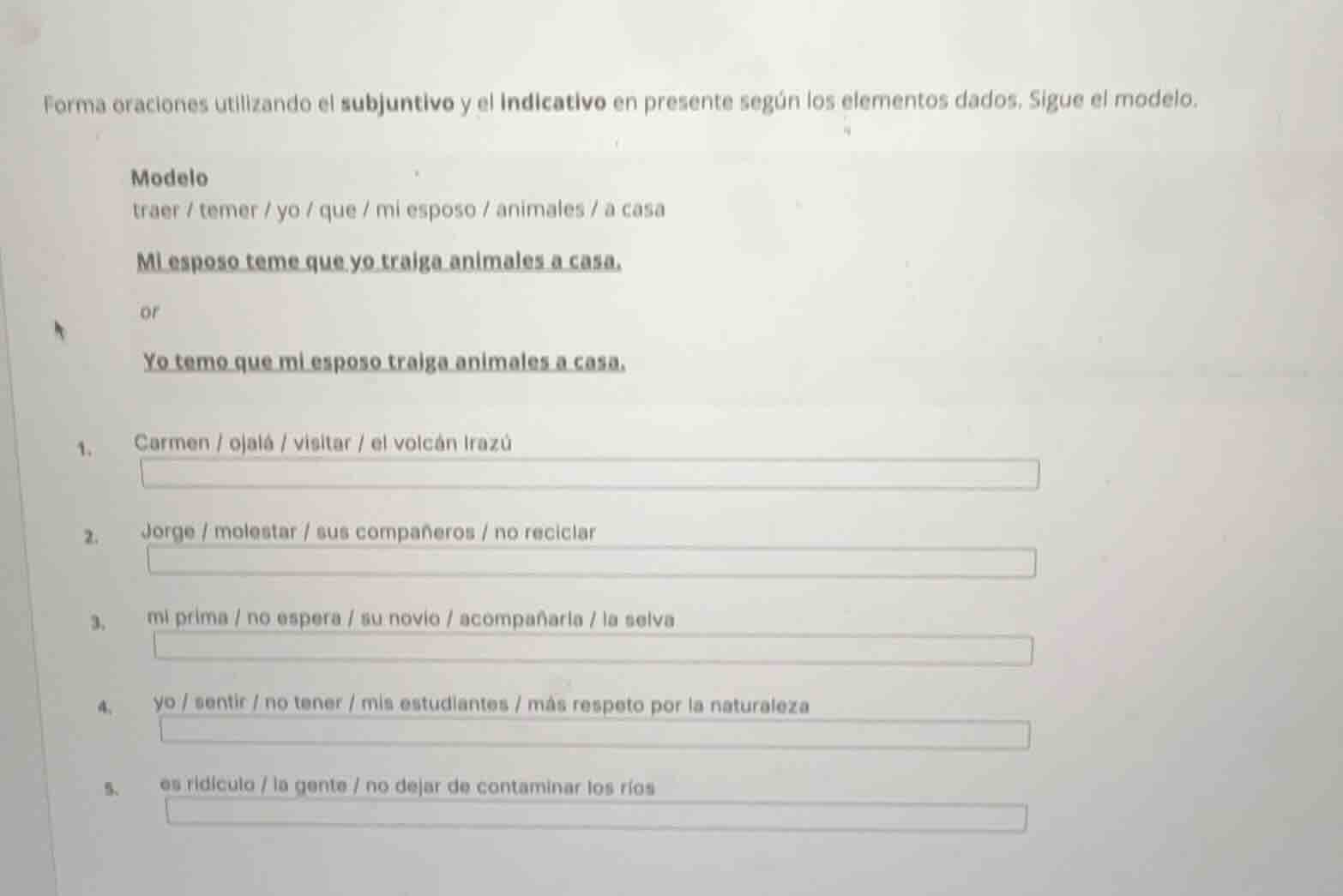
forma oraciones utilizando el subjuntivo y el indicativo en presente según los elementos dados. sigue el modelo.
modelo
traer / temer / yo / que / mi esposo / animales / a casa
mi esposo teme que yo traiga animales a casa.
or
yo temo que mi esposo traiga animales a casa.
- carmen / ojalá / visitar / el volcán irazú
- jorge / molestar / sus compañeros / no reciclar
- mi prima / no espera / su novio / acompañarla / la selva
- yo / sentir / no tener / mis estudiantes / más respeto por la naturaleza
- es ridículo / la gente / no dejar de contaminar los ríos
1. Carmen / ojalá / visitar / el volcán Irazú
"Ojalá" is used with the subjunctive to express a wish or hope. The verb "visitar" in the subjunctive for "Carmen" (third - person singular) is "visite". So we form the sentence as "Carmen ojalá que visite el volcán Irazú" or more commonly "Ojalá que Carmen visite el volcán Irazú".
The structure here is that Jorge is bothered by his classmates not recycling. The verb "molestar" is in the indicative (Jorge molesta), and the subjunctive is used for the action of not recycling (no reciclen, since "sus compañeros" is third - person plural). So the sentence is "Jorge molesta que sus compañeros no reciclen" or more accurately "A Jorge le molesta que sus compañeros no reciclen".
"Esperar" can take the subjunctive when there is doubt or uncertainty about the action. Here, "mi prima no espera" (indicative) that her boyfriend (subjunctive: acompañe, third - person singular) her to the jungle. So the sentence is "Mi prima no espera que su novio la acompañe a la selva".

Snap & solve any problem in the app
Get step-by-step solutions on Sovi AI
Photo-based solutions with guided steps
Explore more problems and detailed explanations
Ojalá que Carmen visite el volcán Irazú.