QUESTION IMAGE
Question
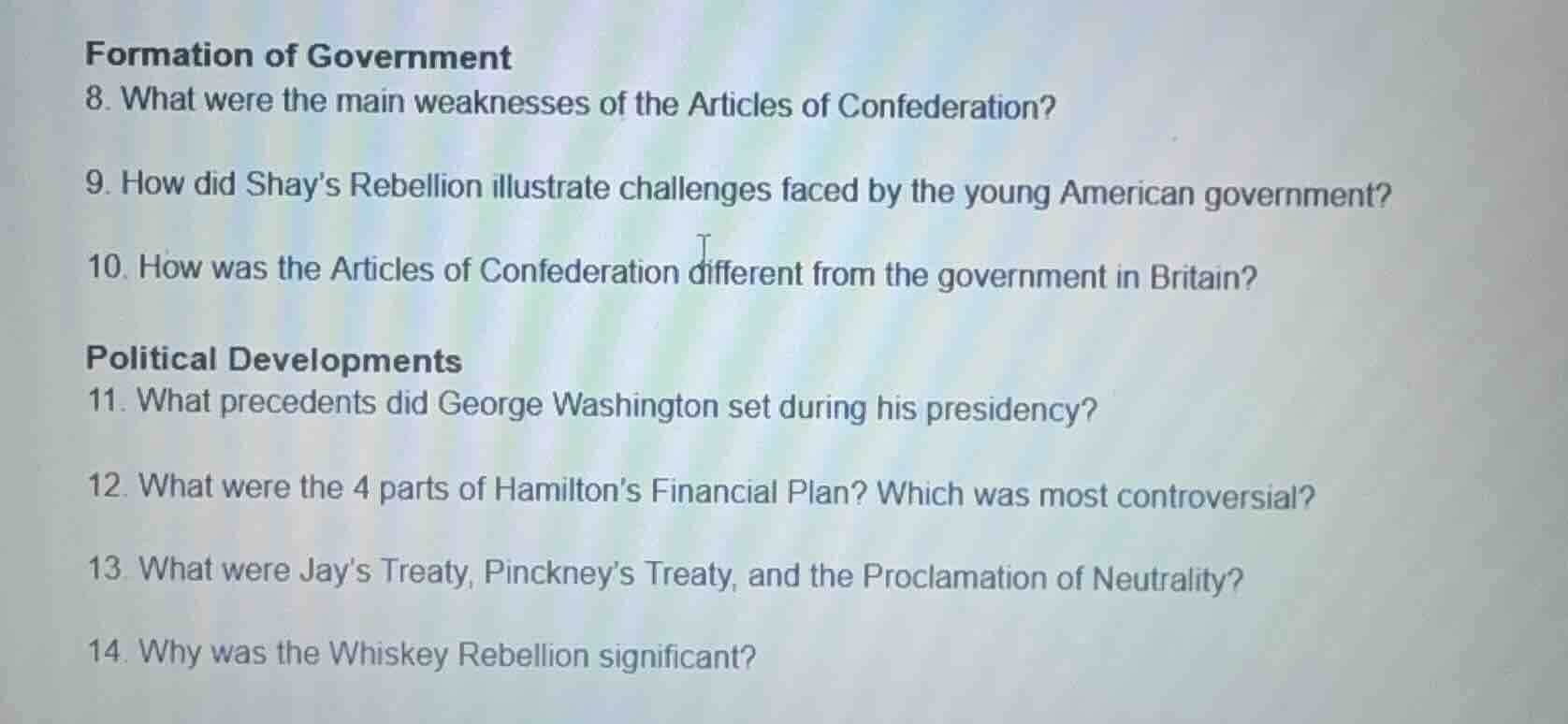
formation of government
- what were the main weaknesses of the articles of confederation?
- how did shay’s rebellion illustrate challenges faced by the young american government?
- how was the articles of confederation different from the government in britain?
political developments
- what precedents did george washington set during his presidency?
- what were the 4 parts of hamilton’s financial plan? which was most controversial?
- what were jay’s treaty, pinckney’s treaty, and the proclamation of neutrality?
- why was the whiskey rebellion significant?
Question 8:
The Articles of Confederation was the first U.S. governing document, with structural flaws that limited federal power. Key weaknesses stemmed from a lack of centralized authority.
Question 9:
Shay's Rebellion was an uprising of debt-ridden farmers, exposing the federal government's inability to maintain order under the Articles.
Question 10:
The Articles created a decentralized system, while Britain had a centralized, monarchical government with concentrated power.
Question 11:
George Washington established norms that shaped the U.S. presidency as an institution, rather than a royal-like office.
Question 12:
Alexander Hamilton's plan aimed to stabilize U.S. finances; its most controversial part clashed with agrarian, anti-federalist interests.
Question 13:
These were key foreign policy actions of the early U.S. to avoid conflict and resolve border/trade disputes.
Question 14:
The Whiskey Rebellion tested the new federal government's authority under the U.S. Constitution.

Snap & solve any problem in the app
Get step-by-step solutions on Sovi AI
Photo-based solutions with guided steps
Explore more problems and detailed explanations
- The main weaknesses were:
- No power to tax (could only request funds from states)
- No executive branch to enforce laws
- No national court system to settle disputes
- Required unanimous state approval to amend the Articles
- Could not regulate interstate or foreign commerce
- No power to raise a national army (relied on state militias)
- Shay's Rebellion showed that the federal government under the Articles of Confederation lacked the power to raise an army to put down internal unrest, could not address economic crises that sparked the rebellion, and demonstrated that state governments were unable to handle large-scale uprisings on their own, exposing the need for a stronger central government.
- Key differences:
- The Articles created a weak federal government with most power held by states, while Britain had a strong, centralized government led by a monarch.
- The U.S. under the Articles had no executive leader, while Britain had a king/queen as head of state with significant authority.
- The Articles had a unicameral legislature (one house) with equal state representation, while Britain had a bicameral Parliament with representation tied to population/aristocracy.
- The U.S. under the Articles was a republic with elected representatives, while Britain was a constitutional monarchy with a hereditary ruler.
- Washington set these precedents:
- Serving only two four-year terms (later made a 22nd Amendment)
- Using the title "Mr. President" instead of a royal-style title
- Establishing a cabinet of advisors to assist the presidency
- Delivering an annual State of the Union address
- Maintaining neutrality in foreign conflicts
- The 4 parts of Hamilton's Financial Plan:
- Pay off all federal war debts in full
- Repay state war debts
- Create a national bank to manage government funds and issue currency
- Impose high tariffs on imported goods to protect American industry and raise revenue
The most controversial part was the creation of the national bank, as opponents argued it was unconstitutional and favored wealthy, northern business interests over southern farmers.
13.
- Jay's Treaty (1794): A treaty with Britain that resolved leftover Revolutionary War disputes, including British withdrawal from western U.S. forts, and established trade relations.
- Pinckney's Treaty (1795): A treaty with Spain that granted the U.S. navigation rights on the Mississippi River, access to the port of New Orleans, and settled southern border disputes between the U.S. and Spanish Florida.
- Proclamation of Neutrality (1793): A declaration by George Washington that the U.S. would remain neutral in the conflict between Britain and France, avoiding involvement in European wars.
- The Whiskey Rebellion was significant because:
- It was the first major test of the U.S. federal government's authority under the new Constitution, proving it could enforce laws and use military force to put down internal unrest.
- It demonstrated the difference between the strong federal government under the Constitution and the weak one under the Articles of Confederation.
- It highlighted regional tensions between northern business interests and southern/frontier agrarian communities over federal taxation.