QUESTION IMAGE
Question
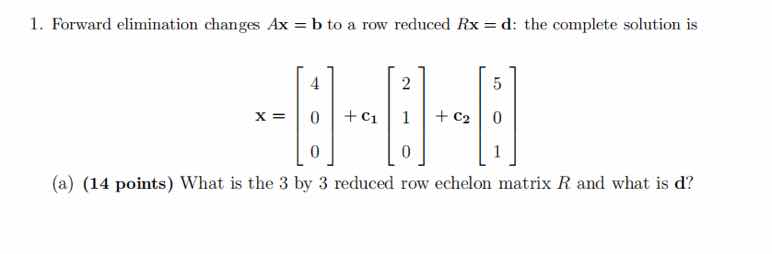
- forward elimination changes $ax = b$ to a row reduced $rx = d$: the complete solution is
$\mathbf{x} = \
+ c_1 \
+ c_2 \
$
(a) (14 points) what is the 3 by 3 reduced row echelon matrix $r$ and what is $d$?
Step1: Identify solution components
The complete solution is $\mathbf{x} = \mathbf{x_p} + c_1\mathbf{x_{n1}} + c_2\mathbf{x_{n2}}$, where:
Particular solution: $\mathbf{x_p} =
$, null space vectors: $\mathbf{x_{n1}} =
$, $\mathbf{x_{n2}} =
$
Step2: Find $\mathbf{d}$ from particular solution
Since $R\mathbf{x_p} = \mathbf{d}$, substitute $\mathbf{x_p}$:
In reduced row echelon form, this gives $\mathbf{d} =
$.
Step3: Derive $R$ from null space
Let $R =
$. For null space vectors, $R\mathbf{x_n} = \mathbf{0}$:
For $\mathbf{x_{n1}}$:
For $\mathbf{x_{n2}}$:
Using reduced row echelon form rules (leading 1s, zeros above/below):
$r_{11}=1, r_{22}=1, r_{31}=r_{32}=r_{33}=0$. Solve for other entries:
$r_{12} = -2, r_{13} = -5; r_{21}=0, r_{23}=-5$.
Thus $R =
$

Snap & solve any problem in the app
Get step-by-step solutions on Sovi AI
Photo-based solutions with guided steps
Explore more problems and detailed explanations
$R =
$, $\mathbf{d} =
$