QUESTION IMAGE
Question
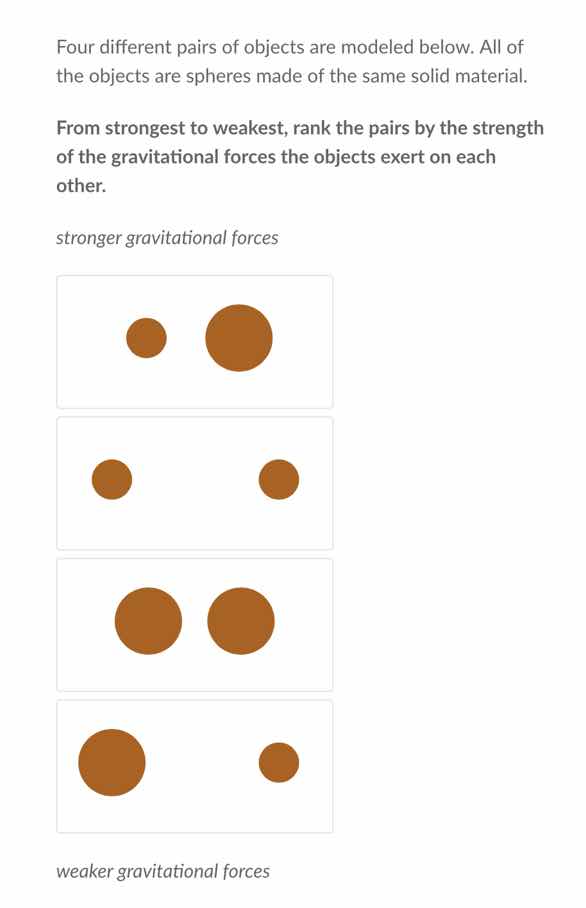
four different pairs of objects are modeled below. all of the objects are spheres made of the same solid material. from strongest to weakest, rank the pairs by the strength of the gravitational forces the objects exert on each other. stronger gravitational forces weaker gravitational forces
To rank the pairs by gravitational force strength, we use the formula for gravitational force: \( F = G\frac{m_1m_2}{r^2} \), where \( G \) is the gravitational constant, \( m_1 \) and \( m_2 \) are the masses of the objects, and \( r \) is the distance between their centers. All objects are made of the same material, so mass is proportional to volume (and thus to the cube of the radius, since they are spheres).
Step 1: Analyze Mass and Distance for Each Pair
- Pair 1 (Top): One small sphere, one large sphere, close distance.
- Pair 2 (Second): Two small spheres, moderate distance.
- Pair 3 (Third): Two large spheres, moderate distance.
- Pair 4 (Bottom): One large sphere, one small sphere, large distance.
Step 2: Compare Mass Products and Distances
- Mass Product: Two large spheres (Pair 3) have the largest mass product. One large and one small (Pairs 1 and 4) have a smaller mass product than Pair 3 but larger than Pair 2 (two smalls).
- Distance: Pair 1 has a smaller distance than Pair 4. Pair 2 and 3 have moderate distances (Pair 3's distance is similar to Pair 2, but mass is larger).
Step 3: Rank by Force Strength
- Strongest: Pair 3 (two large spheres, moderate distance, largest mass product).
- Next: Pair 1 (one large, one small, close distance – larger mass product than Pair 2, smaller distance than Pair 4).
- Next: Pair 4 (one large, one small, large distance – larger mass product than Pair 2, but larger distance than Pair 1).
- Weakest: Pair 2 (two small spheres, moderate distance, smallest mass product).
Wait, correction: Wait, actually, let's re-express:
Wait, the formula is \( F \propto \frac{m_1m_2}{r^2} \). Let's denote:
- Let small sphere mass = \( m \), radius \( r_s \); large sphere mass = \( M \), radius \( r_l \), with \( M > m \).
- Pair 2: \( m_1 = m_2 = m \), so \( m_1m_2 = m^2 \).
- Pair 3: \( m_1 = m_2 = M \), so \( m_1m_2 = M^2 \).
- Pairs 1 and 4: \( m_1 = M \), \( m_2 = m \), so \( m_1m_2 = Mm \).
Now, distance: Let \( d_1 \) (Pair 1 distance) < \( d_2 \) (Pair 2 distance) ≈ \( d_3 \) (Pair 3 distance) < \( d_4 \) (Pair 4 distance).
So:
- Pair 3: \( \frac{M^2}{d_3^2} \)
- Pair 1: \( \frac{Mm}{d_1^2} \)
- Pair 4: \( \frac{Mm}{d_4^2} \) (since \( d_4 > d_1 \), this is smaller than Pair 1)
- Pair 2: \( \frac{m^2}{d_2^2} \) (smallest mass product)
Since \( M^2 > Mm > m^2 \) (because \( M > m \)), and \( d_1 < d_3 \approx d_2 < d_4 \), the ranking from strongest to weakest is:
- Pair 3 (two large, moderate distance)
- Pair 1 (large and small, close distance)
- Pair 4 (large and small, large distance)
- Pair 2 (two small, moderate distance)
Wait, but in the diagram, Pair 3 (two large) is third from top, Pair 1 (small and large, close) is top, Pair 4 (large and small, far) is bottom, Pair 2 (two small) is second. So the order from strongest to weakest (top to bottom in the ranking) should be:
- Third pair (two large)
- First pair (small and large, close)
- Fourth pair (large and small, far)
- Second pair (two small)
So the correct ranking (from strongest to weakest) is:
Third pair (two large) > First pair (small and large, close) > Fourth pair (large and small, far) > Second pair (two small)

Snap & solve any problem in the app
Get step-by-step solutions on Sovi AI
Photo-based solutions with guided steps
Explore more problems and detailed explanations
From strongest to weakest, the ranking is:
- Pair with two large spheres (third from top)
- Pair with one small and one large sphere (close distance, top)
- Pair with one large and one small sphere (large distance, bottom)
- Pair with two small spheres (second from top)
(Visually, the order from top to bottom in the ranking should be: third pair, first pair, fourth pair, second pair.)