QUESTION IMAGE
Question
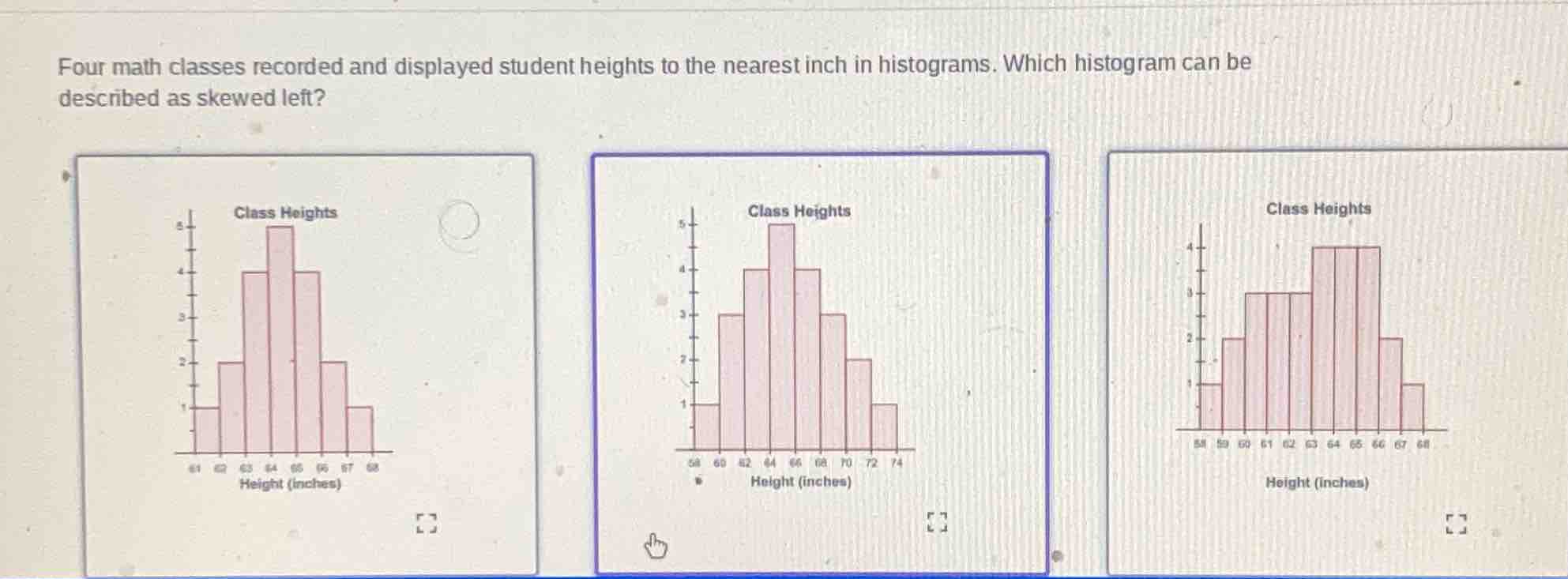
four math classes recorded and displayed student heights to the nearest inch in histograms. which histogram can be described as skewed left?
Step1: Recall skewed left definition
A left - skewed (negatively skewed) histogram has a longer tail on the left side. This means that the majority of the data is concentrated on the right side of the histogram, and the left tail (lower values) is stretched out.
Step2: Analyze each histogram
- For the first histogram: The bars are symmetric around the middle bar (height 65 inches approximately). So it is approximately symmetric, not left - skewed.
- For the second histogram: The tail on the left (lower height values) is relatively short, and the tail on the right (higher height values) is longer. Wait, no, wait. Wait, in a left - skewed distribution, the mean is less than the median, and the left tail is long. Wait, let's re - examine. Wait, the second histogram: the lower height categories (58, 60, 62) have relatively low frequencies, and as we move to higher heights, the frequency first increases and then decreases, but the left tail (lower heights) is not the long one. Wait, no, maybe I made a mistake. Wait, the third histogram: Wait, no, let's look at the second histogram again. Wait, the second histogram's bars: the left - most bars (58, 60, 62) have frequencies 1, 3, 4. Then as we move to the right, the frequency increases to 5 at 64, then decreases. Wait, no, a left - skewed histogram has the long tail on the left. So the data is concentrated on the right. So in a left - skewed histogram, the right side has the higher frequencies, and the left side (lower values) has a long tail (low frequencies but stretched out). Wait, the second histogram: the left tail (lower heights) has bars with low frequencies, and the main body of the data is on the right? No, wait, no. Wait, let's think again. A left - skewed distribution: mode > median > mean. The tail is on the left. So the histogram should have most of the data on the right, with a long tail on the left. So looking at the three histograms, the second histogram (the middle one) has the left - most bars (lower heights) with relatively low frequencies, and the higher height bars have higher frequencies at first, but then the right - most bars (higher heights like 70, 72, 74) have low frequencies. Wait, no, maybe I messed up. Wait, the third histogram: the left - most bar (58) has frequency 1, then 59 has 2, 60 - 62 have 3, then 63 - 66 have 4, then 67 has 2, 68 has 1. It is approximately symmetric. The first histogram is symmetric. The second histogram: the left - most bars (58, 60, 62) have frequencies 1, 3, 4. Then 64 has 5, 66 has 4, 68 has 3, 70 has 2, 72 has 1. Wait, no, the x - axis labels: 58, 60, 62, 64, 66, 68, 70, 72, 74. So the lower height values (left side) have lower frequencies, and as we move to the middle (64), the frequency increases, then decreases. But the left tail (lower heights) is not the long one. Wait, maybe I got the direction wrong. Wait, no, a left - skewed histogram has the tail on the left. So the correct histogram is the second one? Wait, no, wait the problem has three histograms? Wait, the user's image: three histograms. Wait, the second histogram (the middle one) has a long left tail? Wait, no, let's count the frequencies. First histogram: heights 61 (1), 62 (2), 63 (4), 64 (5), 65 (4), 66 (2), 67 (1). Symmetric. Second histogram: heights 58 (1), 60 (3), 62 (4), 64 (5), 66 (4), 68 (3), 70 (2), 72 (1). Wait, no, the x - axis is 58, 60, 62, 64, 66, 68, 70, 72, 74. So the left - most (58) has 1, 60 has 3, 62 has 4, 64 has 5, 66 has 4, 68 has 3, 70 has 2, 72 has 1, 74 has 1. Wait, the left tail (58, 60, 62) has low frequencies, and the right tail…

Snap & solve any problem in the app
Get step-by-step solutions on Sovi AI
Photo-based solutions with guided steps
Explore more problems and detailed explanations
Step1: Recall skewed left definition
A left - skewed (negatively skewed) histogram has a longer tail on the left side. This means that the majority of the data is concentrated on the right side of the histogram, and the left tail (lower values) is stretched out.
Step2: Analyze each histogram
- For the first histogram: The bars are symmetric around the middle bar (height 65 inches approximately). So it is approximately symmetric, not left - skewed.
- For the second histogram: The tail on the left (lower height values) is relatively short, and the tail on the right (higher height values) is longer. Wait, no, wait. Wait, in a left - skewed distribution, the mean is less than the median, and the left tail is long. Wait, let's re - examine. Wait, the second histogram: the lower height categories (58, 60, 62) have relatively low frequencies, and as we move to higher heights, the frequency first increases and then decreases, but the left tail (lower heights) is not the long one. Wait, no, maybe I made a mistake. Wait, the third histogram: Wait, no, let's look at the second histogram again. Wait, the second histogram's bars: the left - most bars (58, 60, 62) have frequencies 1, 3, 4. Then as we move to the right, the frequency increases to 5 at 64, then decreases. Wait, no, a left - skewed histogram has the long tail on the left. So the data is concentrated on the right. So in a left - skewed histogram, the right side has the higher frequencies, and the left side (lower values) has a long tail (low frequencies but stretched out). Wait, the second histogram: the left tail (lower heights) has bars with low frequencies, and the main body of the data is on the right? No, wait, no. Wait, let's think again. A left - skewed distribution: mode > median > mean. The tail is on the left. So the histogram should have most of the data on the right, with a long tail on the left. So looking at the three histograms, the second histogram (the middle one) has the left - most bars (lower heights) with relatively low frequencies, and the higher height bars have higher frequencies at first, but then the right - most bars (higher heights like 70, 72, 74) have low frequencies. Wait, no, maybe I messed up. Wait, the third histogram: the left - most bar (58) has frequency 1, then 59 has 2, 60 - 62 have 3, then 63 - 66 have 4, then 67 has 2, 68 has 1. It is approximately symmetric. The first histogram is symmetric. The second histogram: the left - most bars (58, 60, 62) have frequencies 1, 3, 4. Then 64 has 5, 66 has 4, 68 has 3, 70 has 2, 72 has 1. Wait, no, the x - axis labels: 58, 60, 62, 64, 66, 68, 70, 72, 74. So the lower height values (left side) have lower frequencies, and as we move to the middle (64), the frequency increases, then decreases. But the left tail (lower heights) is not the long one. Wait, maybe I got the direction wrong. Wait, no, a left - skewed histogram has the tail on the left. So the correct histogram is the second one? Wait, no, wait the problem has three histograms? Wait, the user's image: three histograms. Wait, the second histogram (the middle one) has a long left tail? Wait, no, let's count the frequencies. First histogram: heights 61 (1), 62 (2), 63 (4), 64 (5), 65 (4), 66 (2), 67 (1). Symmetric. Second histogram: heights 58 (1), 60 (3), 62 (4), 64 (5), 66 (4), 68 (3), 70 (2), 72 (1). Wait, no, the x - axis is 58, 60, 62, 64, 66, 68, 70, 72, 74. So the left - most (58) has 1, 60 has 3, 62 has 4, 64 has 5, 66 has 4, 68 has 3, 70 has 2, 72 has 1, 74 has 1. Wait, the left tail (58, 60, 62) has low frequencies, and the right tail (70, 72, [LLM SSE On Failure]