QUESTION IMAGE
Question
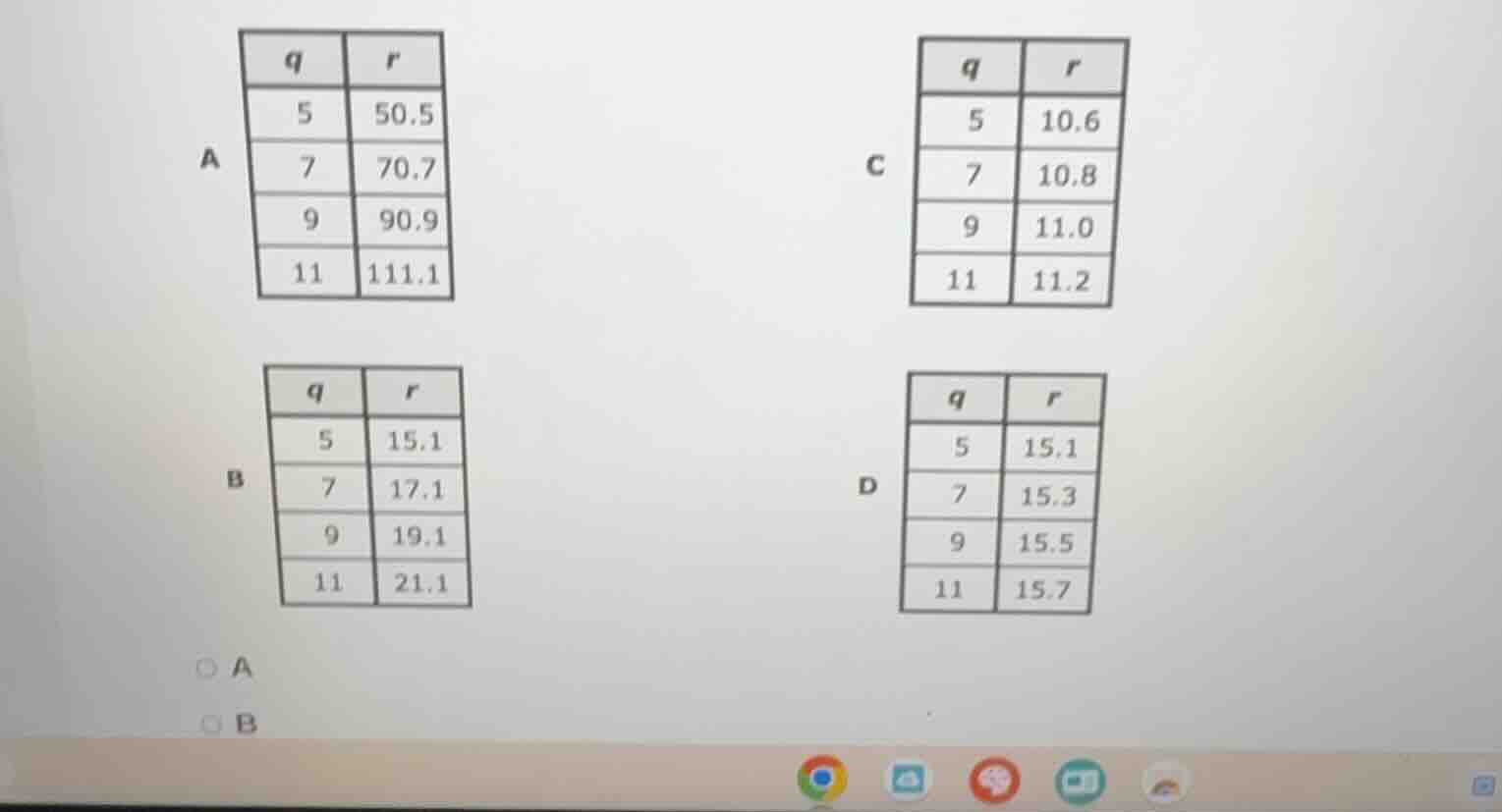
a, b, c, d four options, each with a table of q and r values. a: q=5, r=50.5; q=7, r=70.7; q=9, r=90.9; q=11, r=111.1. b: q=5, r=15.1; q=7, r=17.1; q=9, r=19.1; q=11, r=21.1. c: q=5, r=10.6; q=7, r=10.8; q=9, r=11.0; q=11, r=11.2. d: q=5, r=15.1; q=7, r=15.3; q=9, r=15.5; q=11, r=15.7. options a, b are selected with radio buttons.
To determine the correct table, we analyze the relationship between \( q \) and \( r \) in each option by checking the rate of change (slope) between consecutive rows.
Analyzing Option A:
For \( q = 5 \), \( r = 50.5 \); \( q = 7 \), \( r = 70.7 \).
Change in \( q \): \( 7 - 5 = 2 \)
Change in \( r \): \( 70.7 - 50.5 = 20.2 \)
Rate: \( \frac{20.2}{2} = 10.1 \)
For \( q = 7 \) to \( q = 9 \):
Change in \( q \): \( 9 - 7 = 2 \)
Change in \( r \): \( 90.9 - 70.7 = 20.2 \)
Rate: \( \frac{20.2}{2} = 10.1 \)
For \( q = 9 \) to \( q = 11 \):
Change in \( q \): \( 11 - 9 = 2 \)
Change in \( r \): \( 111.1 - 90.9 = 20.2 \)
Rate: \( \frac{20.2}{2} = 10.1 \)
The rate of change is constant (\( 10.1 \)) for all intervals.
Analyzing Option B:
For \( q = 5 \) to \( q = 7 \):
Change in \( q \): \( 2 \)
Change in \( r \): \( 17.1 - 15.1 = 2 \)
Rate: \( \frac{2}{2} = 1 \)
For \( q = 7 \) to \( q = 9 \):
Change in \( q \): \( 2 \)
Change in \( r \): \( 19.1 - 17.1 = 2 \)
Rate: \( \frac{2}{2} = 1 \)
For \( q = 9 \) to \( q = 11 \):
Change in \( q \): \( 2 \)
Change in \( r \): \( 21.1 - 19.1 = 2 \)
Rate: \( \frac{2}{2} = 1 \)
While the rate is constant (\( 1 \)), the initial relationship (\( r = 10.1q \) for A vs. \( r = q + 10.1 \) for B) does not match the proportionality implied by the first interval of A (where \( r \) is roughly \( 10.1 \times q \)).
Analyzing Option C:
For \( q = 5 \) to \( q = 7 \):
Change in \( q \): \( 2 \)
Change in \( r \): \( 10.8 - 10.6 = 0.2 \)
Rate: \( \frac{0.2}{2} = 0.1 \)
For \( q = 7 \) to \( q = 9 \):
Change in \( q \): \( 2 \)
Change in \( r \): \( 11.0 - 10.8 = 0.2 \)
Rate: \( \frac{0.2}{2} = 0.1 \)
For \( q = 9 \) to \( q = 11 \):
Change in \( q \): \( 2 \)
Change in \( r \): \( 11.2 - 11.0 = 0.2 \)
Rate: \( \frac{0.2}{2} = 0.1 \)
The rate is constant (\( 0.1 \)), but the initial \( r \)-values are too small (e.g., \( 10.6 \) when \( q = 5 \), vs. \( 50.5 \) in A).
Analyzing Option D:
For \( q = 5 \) to \( q = 7 \):
Change in \( q \): \( 2 \)
Change in \( r \): \( 15.3 - 15.1 = 0.2 \)
Rate: \( \frac{0.2}{2} = 0.1 \)
For \( q = 7 \) to \( q = 9 \):
Change in \( q \): \( 2 \)
Change in \( r \): \( 15.5 - 15.3 = 0.2 \)
Rate: \( \frac{0.2}{2} = 0.1 \)
For \( q = 9 \) to \( q = 11 \):
Change in \( q \): \( 2 \)
Change in \( r \): \( 15.7 - 15.5 = 0.2 \)
Rate: \( \frac{0.2}{2} = 0.1 \)
The rate is constant (\( 0.1 \)), but the \( r \)-values are nearly flat (e.g., \( 15.1 \) to \( 15.7 \)) and do not match the proportionality of A.
Only Option A has a consistent rate of change that aligns with a proportional relationship between \( q \) and \( r \) (e.g., \( r \approx 10.1q \)).

Snap & solve any problem in the app
Get step-by-step solutions on Sovi AI
Photo-based solutions with guided steps
Explore more problems and detailed explanations
A