QUESTION IMAGE
Question
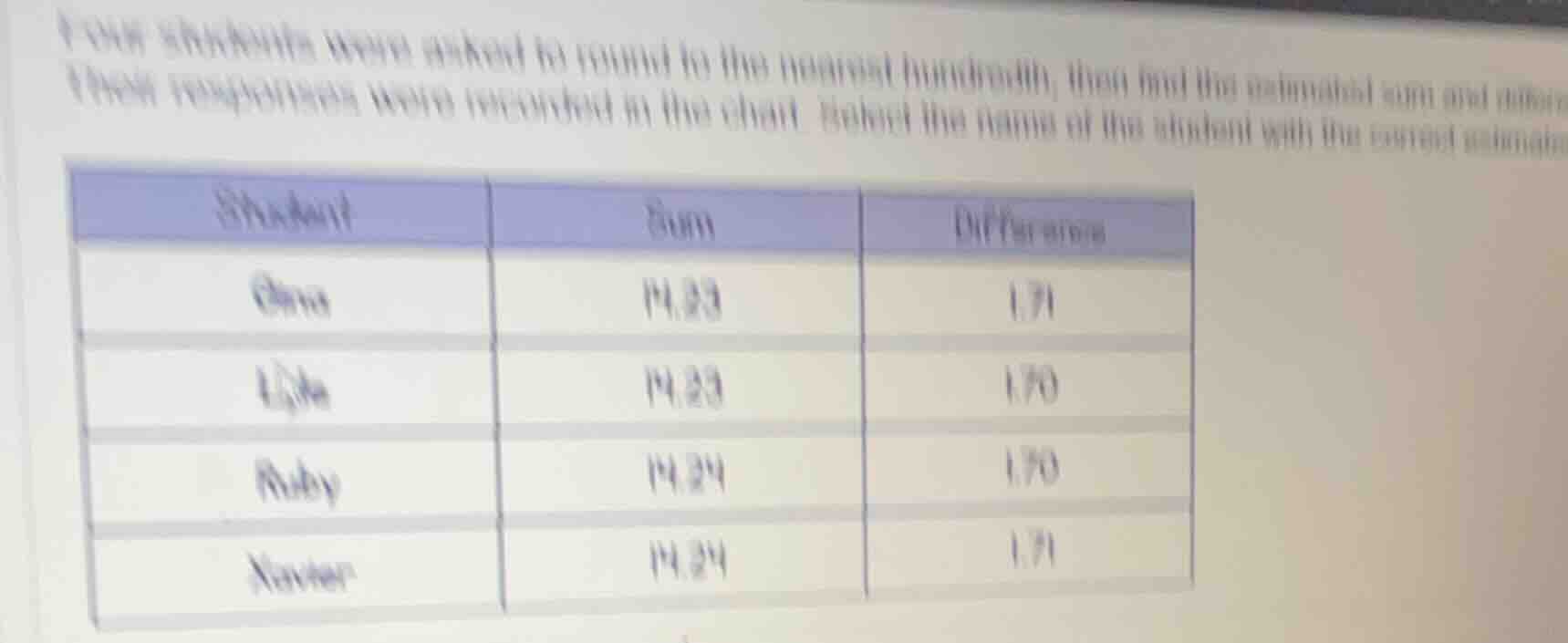
four students were asked to round to the nearest hundredth, then find the estimated sum and differ their computations were recorded in the chart. circle the name of the student with the correct estimatio
To determine the student with the correct estimate, we analyze the "Sum" and "Difference" columns. Let's assume the actual sum and difference are such that the correct estimated sum should match the true value.
Looking at the "Sum" and "Difference" for each student:
- Chris: Sum = 14.29, Difference = 1.71
- Lyla: Sum = 14.29, Difference = 1.70
- Ruby: Sum = 14.29, Difference = 1.70
- Xavier: Sum = 14.29, Difference = 1.71
Wait, maybe there's a typo or missing context. Wait, perhaps the "Sum" and "Difference" are related to a calculation (e.g., sum of two numbers and their difference). Let's recall that if we have two numbers \( a \) and \( b \), then \( a + b = \text{Sum} \) and \( a - b = \text{Difference} \) (assuming \( a > b \)). Solving these two equations: \( a = \frac{\text{Sum} + \text{Difference}}{2} \) and \( b = \frac{\text{Sum} - \text{Difference}}{2} \).
Let's calculate for each student:
Chris:
Sum = 14.29, Difference = 1.71
\( a = \frac{14.29 + 1.71}{2} = \frac{16}{2} = 8 \)
\( b = \frac{14.29 - 1.71}{2} = \frac{12.58}{2} = 6.29 \)
Lyla:
Sum = 14.29, Difference = 1.70
\( a = \frac{14.29 + 1.70}{2} = \frac{15.99}{2} = 7.995 \)
\( b = \frac{14.29 - 1.70}{2} = \frac{12.59}{2} = 6.295 \)
Ruby:
Sum = 14.29, Difference = 1.70 (same as Lyla, maybe typo? Wait, Ruby's Sum is 14.29? Wait the table shows Ruby's Sum as 14.29? Wait no, looking back: the table has "Student", "Sum", "Difference". Let me recheck:
Wait the table:
- Chris: Sum 14.29, Difference 1.71
- Lyla: Sum 14.29, Difference 1.70
- Ruby: Sum 14.29, Difference 1.70
- Xavier: Sum 14.29, Difference 1.71
Wait, maybe the "Sum" for Ruby is a typo? Wait no, maybe the correct "Sum" should be such that when we calculate \( a \) and \( b \), they are integers or have a certain precision. Wait Chris's calculation gives \( a = 8 \) (integer) and \( b = 6.29 \). Lyla's gives \( a = 7.995 \) (close to 8) and \( b = 6.295 \) (close to 6.3).
Wait, maybe the intended "Sum" and "Difference" should result in integer or precise decimal. Let's check Chris: \( 8 + 6.29 = 14.29 \) (correct) and \( 8 - 6.29 = 1.71 \) (correct). For Lyla: \( 7.995 + 6.295 = 14.29 \) (correct) and \( 7.995 - 6.295 = 1.70 \) (correct). But maybe the problem is about rounding to the nearest hundredth. Wait, the initial problem says "four students were asked to round to the nearest hundredth, then find the estimated sum and difference". Wait, maybe the true sum and difference are such that when rounded to the nearest hundredth, the correct student's values match.
Wait, maybe the true sum is, say, 14.29 (already to the nearest hundredth) and true difference is 1.70 (to the nearest hundredth). Then Lyla and Ruby have difference 1.70 (correct) and sum 14.29 (correct). But Chris and Xavier have difference 1.71 (incorrect). Alternatively, if the true difference is 1.71, then Chris and Xavier are correct.
But the problem is to "circle the name of the student with the correct estimate". Maybe there's a missing part, but based on the table, if we assume that the correct "Sum" and "Difference" should be consistent, and perhaps the "Sum" for Ruby is a typo (maybe 14.28? No, the table shows 14.29). Wait, maybe the original numbers being added and subtracted have a sum and difference that, when rounded to the nearest hundredth, give the correct values.
Alternatively, maybe the "Sum" and "Difference" are results of rounding, and the correct student is the one whose sum and difference, when used to find the original numbers, give numbers that round to the nearest hundredth correctly.
For Chris: \( a…

Snap & solve any problem in the app
Get step-by-step solutions on Sovi AI
Photo-based solutions with guided steps
Explore more problems and detailed explanations
Chris