QUESTION IMAGE
Question
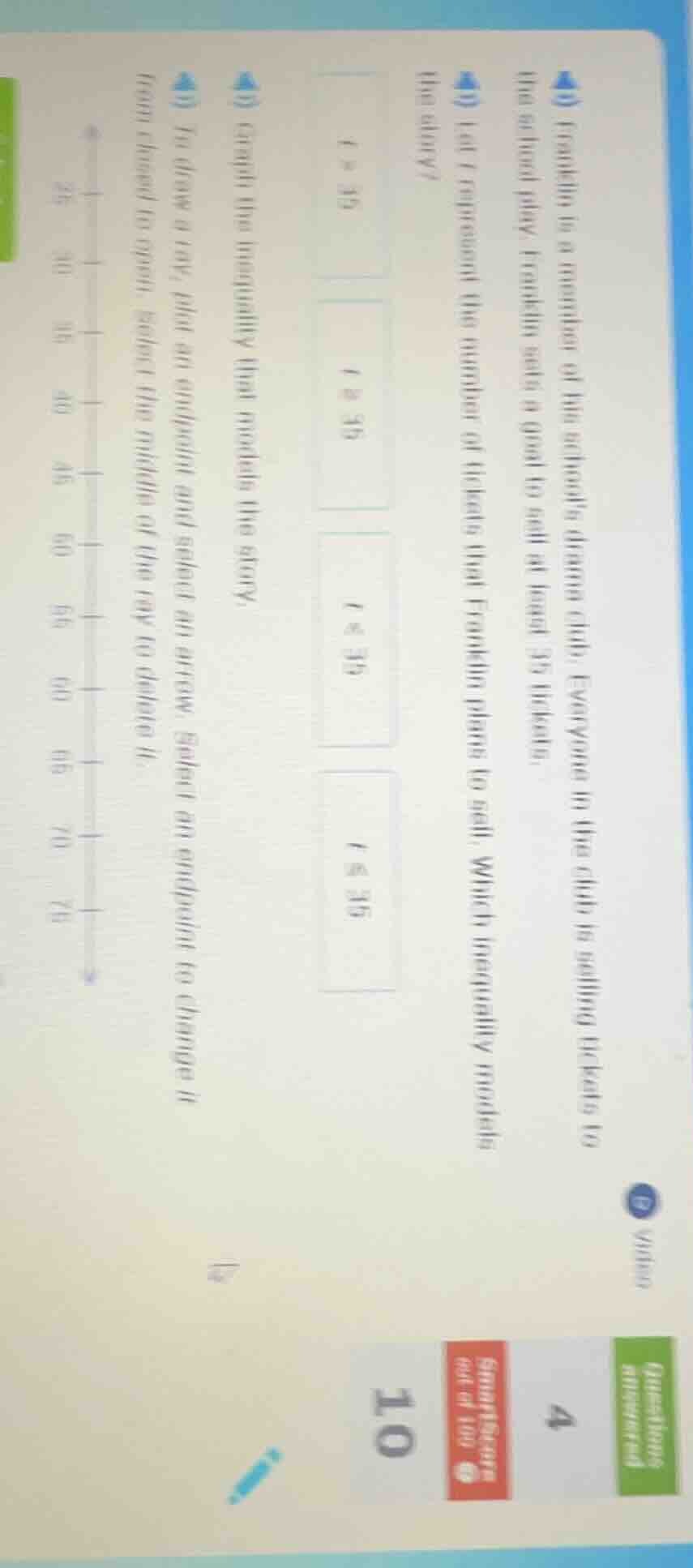
franklin is a member of his schools drama club. everyone in the club is selling tickets to the school play. franklin sets a goal to sell at least 35 tickets. let ( t ) represent the number of tickets that franklin plans to sell. which inequality models the story? ( t = 35 ) ( t geq 35 ) ( t leq 35 ) ( t < 35 ) graph the inequality that models the story. to draw a ray, plot an endpoint and select an arrow. select an endpoint to change it from closed to open. select the middle of the ray to delete it. (number line with marks at 25, 30, 35, 40, 45, 50, 55, 60, 65, 70, 75)
Part (a)
Step1: Understand the problem
Franklin needs to sell at least 35 tickets. "At least" means the number of tickets \( t \) is greater than or equal to 35.
Step2: Analyze the inequalities
- \( t = 35 \): This means exactly 35 tickets, but we need at least 35 (including 35 and more), so this is not correct.
- \( t \geq 35 \): This means \( t \) is 35 or more, which matches "at least 35".
- \( t > 35 \): This means more than 35, but it doesn't include 35, so it's incorrect.
- \( t \leq 35 \): This means 35 or less, which is the opposite of what we need, so it's incorrect.
Step1: Recall how to graph \( t \geq 35 \)
To graph \( t \geq 35 \) on a number line:
- First, find 35 on the number line.
- Since the inequality is "greater than or equal to", we use a closed dot (filled circle) at 35 to show that 35 is included.
- Then, draw an arrow to the right (towards larger numbers) to show all numbers greater than 35 are also included.

Snap & solve any problem in the app
Get step-by-step solutions on Sovi AI
Photo-based solutions with guided steps
Explore more problems and detailed explanations
\( t \geq 35 \)