QUESTION IMAGE
Question
free response practice - electrochemistry
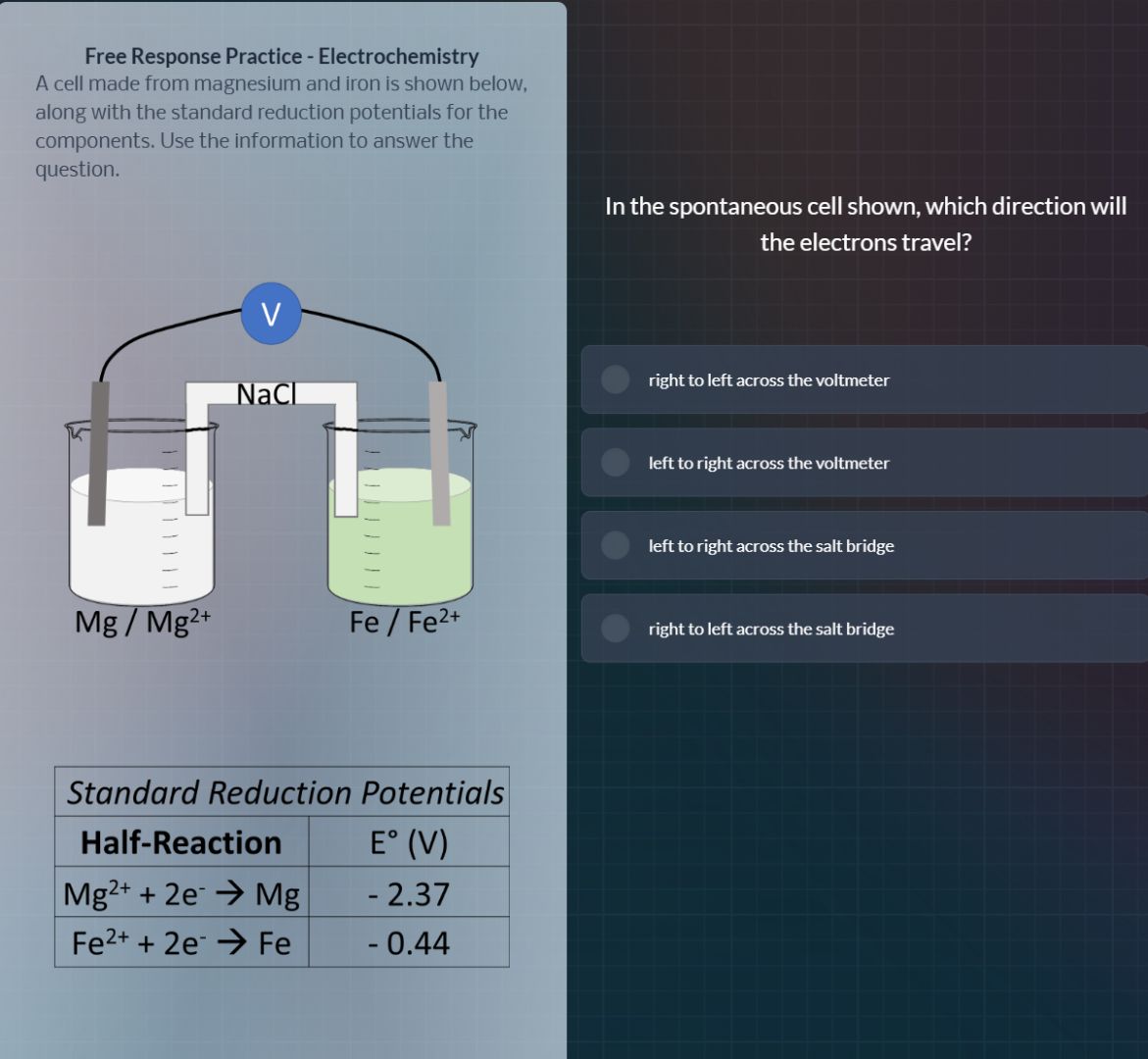
a cell made from magnesium and iron is shown below,
along with the standard reduction potentials for the
components. use the information to answer the
question.
in the spontaneous cell shown, which direction will
the electrons travel?
right to left across the voltmeter
left to right across the voltmeter
left to right across the salt bridge
right to left across the salt bridge
standard reduction potentials
half - reaction e° (v)
mg²⁺ + 2e⁻ → mg - 2.37
fe²⁺ + 2e⁻ → fe - 0.44
To determine electron flow, we first identify the anode (oxidation) and cathode (reduction). The more negative reduction potential means the half - reaction is more likely to be reversed (oxidation). For \(Mg^{2+}+2e^-\to Mg\), \(E^{\circ}=- 2.37\ V\) and for \(Fe^{2+}+2e^-\to Fe\), \(E^{\circ}=-0.44\ V\). Since \(-2.37\) is more negative than \(-0.44\), the \(Mg\) half - reaction will be reversed (oxidation: \(Mg\to Mg^{2+}+2e^-\)), so \(Mg\) is the anode (left electrode). Oxidation occurs at the anode, releasing electrons. Electrons flow from the anode (left) to the cathode (right) through the external circuit (voltmeter). Salt bridges allow ion flow, not electron flow.

Snap & solve any problem in the app
Get step-by-step solutions on Sovi AI
Photo-based solutions with guided steps
Explore more problems and detailed explanations
left to right across the voltmeter