QUESTION IMAGE
Question
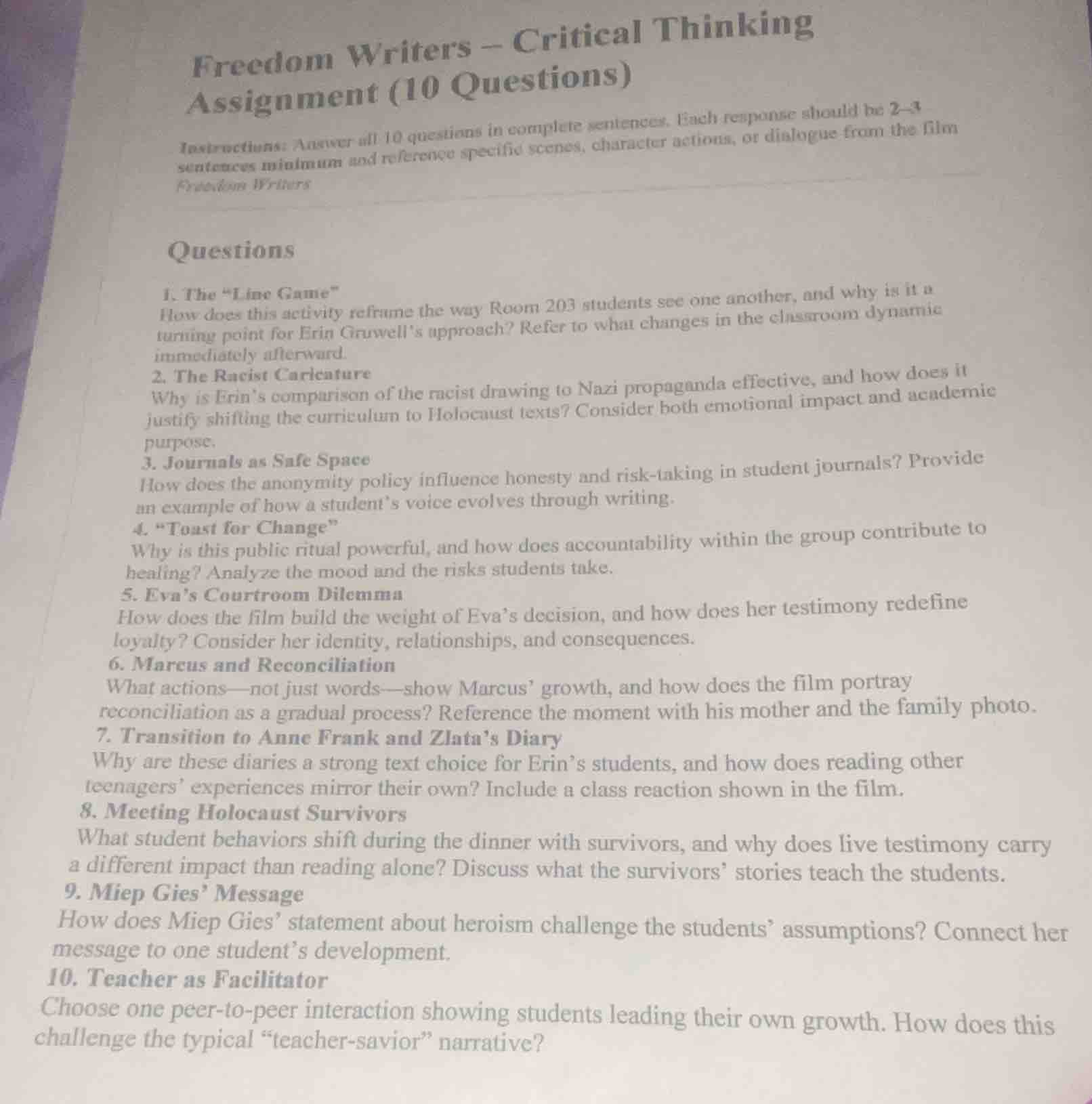
freedom writers – critical thinking
assignment (10 questions)
instructions: answer all 10 questions in complete sentences. each response should be 2–3
sentences minimum and reference specific scenes, character actions, or dialogue from the film
freedom writers
questions
- the “line game”
how does this activity reframe the way room 203 students see one another, and why is it a
turning point for erin gruwell’s approach? refer to what changes in the classroom dynamic
immediately afterward.
- the racist caricature
why is erin’s comparison of the racist drawing to nazi propaganda effective, and how does it
justify shifting the curriculum to holocaust texts? consider both emotional impact and academic
purpose.
- journals as safe space
how does the anonymity policy influence honesty and risk - taking in student journals? provide
an example of how a student’s voice evolves through writing.
- “toast for change”
why is this public ritual powerful, and how does accountability within the group contribute to
healing? analyze the mood and the risks students take.
- eva’s courtroom dilemma
how does the film build the weight of eva’s decision, and how does her testimony redefine
loyalty? consider her identity, relationships, and consequences.
- marcus and reconciliation
what actions—not just words—show marcus’ growth, and how does the film portray
reconciliation as a gradual process? reference the moment with his mother and the family photo.
- transition to anne frank and zlata’s diary
why are these diaries a strong text choice for erin’s students, and how does reading other
teenagers’ experiences mirror their own? include a class reaction shown in the film.
- meeting holocaust survivors
what student behaviors shift during the dinner with survivors, and why does live testimony carry
a different impact than reading alone? discuss what the survivors’ stories teach the students.
- miep gies’ message
how does miep gies’ statement about heroism challenge the students’ assumptions? connect her
message to one student’s development.
- teacher as facilitator
choose one peer - to - peer interaction showing students leading their own growth. how does this
challenge the typical “teacher - savior” narrative?
- The "Line Game": The activity makes students confront shared trauma (like abuse, loss, or poverty) they never discussed, breaking down gang/racial barriers. For example, when students step forward for experiences like "I have lost someone to violence," they realize their peers face similar pain. This is a turning point for Erin because it shows her students need connection first, so she shifts to empathy-building lessons instead of standard curriculum; immediately, students stop hostile interactions and start listening to one another.
- The Racist Caricature: Comparing the drawing to Nazi propaganda is effective because it links the small, classroom hate symbol to a large-scale, genocidal system of dehumanization—emotionally, it shocks students into seeing their casual bigotry as part of a dangerous pattern. Academically, it justifies Holocaust texts because it gives students a personal, urgent context to study dehumanization, helping them connect historical atrocities to their own lives.
- Journals as Safe Space: The anonymity policy lets students write openly without fear of judgment from peers or Erin. For example, one student initially writes about hiding their abuse, then gradually shares more vulnerable details as they trust the safe space; this honesty lets them take risks like writing about their role in gang violence, evolving their voice from guarded to reflective.
- "Toast for Change": This public ritual is powerful because it forces students to vocalize their regrets and goals in front of peers, making their commitments tangible. Accountability heals because students know their group will hold them to their promises—for example, when Marcus toasts to making amends with his mother, the group’s support gives him courage. The mood shifts from tense to hopeful, and students risk vulnerability by sharing painful truths publicly.
- Eva's Courtroom Dilemma: The film builds weight by showing Eva’s loyalty to her gang (who pressure her to lie) and her fear of retaliation, balanced with her new understanding of justice from Erin’s class. Her testimony redefines loyalty as choosing what is right over protecting harmful group norms; she risks her safety to tell the truth about the shooting, prioritizing integrity over gang allegiance, which changes how her peers see loyalty and personal responsibility.
- Marcus and Reconciliation: Marcus’s growth is shown through actions like visiting his mother in rehab and asking for forgiveness, not just saying he is sorry. The film portrays reconciliation as gradual: first, he tentatively reaches out, then he participates in taking a family photo, a small step that shows he is rebuilding trust over time, rather than fixing his relationship in one moment.
- Transition to Anne Frank and Zlata's Diary: These diaries are a strong choice because they are written by teenagers, so Erin’s students can directly relate to the authors’ fears, hopes, and daily struggles. For example, when students read about Anne’s loneliness, they connect it to their own feelings of isolation in their neighborhoods. A class reaction shown is students crying and openly discussing how the diaries make them realize their own trauma is shared, even across time and cultures.
- Meeting Holocaust Survivors: Students shift from being dismissive and distracted to quiet, respectful, and engaged—they ask thoughtful questions instead of acting out. Live testimony is more impactful than reading because it humanizes history; survivors share personal, vivid stories that make the Holocaust…

Snap & solve any problem in the app
Get step-by-step solutions on Sovi AI
Photo-based solutions with guided steps
Explore more problems and detailed explanations
- The "Line Game" makes Room 203 students recognize shared trauma, breaking down racial/gang barriers. It is a turning point for Erin because it pushes her to prioritize empathy-building over standard lessons; immediately, students stop hostile interactions and begin listening to one another.
- Erin's comparison is effective because it links the classroom's small racist drawing to the large-scale dehumanization of Nazi propaganda, shocking students into seeing their casual bigotry as dangerous. It justifies Holocaust texts by giving students a personal, urgent context to study dehumanization, connecting historical atrocities to their own lives emotionally and academically.
- The anonymity policy lets students write without fear of judgment, encouraging honesty and risk-taking. For example, a student initially writes guarded entries about family abuse, then gradually shares vulnerable details about their gang involvement, evolving their voice from closed-off to reflective.
- This public ritual is powerful because it makes students' commitments to change tangible. Group accountability heals by letting students rely on peers to hold them to their promises; the mood shifts from tense to hopeful, and students risk vulnerability by sharing painful truths publicly, like Marcus toasting to making amends with his mother.
- The film builds weight by showing Eva's conflict between gang loyalty (and fear of retaliation) and her new understanding of justice. Her testimony redefines loyalty as choosing integrity over harmful group norms; she risks her safety to tell the truth in court, prioritizing doing what is right over protecting her gang.
- Marcus's growth is shown through actions like visiting his mother in rehab and asking for forgiveness, not just words. The film portrays reconciliation as gradual: he takes small steps, like participating in a family photo, to rebuild trust with his mother over time, rather than fixing their relationship in one moment.
- These diaries are a strong choice because they are written by relatable teenagers, letting students connect the authors' struggles to their own. For example, students cry and discuss how Anne Frank's loneliness mirrors their own isolation; reading these texts makes their trauma feel shared across time and cultures.
- Students shift from dismissive and distracted to quiet, respectful, and engaged, asking thoughtful questions. Live testimony is more impactful than reading because it humanizes history—survivors' personal stories make the Holocaust feel real, teaching students that resilience is possible and that they can choose kindness over hate.
- Miep Gies' statement that she is not a hero, just someone who did the right thing, challenges students' assumption that heroes are extraordinary. This connects to Marcus's development: it makes him realize small, brave choices (like apologizing to his mother) are acts of heroism, giving him hope for his own growth.
- When students organize the Holocaust survivor dinner on their own, it shows them leading their own growth. This challenges the "teacher-savior" narrative because it proves students have agency to drive their own learning and healing, framing Erin as a guide rather than a rescuer.