QUESTION IMAGE
Question
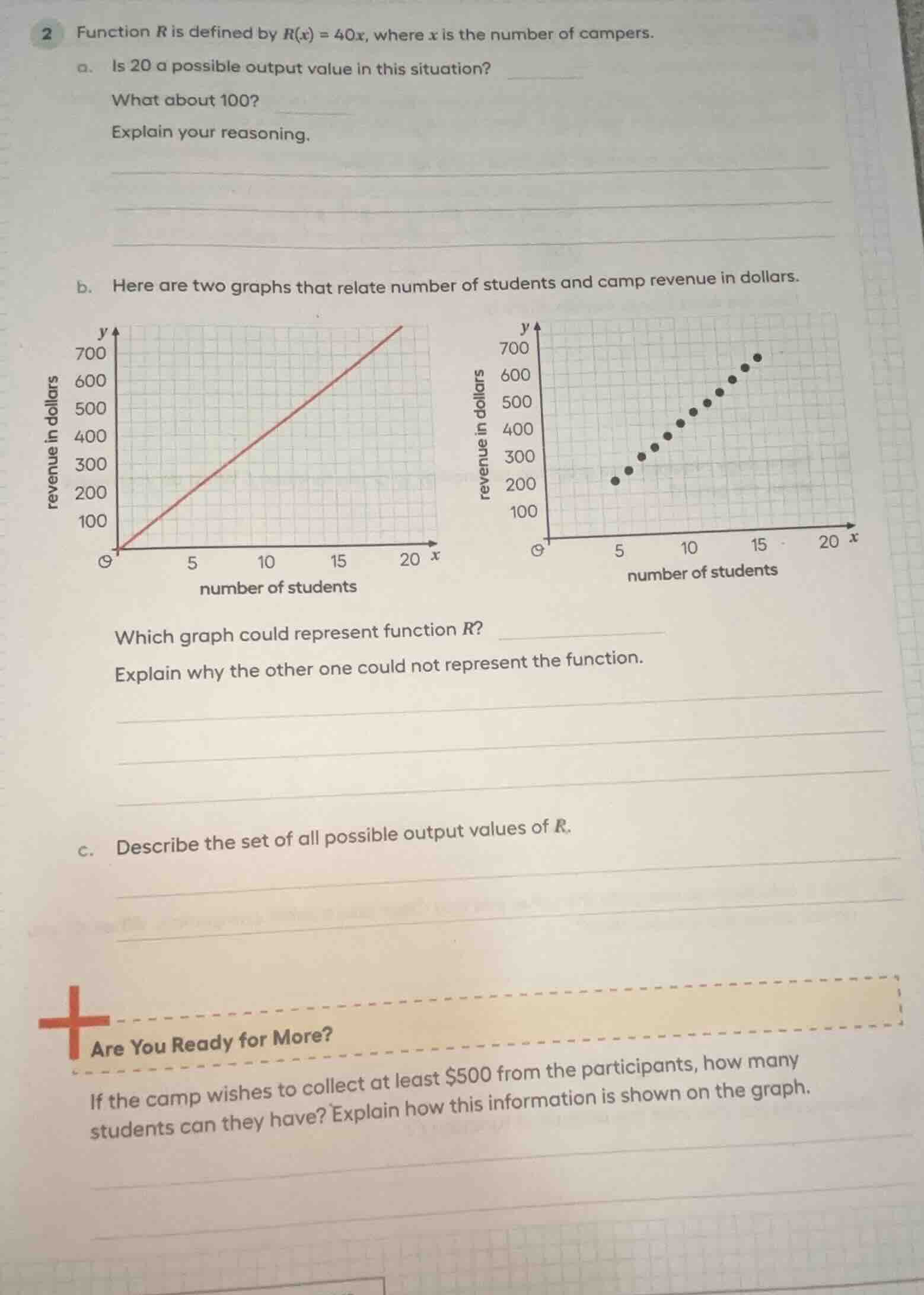
2 function r is defined by r(x) = 40x, where x is the number of campers.
a. is 20 a possible output value in this situation?
what about 100?
explain your reasoning.
b. here are two graphs that relate number of students and camp revenue in dollars.
which graph could represent function r?
explain why the other one could not represent the function.
c. describe the set of all possible output values of r.
are you ready for more?
if the camp wishes to collect at least $500 from the participants, how many students can they have? explain how this information is shown on the graph.
Step1: Solve for x when R(x)=20
$20 = 40x \implies x = \frac{20}{40} = 0.5$
Step2: Solve for x when R(x)=100
$100 = 40x \implies x = \frac{100}{40} = 2.5$
Step3: Analyze graph validity for $R(x)=40x$
For $x=5$, $R(5)=40*5=200$; $x=10$, $R(10)=400$; $x=15$, $R(15)=600$. Check graph points.
Step4: Define possible outputs of R(x)
x is non-negative integer, so $R(x)=40x$ is multiples of 40.
Step5: Solve for minimum x for $R(x)\geq500$
$40x \geq 500 \implies x \geq \frac{500}{40}=12.5$, so $x\geq13$

Snap & solve any problem in the app
Get step-by-step solutions on Sovi AI
Photo-based solutions with guided steps
Explore more problems and detailed explanations
Part a
- 20 is not a possible output value, because solving $R(x)=20$ gives $x=0.5$, and the number of campers must be a non-negative whole number.
- 100 is not a possible output value, because solving $R(x)=100$ gives $x=2.5$, which is not a valid number of campers.
Part b
- The first (left) graph could represent function $R$.
- The second (right) graph cannot represent $R$: for $x=15$, the graph shows a revenue of ~650, but $R(15)=40*15=600$, which does not match. Also, the right graph has discrete points, but $R(x)=40x$ is defined for all non-negative real numbers (or all non-negative integers, which would still align with the continuous line when considering all possible whole number inputs scaled correctly).
Part c
The set of all possible output values of $R$ is all non-negative multiples of 40 (i.e., $0, 40, 80, 120, ...$), since $x$ is a non-negative whole number of campers, and $R(x)=40x$.
"Are You Ready for More?"
They need at least 13 students. Solving $40x\geq500$ gives $x\geq12.5$, so the smallest whole number of students is 13. On the graph of $R(x)$, this is shown by finding the point where the line $y=500$ intersects the graph of $R(x)$; all $x$-values to the right of this intersection (rounded up to the next whole number) satisfy the revenue requirement.