QUESTION IMAGE
Question
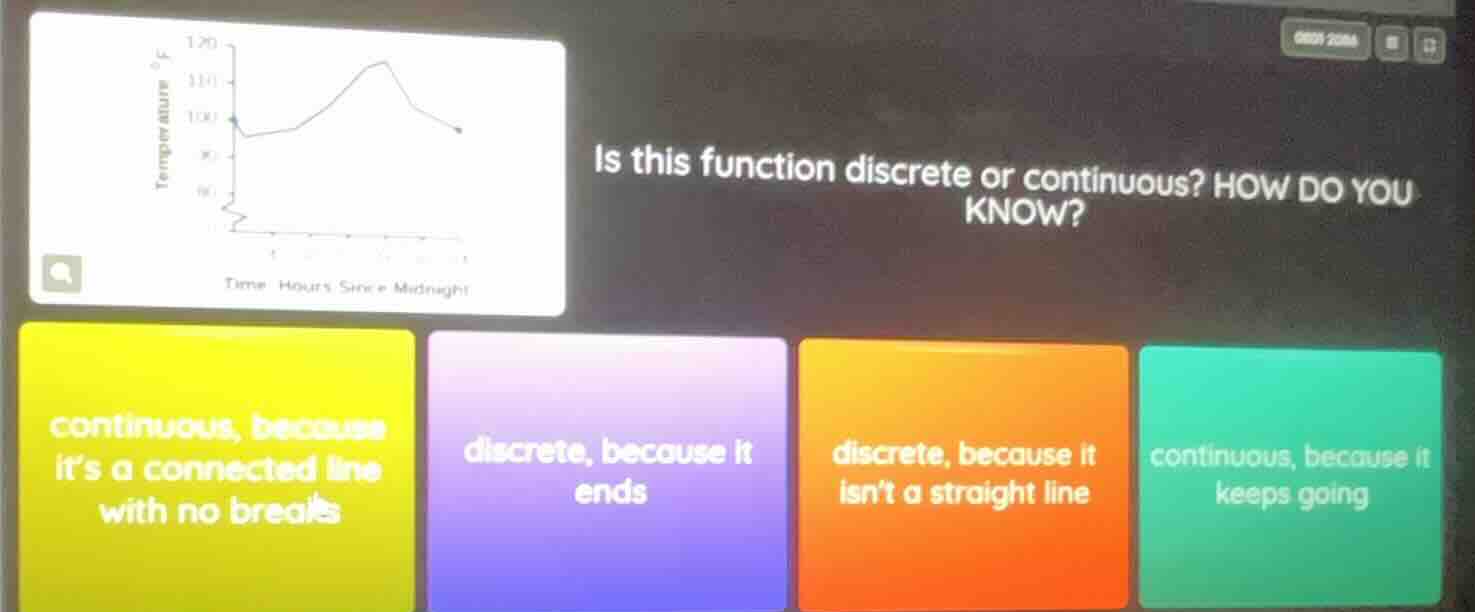
is this function discrete or continuous? how do you know?
continuous, because it’s a connected line with no breaks
discrete, because it ends
discrete, because it isn’t a straight line
continuous, because it keeps going
To determine if a function is discrete or continuous, we analyze the graph:
- A discrete function has isolated points (not connected).
- A continuous function has a connected graph with no breaks, representing data that can take any value in an interval (e.g., time, temperature).
The graph here is a connected line (no breaks) showing temperature over time (hours since midnight). Time and temperature are continuous quantities (they can take any value in a range, not just whole numbers). The yellow option correctly states it is continuous because the graph is a connected line with no breaks.
Other options are incorrect:
- "discrete, because it ends": A graph ending does not make it discrete (discrete depends on connectedness, not length).
- "discrete, because it isn’t a straight line": Linearity is irrelevant to discrete/continuous classification.
- "continuous, because it keeps going": The graph may end, but "keeps going" is not the key; the key is the connected, unbroken line.

Snap & solve any problem in the app
Get step-by-step solutions on Sovi AI
Photo-based solutions with guided steps
Explore more problems and detailed explanations
A. continuous, because it’s a connected line with no breaks