QUESTION IMAGE
Question
function operations
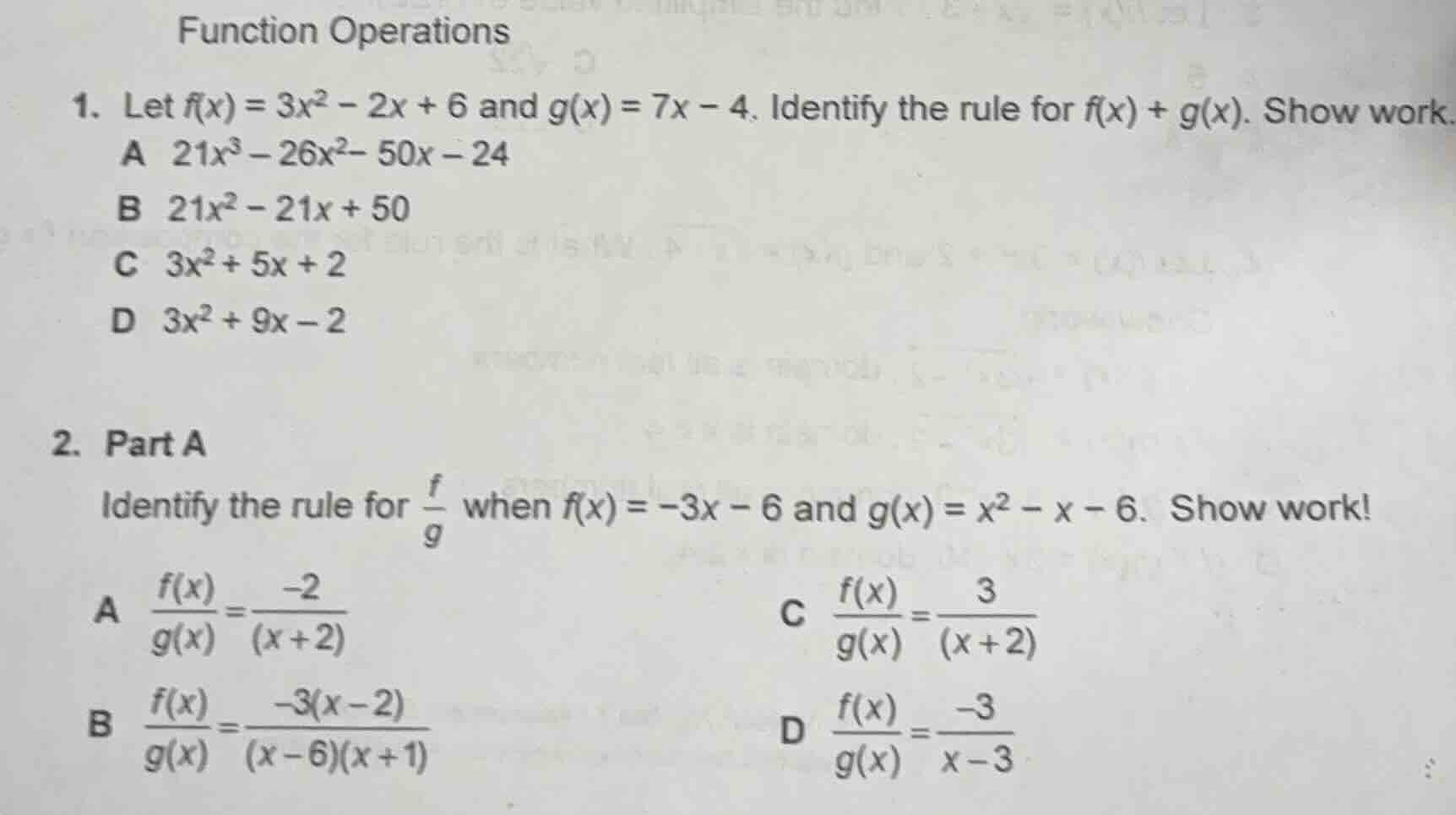
- let ( f(x) = 3x^2 - 2x + 6 ) and ( g(x) = 7x - 4 ). identify the rule for ( f(x) + g(x) ). show work.
a ( 21x^3 - 26x^2 - 50x - 24 )
b ( 21x^2 - 21x + 50 )
c ( 3x^2 + 5x + 2 )
d ( 3x^2 + 9x - 2 )
- part a
identify the rule for ( \frac{f}{g} ) when ( f(x) = -3x - 6 ) and ( g(x) = x^2 - x - 6 ). show work!
a ( \frac{f(x)}{g(x)} = \frac{-2}{(x + 2)} )
c ( \frac{f(x)}{g(x)} = \frac{3}{(x + 2)} )
b ( \frac{f(x)}{g(x)} = \frac{-3(x - 2)}{(x - 6)(x + 1)} )
d ( \frac{f(x)}{g(x)} = \frac{-3}{x - 3} )
Question 1
Step1: Write the sum of the functions
To find \( f(x) + g(x) \), we substitute the given functions:
\( f(x) + g(x) = (3x^2 - 2x + 6) + (7x - 4) \)
Step2: Combine like terms
First, combine the \( x \)-terms: \( -2x + 7x = 5x \)
Then, combine the constant terms: \( 6 - 4 = 2 \)
The \( x^2 \)-term remains \( 3x^2 \) as there is no like term in \( g(x) \).
So, \( f(x) + g(x) = 3x^2 + 5x + 2 \)
Step1: Write the quotient of the functions
To find \( \frac{f(x)}{g(x)} \), we substitute the given functions:
\( \frac{f(x)}{g(x)} = \frac{-3x - 6}{x^2 - x - 6} \)
Step2: Factor numerator and denominator
Factor the numerator: \( -3x - 6 = -3(x + 2) \)
Factor the denominator: \( x^2 - x - 6 = (x - 3)(x + 2) \)
Step3: Cancel common factors
Cancel the common factor \( (x + 2) \) (assuming \( x
eq -2 \)):
\( \frac{-3(x + 2)}{(x - 3)(x + 2)} = \frac{-3}{x - 3} \) Wait, no, let's check again. Wait, the denominator factors: \( x^2 - x - 6 \). Let's factor correctly:
Looking for two numbers that multiply to -6 and add to -1. Those numbers are -3 and 2. So, \( x^2 - x - 6 = (x - 3)(x + 2) \). The numerator: \( -3x - 6 = -3(x + 2) \). So, cancel \( (x + 2) \):
\( \frac{-3(x + 2)}{(x - 3)(x + 2)} = \frac{-3}{x - 3} \)? Wait, but that's not one of the options. Wait, maybe I made a mistake. Wait, let's check the options again. Wait, option D is \( \frac{-3}{x - 3} \)? Wait, no, the options are:
Wait, the options are:
A. \( \frac{-2}{x + 2} \)
B. \( \frac{-3(x - 2)}{(x - 6)(x + 1)} \)
C. \( \frac{3}{x + 2} \)
D. \( \frac{-3}{x - 3} \)
Wait, let's re-express the numerator: \( -3x - 6 = -3(x + 2) \)
Denominator: \( x^2 - x - 6 = (x - 3)(x + 2) \)
So, cancel \( (x + 2) \): \( \frac{-3(x + 2)}{(x - 3)(x + 2)} = \frac{-3}{x - 3} \), which is option D.
Wait, but let's check again. Wait, maybe I factored the denominator wrong. Wait, \( x^2 - x - 6 \): sum of roots is 1, product is -6. So, roots are 3 and -2. So, \( (x - 3)(x + 2) \). Correct. Numerator: \( -3x - 6 = -3(x + 2) \). So, cancel \( (x + 2) \), we get \( \frac{-3}{x - 3} \), which is option D.

Snap & solve any problem in the app
Get step-by-step solutions on Sovi AI
Photo-based solutions with guided steps
Explore more problems and detailed explanations
C. \( 3x^2 + 5x + 2 \)