QUESTION IMAGE
Question
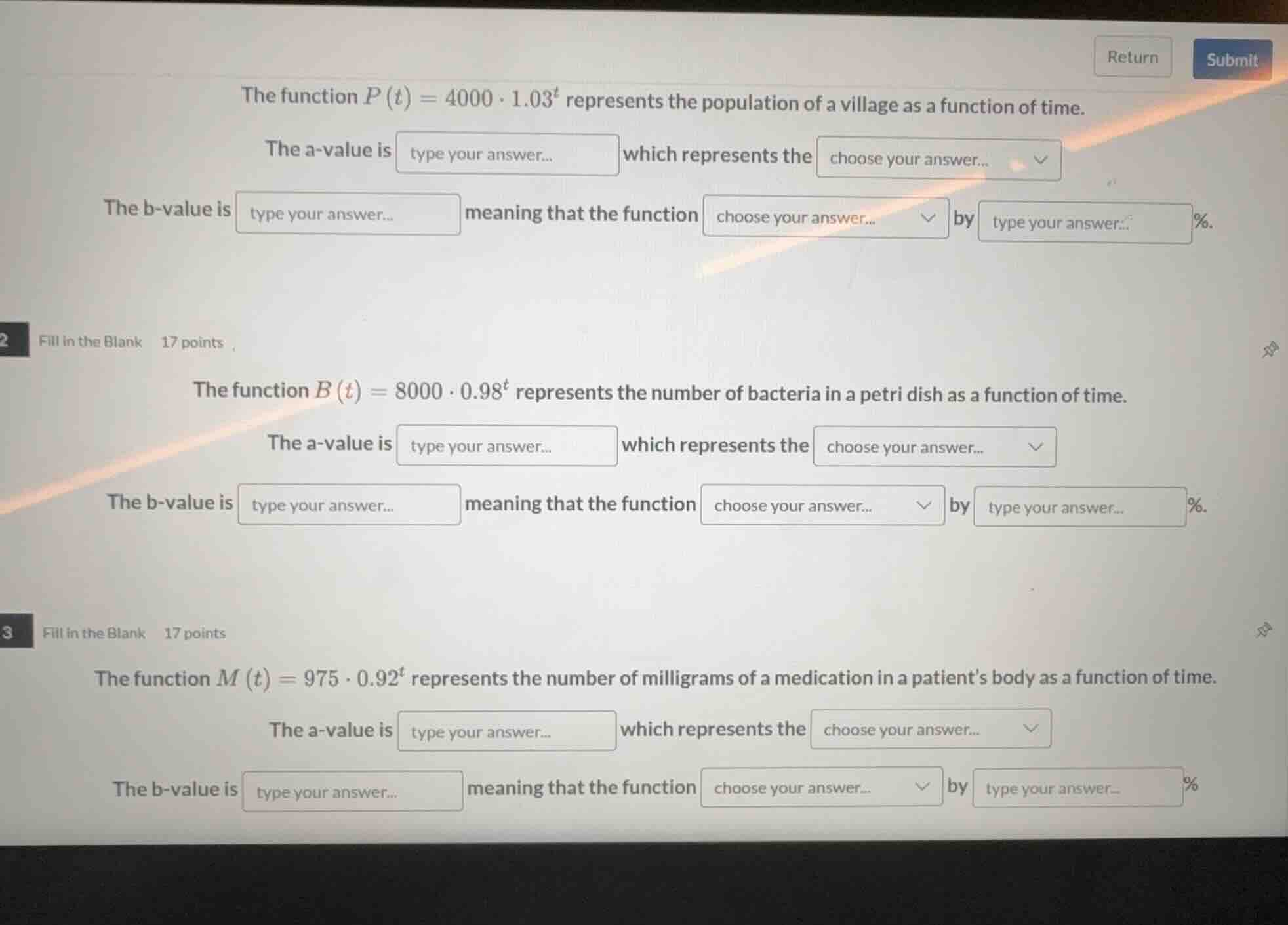
the function $p(t)=4000\cdot1.03^{t}$ represents the population of a village as a function of time.
the a-value is type your answer... which represents the choose your answer...
the b-value is type your answer... meaning that the function choose your answer... by type your answer... %.
2 fill in the blank 17 points
the function $b(t)=8000\cdot0.98^{t}$ represents the number of bacteria in a petri dish as a function of time.
the a-value is type your answer... which represents the choose your answer...
the b-value is type your answer... meaning that the function choose your answer... by type your answer... %.
3 fill in the blank 17 points
the function $m(t)=975\cdot0.92^{t}$ represents the number of milligrams of a medication in a patients body as a function of time.
the a-value is type your answer... which represents the choose your answer...
the b-value is type your answer... meaning that the function choose your answer... by type your answer... %
Step1: Identify a-value (initial amount)
For exponential functions of the form $P(t) = a \cdot b^t$, $a$ is the initial value when $t=0$.
Step2: Calculate growth/decay percentage
If $b>1$, growth rate = $(b-1) \times 100\%$. If $0 --- When $t=0$, $P(0)=4000 \cdot 1.03^0 = 4000$ $(1.03 - 1) \times 100\% = 3\%$ --- When $t=0$, $B(0)=8000 \cdot 0.98^0 = 8000$ $(1 - 0.98) \times 100\% = 2\%$ --- When $t=0$, $M(0)=975 \cdot 0.92^0 = 975$ $(1 - 0.92) \times 100\% = 8\%$For $P(t) = 4000 \cdot 1.03^t$
Step1: Find initial a-value
Step2: Calculate growth percentage
For $B(t) = 8000 \cdot 0.98^t$
Step1: Find initial a-value
Step2: Calculate decay percentage
For $M(t) = 975 \cdot 0.92^t$
Step1: Find initial a-value
Step2: Calculate decay percentage

Snap & solve any problem in the app
Get step-by-step solutions on Sovi AI
Photo-based solutions with guided steps
Explore more problems and detailed explanations
- For $P(t) = 4000 \cdot 1.03^t$:
- The a-value is 4000 which represents the initial village population
- The b-value is 1.03 meaning that the function increases by 3%.
- For $B(t) = 8000 \cdot 0.98^t$:
- The a-value is 8000 which represents the initial bacteria count
- The b-value is 0.98 meaning that the function decreases by 2%.
- For $M(t) = 975 \cdot 0.92^t$:
- The a-value is 975 which represents the initial medication amount
- The b-value is 0.92 meaning that the function decreases by 8%.