QUESTION IMAGE
Question
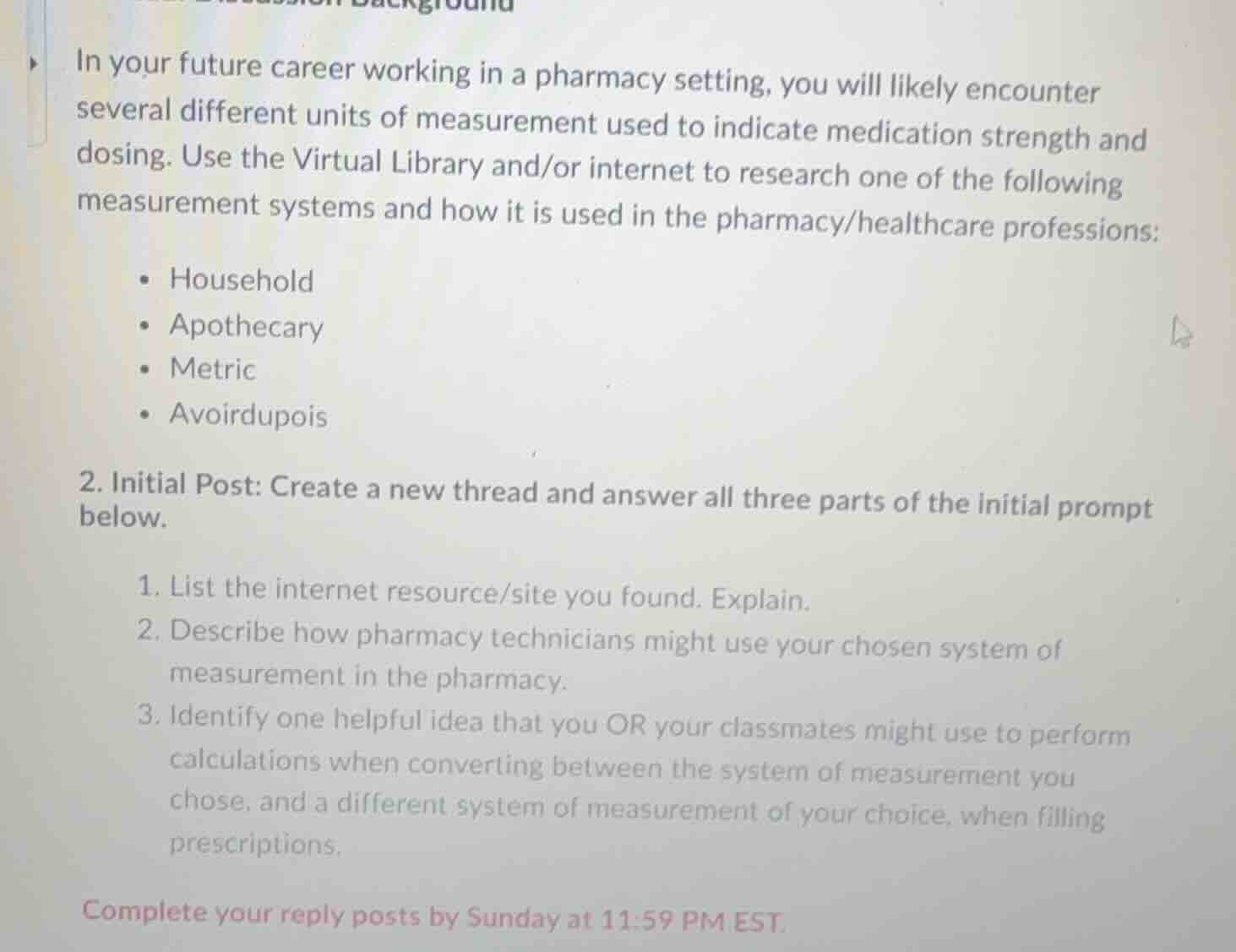
in your future career working in a pharmacy setting, you will likely encounter several different units of measurement used to indicate medication strength and dosing. use the virtual library and/or internet to research one of the following measurement systems and how it is used in the pharmacy/healthcare professions: - household - apothecary - metric - avoirdupois 2. initial post: create a new thread and answer all three parts of the initial prompt below. 1. list the internet resource/site you found. explain. 2. describe how pharmacy technicians might use your chosen system of measurement in the pharmacy. 3. identify one helpful idea that you or your classmates might use to perform calculations when converting between the system of measurement you chose, and a different system of measurement of your choice, when filling prescriptions. complete your reply posts by sunday at 11:59 pm est.
This is a task related to researching and discussing measurement systems in pharmacy, which falls under the Natural Science discipline, specifically in the subfield of Medicine and Health (since it's about pharmacy and healthcare professions). Here's a sample response following the Answer-Explanation Format:
1. Internet Resource/Site:
I chose to research the Metric system. A useful internet resource is the website of the American Pharmacists Association (https://www.pharmacist.com/). This site provides detailed information on pharmaceutical practices, including the use of different measurement systems in pharmacy. It has articles, guidelines, and resources specifically tailored for pharmacy professionals, which can help in understanding how the Metric system is applied in dosing, compounding, and dispensing medications.
2. Use of the Metric System by Pharmacy Technicians:
Pharmacy technicians use the Metric system extensively in the pharmacy. For example, when measuring the volume of liquid medications (like syrups or injectables), they use units such as milliliters ($mL$). When dealing with the mass of solid medications (like tablets or powders), they use grams ($g$) and milligrams ($mg$). In compounding, precise measurements using the Metric system are crucial to ensure the correct concentration of active ingredients in a medication. For instance, if a prescription calls for a 500 mg dose of an antibiotic, the technician will use the Metric system to measure the appropriate amount from a bulk supply (e.g., if the bulk powder is in grams, they will convert it to milligrams as needed, knowing that $1\ g = 1000\ mg$). Also, when preparing intravenous (IV) solutions, the volume (in liters or milliliters) and the amount of solute (in grams or milligrams) are measured using the Metric system to ensure the patient receives the correct dosage.
3. Helpful Idea for Conversion:
When converting between the Metric system and the Household system (for example, when a patient needs to take a medication at home and the prescription is in Metric units but the patient is more familiar with Household units like teaspoons or tablespoons), a helpful idea is to use conversion charts or mnemonic devices. For example, we know that $1\ teaspoon (tsp) \approx 5\ mL$ and $1\ tablespoon (tbsp) \approx 15\ mL$. So, if a prescription is for $10\ mL$ of a liquid medication, we can tell the patient that this is approximately $2\ teaspoons$ (since $10\ mL \div 5\ mL/tsp = 2\ tsp$). Another way is to use online conversion tools or mobile apps that can quickly convert between the two systems. However, for manual calculations, remembering the basic conversion factors (like $1\ mL \approx 0.2\ tsp$ or $1\ tsp \approx 5\ mL$) can be very helpful. Also, creating a cheat sheet with common conversions (e.g., $1\ g = 1000\ mg$, $1\ kg = 1000\ g$, $1\ L = 1000\ mL$ for Metric - Metric conversions, and Metric - Household conversions as mentioned) and keeping it accessible at the pharmacy workstation can assist in quick and accurate calculations when filling prescriptions.

Snap & solve any problem in the app
Get step-by-step solutions on Sovi AI
Photo-based solutions with guided steps
Explore more problems and detailed explanations
- Internet Resource: American Pharmacists Association (https://www.pharmacist.com/), a reliable source for pharmacy - related measurement system information.
- Pharmacy technicians use the Metric system for measuring liquid (e.g., $mL$) and solid (e.g., $mg$, $g$) medication amounts, compounding, and IV solution preparation.
- Use conversion charts/mnemonic devices (e.g., $1\ tsp\approx5\ mL$) or online tools for converting between Metric and other systems (e.g., Household) when filling prescriptions.