QUESTION IMAGE
Question
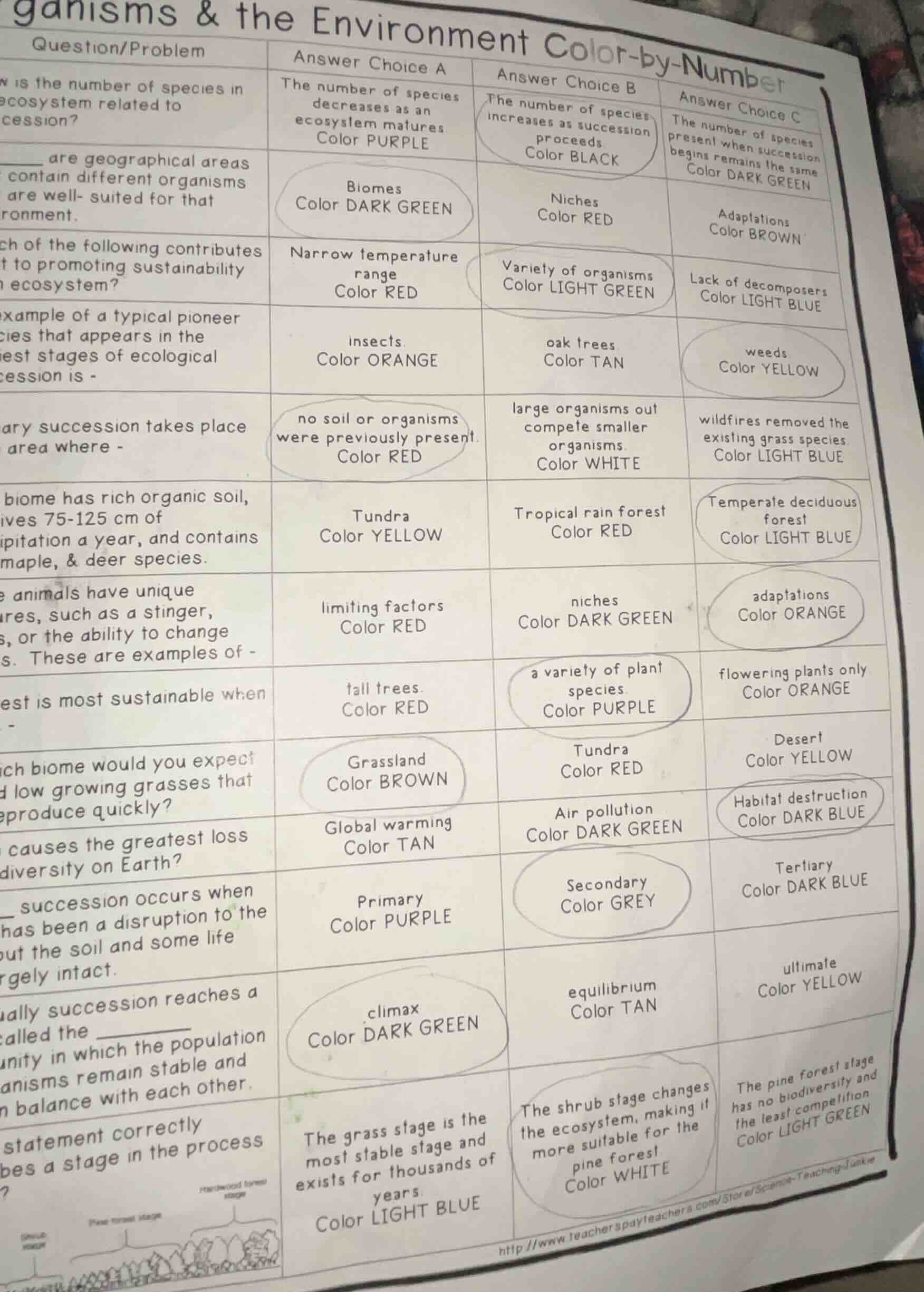
ganisms & the environment color-by-number
question/problem\tanswer choice a\tanswer choice b\tanswer choice c
w is the number of species in ecosystem related to cession?\tthe number of species decreases as an ecosystem matures color purple\tthe number of species increases as succession proceeds color black\tthe number of species present when succession begins remains the same color dark green
______ are geographical areas contain different organisms are well- suited for that ronnement.\tbiomes color dark green\tniches color red\tadaptations color brown
ch of the following contributes t to promoting sustainability n ecosystem?\tnarrow temperature range color red\tvariety of organisms color light green\tlack of decomposers color light blue
example of a typical pioneer cies that appears in the est stages of ecological cession is -\tinsects color orange\toak trees color tan\tweeds color yellow
ary succession takes place area where -\tno soil or organisms were previously present color red\tlarge organisms out compete smaller organisms color white\twildfires removed the existing grass species color light blue
biome has rich organic soil, ives 75 - 125 cm of ipitation a year, and contains maple, & deer species.\ttundra color yellow\ttropical rain forest color red\ttemperate deciduous forest color light blue
e animals have unique ures, such as a stinger, s, or the ability to change s. these are examples of -\tlimiting factors color red\tniches color dark green\tadaptations color orange
eest is most sustainable when -\ttall trees color red\ta variety of plant species color purple\tflowering plants only color orange
ich biome would you expect d low growing grasses that eproduce quickly?\tgrassland color brown\ttundra color red\tdesert color yellow
causes the greatest loss diversity on earth?\tglobal warming color tan\tair pollution color dark green\thabitat destruction color dark blue
____ succession occurs when has been a disruption to the but the soil and some life rgely intact.\tprimary color purple\tsecondary color grey\ttertiary color dark blue
ually succession reaches a called the ______ unity in which the population anisms remain stable and n balance with each other.\tclimax color dark green\tequilibrium color tan\tultimate color yellow
statement correctly bes a stage in the process?\tthe grass stage is the most stable stage and exists for thousands of years color light blue\tthe shrub stage changes the ecosystem, making it more suitable for the pine forest color white\tthe pine forest stage has no biodiversity and the least competition color light green
To solve these multiple - choice questions related to ecosystems and the environment, we analyze each one based on ecological concepts:
Question 1: How is the number of species in an ecosystem related to succession?
- Concept: Ecological succession is the process of change in the species structure of an ecological community over time. As succession proceeds (from pioneer to climax community), the number of species generally increases because more niches are created and the ecosystem becomes more complex.
- Answer: B. The number of species increases as succession proceeds Color BLACK
Question 2: ____ are geographical areas that contain different organisms and are well - suited for that environment.
- Concept: Biomes are large geographical areas with distinct climates and characteristic communities of plants and animals. Niches are the role an organism plays in an ecosystem, and adaptations are traits of an organism.
- Answer: A. Biomes Color DARK GREEN
Question 3: Which of the following contributes most to promoting sustainability in an ecosystem?
- Concept: A variety of organisms (high biodiversity) promotes sustainability as it increases the ecosystem's resilience to disturbances. A narrow temperature range and lack of decomposers are not conducive to sustainability.
- Answer: B. Variety of organisms Color LIGHT GREEN
Question 4: An example of a typical pioneer species that appears in the earliest stages of ecological succession is -
- Concept: Pioneer species are the first organisms to colonize a barren environment. Weeds are often pioneer species as they can grow in harsh, newly formed or disturbed environments. Insects and oak trees are not typical pioneer species (oak trees are later successional species, insects depend on plants).
- Answer: C. weeds Color YELLOW
Question 5: Primary succession takes place in an area where -
- Concept: Primary succession occurs in an area where there was no previous soil or organisms (e.g., after a volcanic eruption or glacial retreat). Secondary succession occurs in areas where there was a disturbance but soil and some life remain.
- Answer: A. no soil or organisms were previously present. Color RED
Question 6: A biome has rich organic soil, receives 75 - 125 cm of precipitation a year, and contains maple, & deer species.
- Concept: Temperate deciduous forests have rich organic soil, moderate precipitation (75 - 150 cm/year), and species like maple trees and deer. Tundra has poor soil and low precipitation, tropical rainforests have high precipitation and different species.
- Answer: C. Temperate deciduous forest Color LIGHT BLUE
Question 7: Some animals have unique features, such as a stinger, shells, or the ability to change colors. These are examples of -
- Concept: Adaptations are structural, behavioral, or physiological traits that help an organism survive and reproduce in its environment. Limiting factors are factors that restrict population growth, niches are an organism's role.
- Answer: C. adaptations Color ORANGE
Question 8: A forest is most sustainable when -
- Concept: A variety of plant species (high plant biodiversity) makes a forest more sustainable as it supports a diverse community of animals and increases the forest's ability to withstand disturbances. Tall trees alone or only flowering plants do not promote sustainability as well.
- Answer: B. a variety of plant species Color PURPLE
Question 9: Which biome would you expect to find low - growing grasses that reproduce qu…

Snap & solve any problem in the app
Get step-by-step solutions on Sovi AI
Photo-based solutions with guided steps
Explore more problems and detailed explanations
To solve these multiple - choice questions related to ecosystems and the environment, we analyze each one based on ecological concepts:
Question 1: How is the number of species in an ecosystem related to succession?
- Concept: Ecological succession is the process of change in the species structure of an ecological community over time. As succession proceeds (from pioneer to climax community), the number of species generally increases because more niches are created and the ecosystem becomes more complex.
- Answer: B. The number of species increases as succession proceeds Color BLACK
Question 2: ____ are geographical areas that contain different organisms and are well - suited for that environment.
- Concept: Biomes are large geographical areas with distinct climates and characteristic communities of plants and animals. Niches are the role an organism plays in an ecosystem, and adaptations are traits of an organism.
- Answer: A. Biomes Color DARK GREEN
Question 3: Which of the following contributes most to promoting sustainability in an ecosystem?
- Concept: A variety of organisms (high biodiversity) promotes sustainability as it increases the ecosystem's resilience to disturbances. A narrow temperature range and lack of decomposers are not conducive to sustainability.
- Answer: B. Variety of organisms Color LIGHT GREEN
Question 4: An example of a typical pioneer species that appears in the earliest stages of ecological succession is -
- Concept: Pioneer species are the first organisms to colonize a barren environment. Weeds are often pioneer species as they can grow in harsh, newly formed or disturbed environments. Insects and oak trees are not typical pioneer species (oak trees are later successional species, insects depend on plants).
- Answer: C. weeds Color YELLOW
Question 5: Primary succession takes place in an area where -
- Concept: Primary succession occurs in an area where there was no previous soil or organisms (e.g., after a volcanic eruption or glacial retreat). Secondary succession occurs in areas where there was a disturbance but soil and some life remain.
- Answer: A. no soil or organisms were previously present. Color RED
Question 6: A biome has rich organic soil, receives 75 - 125 cm of precipitation a year, and contains maple, & deer species.
- Concept: Temperate deciduous forests have rich organic soil, moderate precipitation (75 - 150 cm/year), and species like maple trees and deer. Tundra has poor soil and low precipitation, tropical rainforests have high precipitation and different species.
- Answer: C. Temperate deciduous forest Color LIGHT BLUE
Question 7: Some animals have unique features, such as a stinger, shells, or the ability to change colors. These are examples of -
- Concept: Adaptations are structural, behavioral, or physiological traits that help an organism survive and reproduce in its environment. Limiting factors are factors that restrict population growth, niches are an organism's role.
- Answer: C. adaptations Color ORANGE
Question 8: A forest is most sustainable when -
- Concept: A variety of plant species (high plant biodiversity) makes a forest more sustainable as it supports a diverse community of animals and increases the forest's ability to withstand disturbances. Tall trees alone or only flowering plants do not promote sustainability as well.
- Answer: B. a variety of plant species Color PURPLE
Question 9: Which biome would you expect to find low - growing grasses that reproduce quickly?
- Concept: Grasslands are characterized by grasses (both tall and short - growing) that can reproduce quickly. Tundra has low - growing vegetation but is not dominated by grasses that reproduce quickly in the same way, deserts have sparse vegetation.
- Answer: A. Grassland Color BROWN
Question 10: What causes the greatest loss of biodiversity on Earth?
- Concept: Habitat destruction (due to human activities like deforestation, urbanization) is the leading cause of biodiversity loss. Global warming and air pollution also affect biodiversity but not as severely as habitat destruction.
- Answer: C. Habitat destruction Color DARK BLUE
Question 11: ____ succession occurs when there has been a disruption to the area but the soil and some life are largely intact.
- Concept: Secondary succession occurs in areas where there has been a disturbance (like a wildfire) but soil and some organisms remain. Primary succession is in barren areas, tertiary is not a main type of ecological succession.
- Answer: B. Secondary Color GREY
Question 12: Usually succession reaches a stage called the ____ community in which the population of organisms remain stable and in balance with each other.
- Concept: The climax community is the final, stable stage of ecological succession where the community is in equilibrium with the environment.
- Answer: A. climax Color DARK GREEN
Question 13: Which statement correctly describes a stage in the process [of succession]?
- Concept: The shrub stage changes the ecosystem, making it more suitable for the pine forest (this is a part of ecological succession where one stage paves the way for the next). The grass stage is not the most stable stage for thousands of years, and the pine forest stage has biodiversity and competition.
- Answer: B. The shrub stage changes the ecosystem, making it more suitable for the pine forest Color WHITE