QUESTION IMAGE
Question
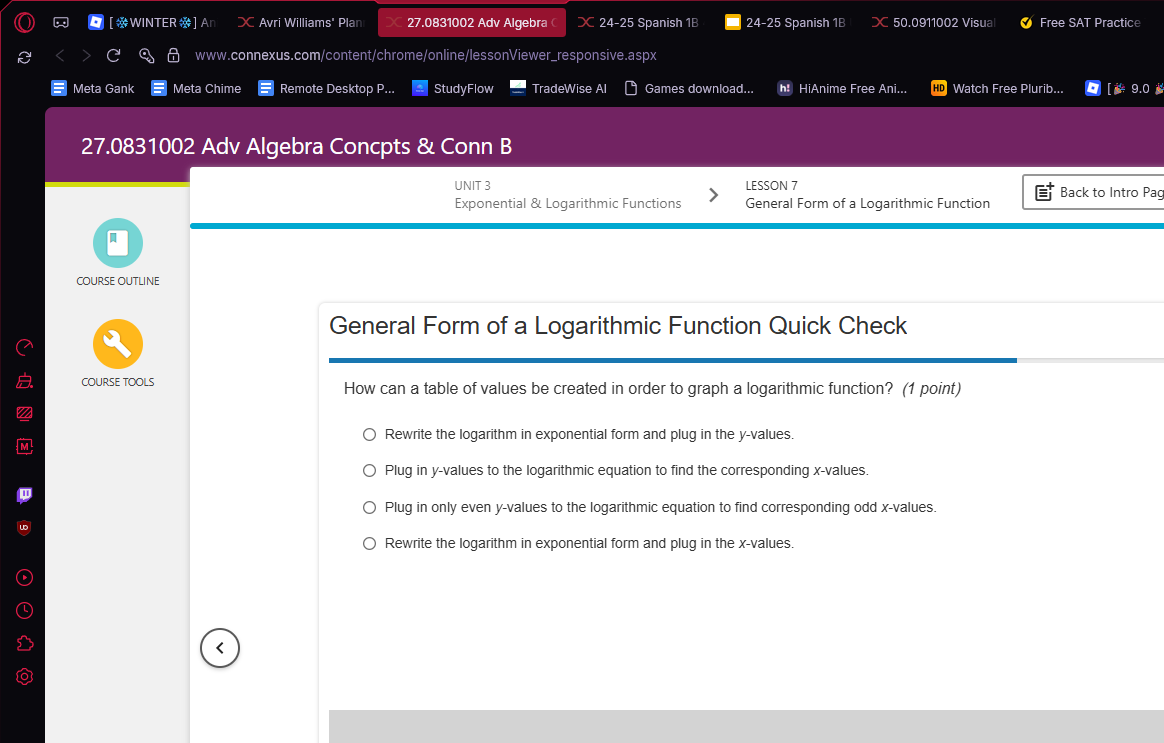
general form of a logarithmic function quick check
how can a table of values be created in order to graph a logarithmic function? (1 point)
rewrite the logarithm in exponential form and plug in the y - values.
plug in y - values to the logarithmic equation to find the corresponding x - values.
plug in only even y - values to the logarithmic equation to find corresponding odd x - values.
rewrite the logarithm in exponential form and plug in the x - values.
To create a table of values for a logarithmic function, we use the relationship between logarithms and exponents. A logarithmic function \( y = \log_b(x) \) can be rewritten in exponential form as \( x = b^y \). To find the corresponding \( x \)-values for a table, we typically plug in \( y \)-values (or sometimes \( x \)-values, but in the context of graphing, when creating a table, we often choose \( y \)-values and find \( x \)-values, or rewrite in exponential form and plug in \( x \)-values? Wait, no—let's recall. The general form of a logarithmic function is \( y=\log_b(x) \), which is equivalent to \( x = b^y \) (exponential form). To create a table, we can rewrite the logarithm in exponential form and then plug in \( y \)-values to find \( x \)-values, or plug in \( x \)-values? Wait, the options:
- Option 1: Rewrite in exponential form and plug in \( y \)-values. Let's see: If we have \( y = \log_b(x) \), rewrite as \( x = b^y \). Then, for a given \( y \), we can compute \( x \). So we plug in \( y \)-values (like \( y = -2, -1, 0, 1, 2 \)) and find \( x = b^y \). That makes sense.
- Option 2: Plug in \( y \)-values to the logarithmic equation to find \( x \)-values. The logarithmic equation is \( y = \log_b(x) \), so solving for \( x \) would require rewriting in exponential form (since \( x = b^y \)), so this is similar to option 1 but maybe less precise.
- Option 3: Plug in only even \( y \)-values to find odd \( x \)-values. This is not a general method; there's no reason to restrict to even/odd.
- Option 4: Rewrite in exponential form and plug in \( x \)-values. Wait, no—if we rewrite as \( x = b^y \), plugging in \( x \)-values would mean solving for \( y \), but typically when creating a table, we choose \( y \)-values (outputs) to find \( x \)-values (inputs), or vice versa. But the correct method is to rewrite the logarithm in exponential form (to make it easier, since exponential form is more straightforward for calculation) and then plug in \( x \)-values? Wait, no—wait, the function is \( y = \log_b(x) \), so \( x \) is the input (domain), \( y \) is the output (range). To create a table, we can choose \( x \)-values (in the domain of the log function, \( x > 0 \)) and compute \( y \), or choose \( y \)-values and compute \( x \). But the options:
Wait, the question is "How can a table of values be created in order to graph a logarithmic function?" Let's analyze each option:
- Rewrite the logarithm in exponential form and plug in the \( y \)-values. So \( y = \log_b(x) \) becomes \( x = b^y \). Then, for each \( y \) (like \( y = -1, 0, 1, 2 \)), we calculate \( x = b^y \). This is a valid method because exponential form is easier to compute for integer \( y \)-values (e.g., \( y = 0 \) gives \( x = 1 \), \( y = 1 \) gives \( x = b \), \( y = -1 \) gives \( x = 1/b \), etc.).
- Plug in \( y \)-values to the logarithmic equation to find \( x \)-values. The logarithmic equation is \( y = \log_b(x) \), so to find \( x \), we need to rewrite it as \( x = b^y \) (exponential form), so this is the same as option 1 but without mentioning the exponential form rewrite, which is necessary. So option 1 is better.
- Plug in only even \( y \)-values to find odd \( x \)-values. This is not a standard method; there's no requirement for even/odd, so this is incorrect.
- Rewrite the logarithm in exponential form and plug in the \( x \)-values. If we rewrite \( y = \log_b(x) \) as \( x = b^y \), plugging in \( x \)-values would mean solving for \( y \) (since \( y = \log_b(x) \)), which is possible, but typically whe…

Snap & solve any problem in the app
Get step-by-step solutions on Sovi AI
Photo-based solutions with guided steps
Explore more problems and detailed explanations
A. Rewrite the logarithm in exponential form and plug in the \( y \)-values.