QUESTION IMAGE
Question
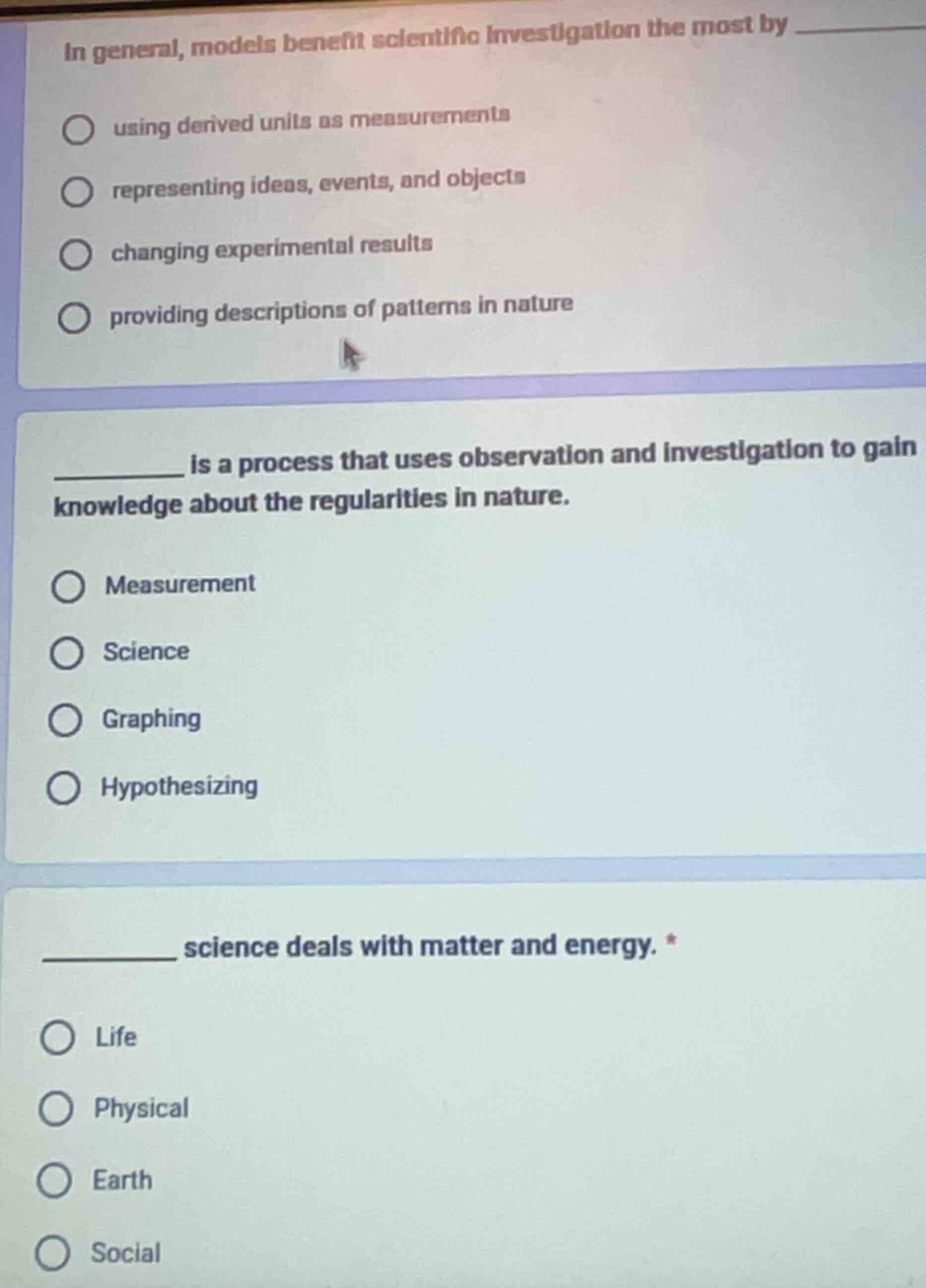
in general, models benefit scientific investigation the most by
using derived units as measurements
representing ideas, events, and objects
changing experimental results
providing descriptions of patterns in nature
______ is a process that uses observation and investigation to gain knowledge about the regularities in nature.
measurement
science
graphing
hypothesizing
______ science deals with matter and energy.
life
physical
earth
social
Response
First Question:
Brief Explanations
- "using derived units as measurements": Models aren't mainly for using derived units; derived units are for measurement systems.
- "representing ideas, events, and objects": Models in science (like physical, conceptual models) represent these to simplify understanding, which is a key benefit.
- "changing experimental results": Models don't change results; they help interpret or predict, not alter data.
- "providing descriptions of patterns in nature": Theories/laws describe patterns; models represent, not just describe patterns.
Brief Explanations
- "Measurement": Is about quantifying, not the process of gaining knowledge about nature's regularities.
- "Science": Science is the process of using observation/investigation to understand natural regularities.
- "Graphing": Is a tool to display data, not the process of gaining knowledge about nature.
- "Hypothesizing": Is part of the scientific method, not the overall process of gaining knowledge about nature's regularities.
Brief Explanations
- "Life science": Deals with living organisms, not matter and energy.
- "Physical science": Includes physics/chemistry, which deal with matter and energy (e.g., motion, energy transfer, chemical reactions).
- "Earth science": Deals with Earth's systems (geology, meteorology), not matter and energy in the broad physical sense.
- "Social science": Deals with human society, not matter and energy.

Snap & solve any problem in the app
Get step-by-step solutions on Sovi AI
Photo-based solutions with guided steps
Explore more problems and detailed explanations
B. representing ideas, events, and objects