QUESTION IMAGE
Question
general steps
- count all bonds to get the number of sigma bonds
- add 1 pi bond for each double bond
- add 2 pi bonds for each triple bond
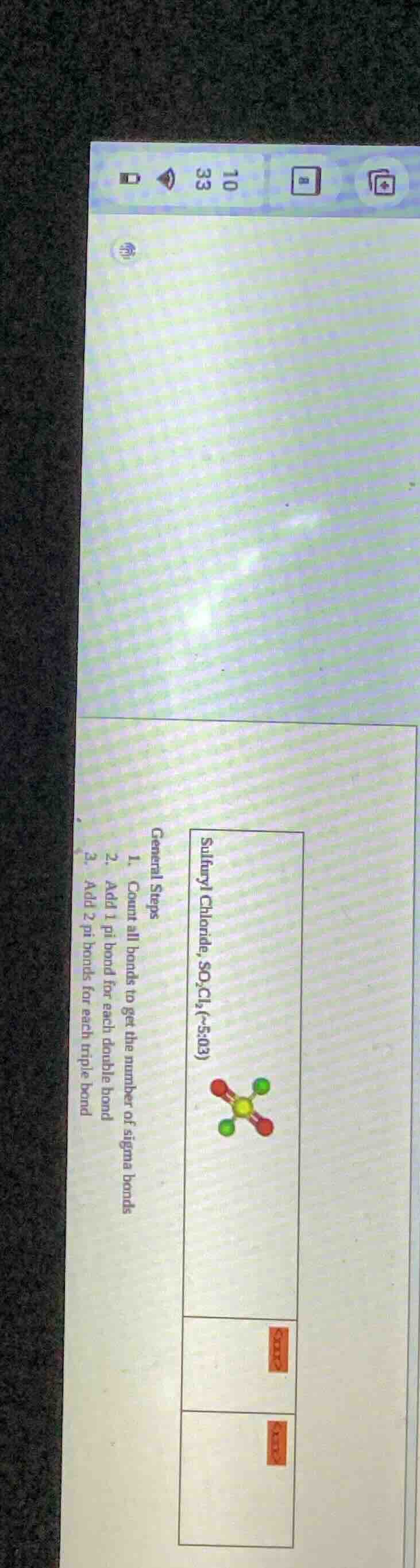
sulfuryl chloride, so₂cl₂ (~5:03)
image of sulfuryl chloride molecule
Step1: Determine the structure of \( SO_2Cl_2 \)
The Lewis structure of \( SO_2Cl_2 \) has the sulfur atom bonded to two chlorine atoms (single bonds) and two oxygen atoms. The sulfur - oxygen bonds: one double bond and one double bond? Wait, actually, the correct structure: Sulfur is the central atom. It forms single bonds with 2 Cl atoms (\( S - Cl \)) and double bonds with 2 O atoms (\( S = O \)).
First, count the sigma bonds: All single bonds and one of the bonds in a double bond is a sigma bond. So, the \( S - Cl \) bonds: 2 sigma bonds. The \( S = O \) bonds: each double bond has 1 sigma bond, so 2 sigma bonds from the double bonds. Also, wait, no: Let's re - examine. The formula for \( SO_2Cl_2 \): S is bonded to 2 Cl (single bonds, so 2 sigma bonds) and 2 O. The S - O bonds: in \( SO_2Cl_2 \), the sulfur - oxygen bonds are double bonds? Wait, the correct Lewis structure: S has a steric number of 4 (2 single bonds to Cl, 2 double bonds to O? No, steric number calculation: number of bonding groups + number of lone pairs. For S in \( SO_2Cl_2 \), valence electrons of S: 6, Cl: 7 each (2 Cl: 14), O: 6 each (2 O: 12). Total valence electrons: \( 6 + 14+12 = 32 \).
Let's distribute the electrons: S is central. Connect S to 2 Cl and 2 O. Each S - Cl bond: 2 electrons (1 bond), so 2 bonds: 4 electrons. Each S - O bond: let's start with single bonds. S - O single bonds: 2 bonds, 4 electrons. Now, S has used \( 2 + 2=4 \) bonds (8 electrons), and has \( 6 - 4 = 2 \) electrons left (1 lone pair? No, wait, valence electrons of S: 6. After forming 4 single bonds (to 2 Cl and 2 O), it has \( 6-4 = 2 \) electrons (1 lone pair). But O has 6 valence electrons. If S - O is a single bond, O has \( 6 - 1=5 \) electrons (needs 1 more to complete octet). So we can form double bonds between S and O. So, convert two of the single S - O bonds to double bonds. So, each S - O double bond: now, for each S - O double bond, we have 1 sigma and 1 pi bond.
Now, count sigma bonds:
- \( S - Cl \) bonds: 2 sigma bonds (single bonds)
- \( S - O \) bonds: each double bond has 1 sigma bond, so 2 sigma bonds (from the two \( S = O \) double bonds)
Wait, no, actually, when we have a double bond (\( S = O \)), one bond is sigma and one is pi. So total sigma bonds: \( S - Cl \) (2) + \( S - O \) (2, one from each double bond) + wait, no, the S is bonded to 2 Cl (single bonds, 2 sigma) and 2 O (double bonds, each double bond has 1 sigma). So total sigma bonds: \( 2 + 2=4 \)? Wait, no, maybe I made a mistake. Let's use the general steps:
Step 1: Count all bonds to get the number of sigma bonds. In a single bond, there is 1 sigma bond. In a double bond, there is 1 sigma and 1 pi bond. In a triple bond, 1 sigma and 2 pi bonds.
For \( SO_2Cl_2 \):
- Bonds: 2 \( S - Cl \) (single bonds, so 2 sigma bonds)
- 2 \( S = O \) (double bonds, each has 1 sigma bond, so 2 sigma bonds)
Total sigma bonds: \( 2 + 2=4 \)? Wait, no, wait the correct structure: Let's check the molecular geometry. The \( SO_2Cl_2 \) has a tetrahedral geometry around S. The bonds: S - Cl (2), S - O (2). The S - O bonds: are they single or double? The formal charge on S: valence electrons of S is 6. In \( SO_2Cl_2 \), if S is bonded to 2 Cl (each single bond: 2 electrons from S) and 2 O (each double bond: 4 electrons from S? No, formal charge formula: \( FC=V - N - \frac{B}{2} \), where V is valence electrons, N is non - bonding electrons, B is bonding electrons.
For S: V = 6, N = 0 (in the correct structure, S has no lone pairs), B: if S is bonded to 2 Cl (single bonds: 2 bonds, 4 electrons) and 2…

Snap & solve any problem in the app
Get step-by-step solutions on Sovi AI
Photo-based solutions with guided steps
Explore more problems and detailed explanations
Sigma bonds: \(\boldsymbol{4}\), Pi bonds: \(\boldsymbol{2}\)