QUESTION IMAGE
Question
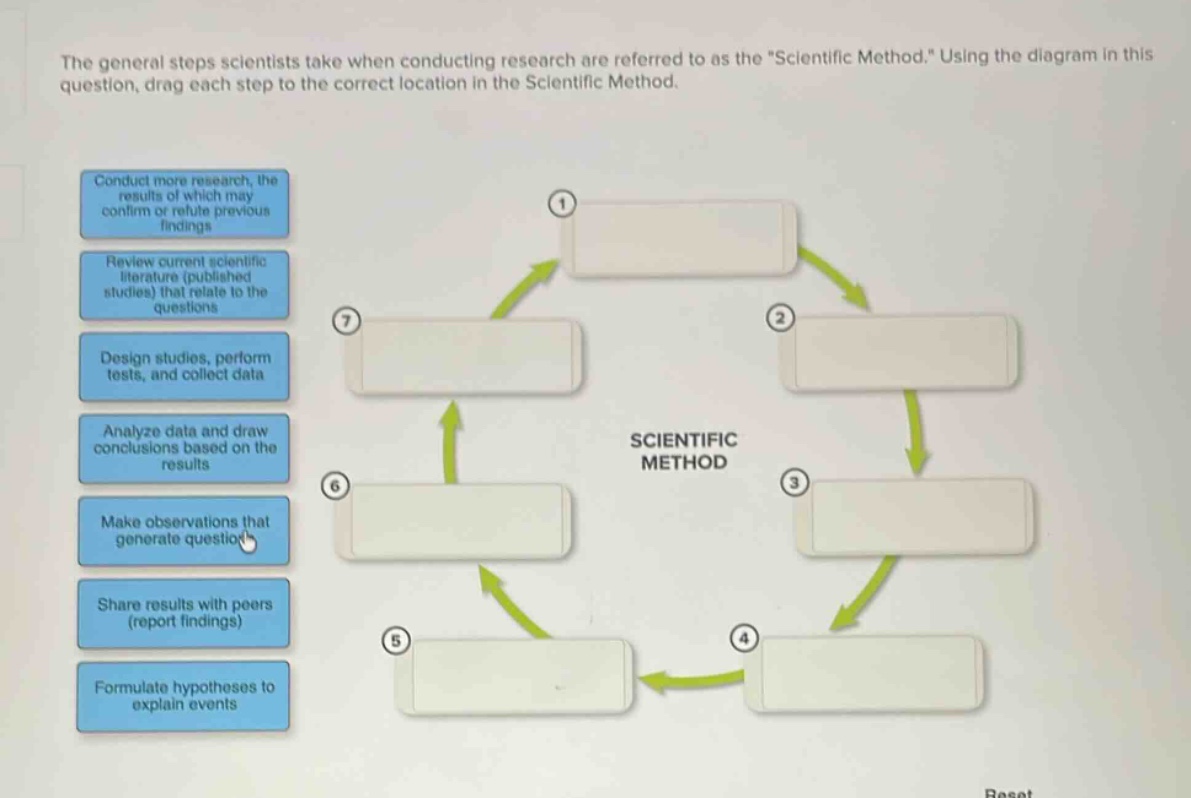
the general steps scientists take when conducting research are referred to as the \scientific method.\ using the diagram in this question, drag each step to the correct location in the scientific method.
conduct more research, the results of which may confirm or refute previous findings
review current scientific literature (published studies) that relate to the questions
design studies, perform tests, and collect data
analyze data and draw conclusions based on the results
make observations that generate questions
share results with peers (report findings)
formulate hypotheses to explain events
The scientific method typically follows this order:
- Make observations that generate questions: This is the starting point, noticing phenomena and forming questions.
- Review current scientific literature: To understand what's already known about the question.
- Formulate hypotheses to explain events: Propose explanations for the observed phenomena.
- Design studies, perform tests, and collect data: Plan and execute experiments to gather data.
- Analyze data and draw conclusions based on the results: Examine the data to see if it supports the hypothesis.
- Share results with peers (report findings): Communicate the results to the scientific community.
- Conduct more research, the results of which may confirm or refute previous findings: Use the results to guide further research, which can either support or contradict earlier work.
So the correct mapping is:
- Make observations that generate questions
- Review current scientific literature (published studies) that relate to the questions
- Formulate hypotheses to explain events
- Design studies, perform tests, and collect data
- Analyze data and draw conclusions based on the results
- Share results with peers (report findings)
- Conduct more research, the results of which may confirm or refute previous findings

Snap & solve any problem in the app
Get step-by-step solutions on Sovi AI
Photo-based solutions with guided steps
Explore more problems and detailed explanations
- Make observations that generate questions
- Review current scientific literature (published studies) that relate to the questions
- Formulate hypotheses to explain events
- Design studies, perform tests, and collect data
- Analyze data and draw conclusions based on the results
- Share results with peers (report findings)
- Conduct more research, the results of which may confirm or refute previous findings