QUESTION IMAGE
Question
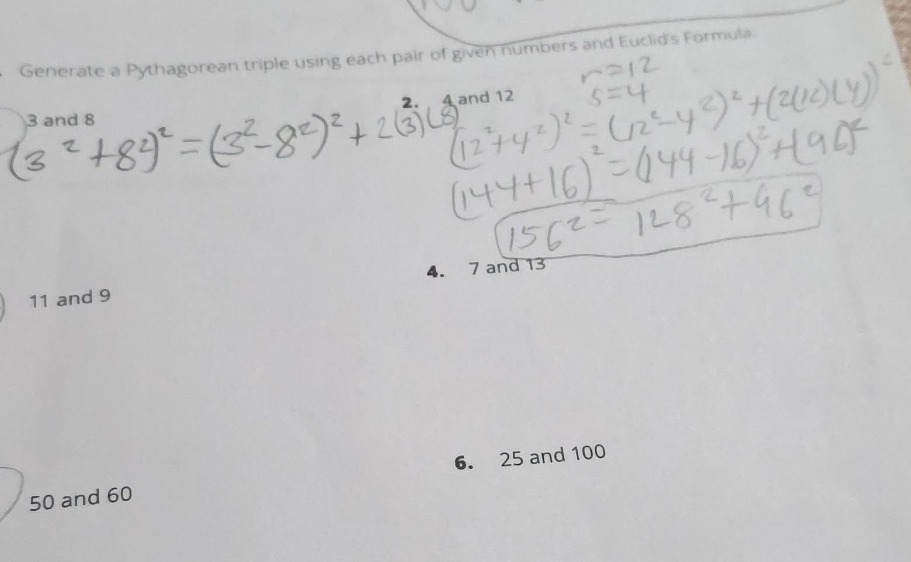
generate a pythagorean triple using each pair of given numbers and euclids formula
3 and 8
$(3^2 + 8^2)^2 = (3^2 - 8^2)^2 + 2(3)(8)$
- 4 and 12
$r = 12$
$s = 4$
$(12^2 + 4^2)^2 = (12^2 - 4^2)^2 + (2(12)(4))^2$
$(144 + 16)^2 = (144 - 16)^2 + (96)^2$
$156^2 = 128^2 + 96^2$
- 7 and 13
11 and 9
- 25 and 100
50 and 60
To generate a Pythagorean triple using Euclid's formula, we use the following steps:
Euclid's Formula:
For two positive integers \( m \) and \( n \) (where \( m > n \)), the Pythagorean triple is given by:
\[
a = m^2 - n^2, \quad b = 2mn, \quad c = m^2 + n^2
\]
Let's solve each problem:
1. 3 and 8
Wait, \( m > n \), so we need \( m = 8 \) and \( n = 3 \) (since \( 8 > 3 \)):
- \( a = 8^2 - 3^2 = 64 - 9 = 55 \)
- \( b = 2 \times 8 \times 3 = 48 \)
- \( c = 8^2 + 3^2 = 64 + 9 = 73 \)
So the triple is \( (48, 55, 73) \).
2. 4 and 12
Here, \( m = 12 \) and \( n = 4 \) (since \( 12 > 4 \)):
- \( a = 12^2 - 4^2 = 144 - 16 = 128 \)
- \( b = 2 \times 12 \times 4 = 96 \)
- \( c = 12^2 + 4^2 = 144 + 16 = 160 \) (Wait, the original work had \( 156 \), which is incorrect. Let's recalculate: \( 12^2 + 4^2 = 144 + 16 = 160 \), so the correct triple is \( (96, 128, 160) \).
3. 11 and 9
Here, \( m = 11 \) and \( n = 9 \) (since \( 11 > 9 \)):
- \( a = 11^2 - 9^2 = 121 - 81 = 40 \)
- \( b = 2 \times 11 \times 9 = 198 \)
- \( c = 11^2 + 9^2 = 121 + 81 = 202 \)
So the triple is \( (40, 198, 202) \).
4. 7 and 13
Here, \( m = 13 \) and \( n = 7 \) (since \( 13 > 7 \)):
- \( a = 13^2 - 7^2 = 169 - 49 = 120 \)
- \( b = 2 \times 13 \times 7 = 182 \)
- \( c = 13^2 + 7^2 = 169 + 49 = 218 \)
So the triple is \( (120, 182, 218) \).
5. 50 and 60
Here, \( m = 60 \) and \( n = 50 \) (since \( 60 > 50 \)):
- \( a = 60^2 - 50^2 = 3600 - 2500 = 1100 \)
- \( b = 2 \times 60 \times 50 = 6000 \)
- \( c = 60^2 + 50^2 = 3600 + 2500 = 6100 \)
So the triple is \( (1100, 6000, 6100) \).
6. 25 and 100
Here, \( m = 100 \) and \( n = 25 \) (since \( 100 > 25 \)):
- \( a = 100^2 - 25^2 = 10000 - 625 = 9375 \)
- \( b = 2 \times 100 \times 25 = 5000 \)
- \( c = 100^2 + 25^2 = 10000 + 625 = 10625 \)
So the triple is \( (5000, 9375, 10625) \).
Final Answers:
- 3 and 8: \( \boldsymbol{(48, 55, 73)} \)
- 4 and 12: \( \boldsymbol{(96, 128, 160)} \) (corrected from the original work)
- 11 and 9: \( \boldsymbol{(40, 198, 202)} \)
- 7 and 13: \( \boldsymbol{(120, 182, 218)} \)
- 50 and 60: \( \boldsymbol{(1100, 6000, 6100)} \)
- 25 and 100: \( \boldsymbol{(5000, 9375, 10625)} \)

Snap & solve any problem in the app
Get step-by-step solutions on Sovi AI
Photo-based solutions with guided steps
Explore more problems and detailed explanations
To generate a Pythagorean triple using Euclid's formula, we use the following steps:
Euclid's Formula:
For two positive integers \( m \) and \( n \) (where \( m > n \)), the Pythagorean triple is given by:
\[
a = m^2 - n^2, \quad b = 2mn, \quad c = m^2 + n^2
\]
Let's solve each problem:
1. 3 and 8
Wait, \( m > n \), so we need \( m = 8 \) and \( n = 3 \) (since \( 8 > 3 \)):
- \( a = 8^2 - 3^2 = 64 - 9 = 55 \)
- \( b = 2 \times 8 \times 3 = 48 \)
- \( c = 8^2 + 3^2 = 64 + 9 = 73 \)
So the triple is \( (48, 55, 73) \).
2. 4 and 12
Here, \( m = 12 \) and \( n = 4 \) (since \( 12 > 4 \)):
- \( a = 12^2 - 4^2 = 144 - 16 = 128 \)
- \( b = 2 \times 12 \times 4 = 96 \)
- \( c = 12^2 + 4^2 = 144 + 16 = 160 \) (Wait, the original work had \( 156 \), which is incorrect. Let's recalculate: \( 12^2 + 4^2 = 144 + 16 = 160 \), so the correct triple is \( (96, 128, 160) \).
3. 11 and 9
Here, \( m = 11 \) and \( n = 9 \) (since \( 11 > 9 \)):
- \( a = 11^2 - 9^2 = 121 - 81 = 40 \)
- \( b = 2 \times 11 \times 9 = 198 \)
- \( c = 11^2 + 9^2 = 121 + 81 = 202 \)
So the triple is \( (40, 198, 202) \).
4. 7 and 13
Here, \( m = 13 \) and \( n = 7 \) (since \( 13 > 7 \)):
- \( a = 13^2 - 7^2 = 169 - 49 = 120 \)
- \( b = 2 \times 13 \times 7 = 182 \)
- \( c = 13^2 + 7^2 = 169 + 49 = 218 \)
So the triple is \( (120, 182, 218) \).
5. 50 and 60
Here, \( m = 60 \) and \( n = 50 \) (since \( 60 > 50 \)):
- \( a = 60^2 - 50^2 = 3600 - 2500 = 1100 \)
- \( b = 2 \times 60 \times 50 = 6000 \)
- \( c = 60^2 + 50^2 = 3600 + 2500 = 6100 \)
So the triple is \( (1100, 6000, 6100) \).
6. 25 and 100
Here, \( m = 100 \) and \( n = 25 \) (since \( 100 > 25 \)):
- \( a = 100^2 - 25^2 = 10000 - 625 = 9375 \)
- \( b = 2 \times 100 \times 25 = 5000 \)
- \( c = 100^2 + 25^2 = 10000 + 625 = 10625 \)
So the triple is \( (5000, 9375, 10625) \).
Final Answers:
- 3 and 8: \( \boldsymbol{(48, 55, 73)} \)
- 4 and 12: \( \boldsymbol{(96, 128, 160)} \) (corrected from the original work)
- 11 and 9: \( \boldsymbol{(40, 198, 202)} \)
- 7 and 13: \( \boldsymbol{(120, 182, 218)} \)
- 50 and 60: \( \boldsymbol{(1100, 6000, 6100)} \)
- 25 and 100: \( \boldsymbol{(5000, 9375, 10625)} \)